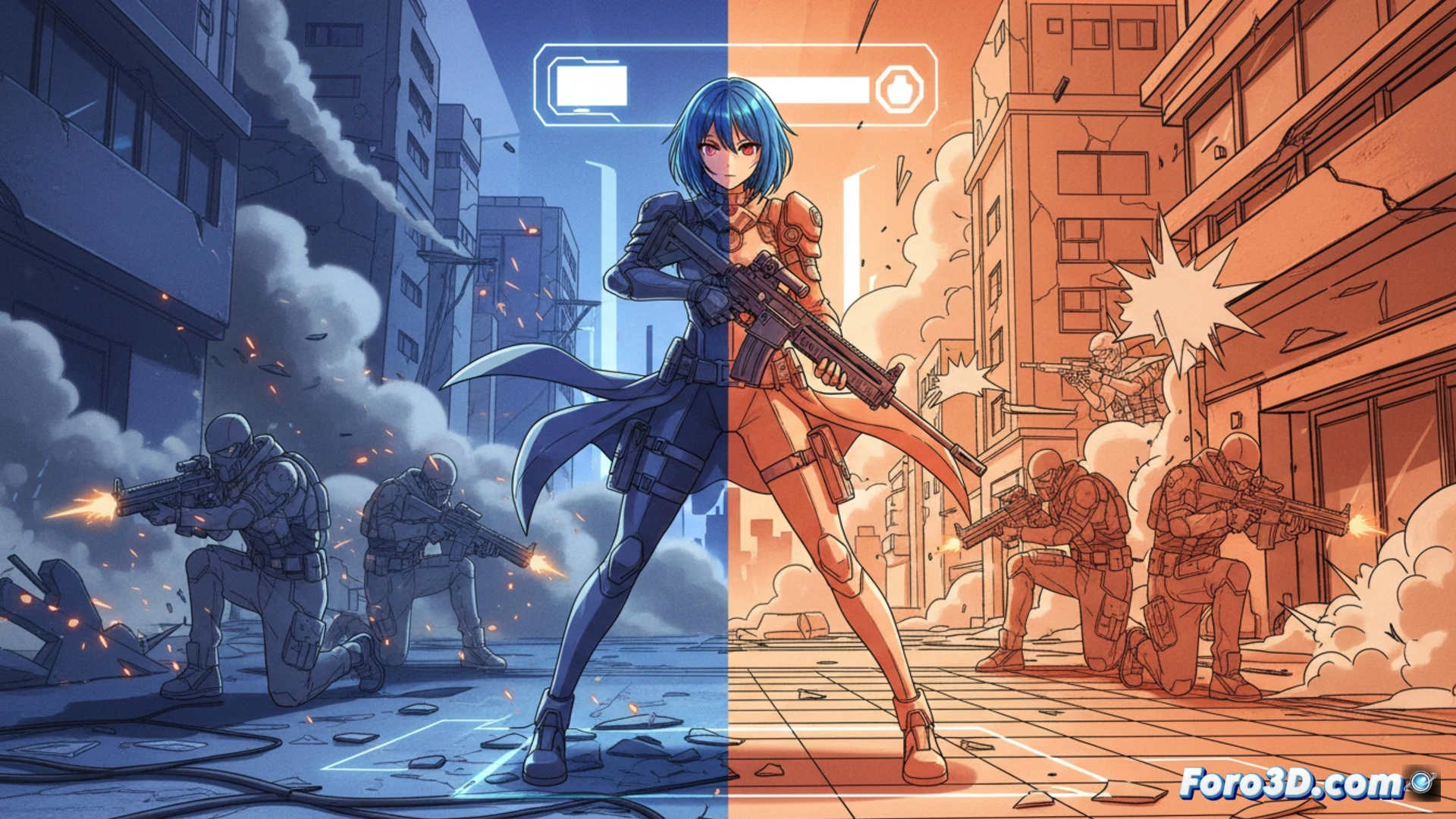
The tactical shooter genre has found a new visual exponent in Strinova, a title developed in Unreal Engine 4 that merges anime aesthetics with a revolutionary gameplay mechanic. The ability for characters to switch between a 3D state and a flat 2D form, similar to a sheet of paper, not only redefines tactical combat but also poses unique technical challenges in rendering and collision detection. This analysis breaks down the development pipeline, from modeling in Maya to the implementation of real-time cel-shading.
Technical Pipeline: From Maya to Unreal Engine 4 and the Challenge of the Dual Dimension 🎮
The asset creation process in Strinova begins with character and environment modeling in Maya, where a clean and optimized topology is applied for cel-shading. Textures are hand-painted in Photoshop, using flat color palettes and defined contour lines to emulate the style of a traditional anime. The real challenge arrives in Unreal Engine 4, where a custom shader is implemented that applies diffuse lighting without gradients and a dynamic outline effect. The dimension-switching mechanic requires the engine to handle two collision states: a volumetric one (3D) for normal movement and a planar one (2D) for sliding through gaps or dodging projectiles. The transition between states is managed by an interpolation system that adjusts the character's Z-axis scale, while the shader recalculates shading to eliminate depth shadows when the model becomes flat. To maintain performance, aggressive Level of Detail (LOD) and geometry occlusion are used in the 2D state, preventing the engine from processing invisible polygons.
Reflection on Cel-Shading and Gameplay in the Anime Tactical Shooter 🎨
Compared to other anime tactical shooters like Valorant or Overwatch, Strinova takes cel-shading aesthetics a step further by integrating them directly into the core mechanic. While Valorant uses hard shadows for a cartoonish style, Strinova sacrifices lighting realism to prioritize the visual legibility of the state change. This approach demonstrates that cel-shading is not just an artistic embellishment, but a gameplay design tool that can alter the player's spatial perception. The implementation in Unreal Engine 4, combined with Maya and Photoshop, shows that the art pipeline for anime games can be as complex as that of a realistic shooter, as long as it is optimized for the transition between dimensions.
As a developer, what specific technical challenges in Unreal Engine 4 did you face when implementing the dimension or 2D/3D perspective switching mechanic in Strinova without breaking hit detection and the tactical shooter's balance?
(PS: 90% of development time is polishing, the other 90% is fixing bugs)