SpaceX seeks more than a thousand annual launches with Starship, but its two current platforms in Starbase, Texas, are insufficient. The company is exploring international options, although the International Traffic in Arms Regulations (ITAR) imposes severe regulatory barriers. To operate from abroad, the Technology Safeguards Agreement is necessary, already signed by Brazil, Norway, New Zealand, Australia, and the United Kingdom. This legal framework directly conditions logistical expansion and the global supply chain.
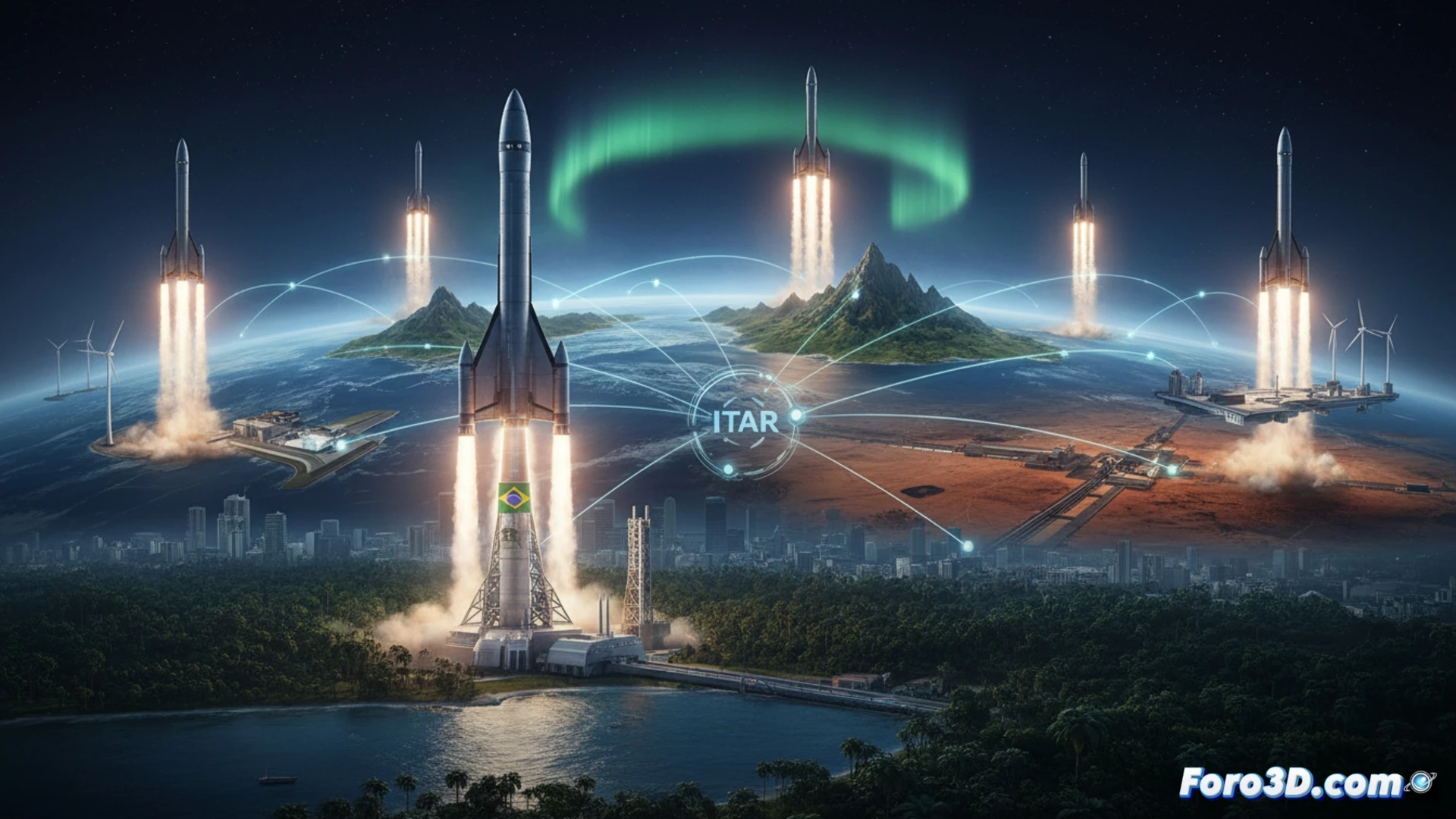
3D Mapping of Routes and Regulatory Restrictions 🌍
To visualize the geopolitical impact, we propose an interactive 3D map representing launch routes from Cape Canaveral (three platforms under modification) and air corridors over the Atlantic. Each country that has signed the Safeguards Agreement (Brazil, Norway, New Zealand, Australia, United Kingdom) would be marked with a potential infrastructure node. The model must include ITAR restriction layers, simulating how a political change in a host country disrupts the flow of critical materials (liquid oxygen, methane, electronic components). The user could activate logistical blockade scenarios and observe the dependence on alternative corridors.
Strategic Dependence and Bottleneck Risk ⚠️
The space supply chain depends not only on rockets but on diplomatic agreements. If a country like Australia revoked its safeguard, SpaceX would lose access to the southern hemisphere, concentrating all risk in Texas and Florida. This analysis reveals that geopolitics is the weakest link: a change of government or a bilateral crisis can paralyze global launch capacity. To mitigate this, the 3D simulation must highlight the need to diversify nodes and safety stock across multiple jurisdictions.
How could SpaceX's need to expand its Starship launch platforms outside the United States reshape geopolitical alliances and global supply chains of critical materials for the aerospace industry?
(PS: at Foro3D we know that a chip travels more than a backpacker on a gap year)