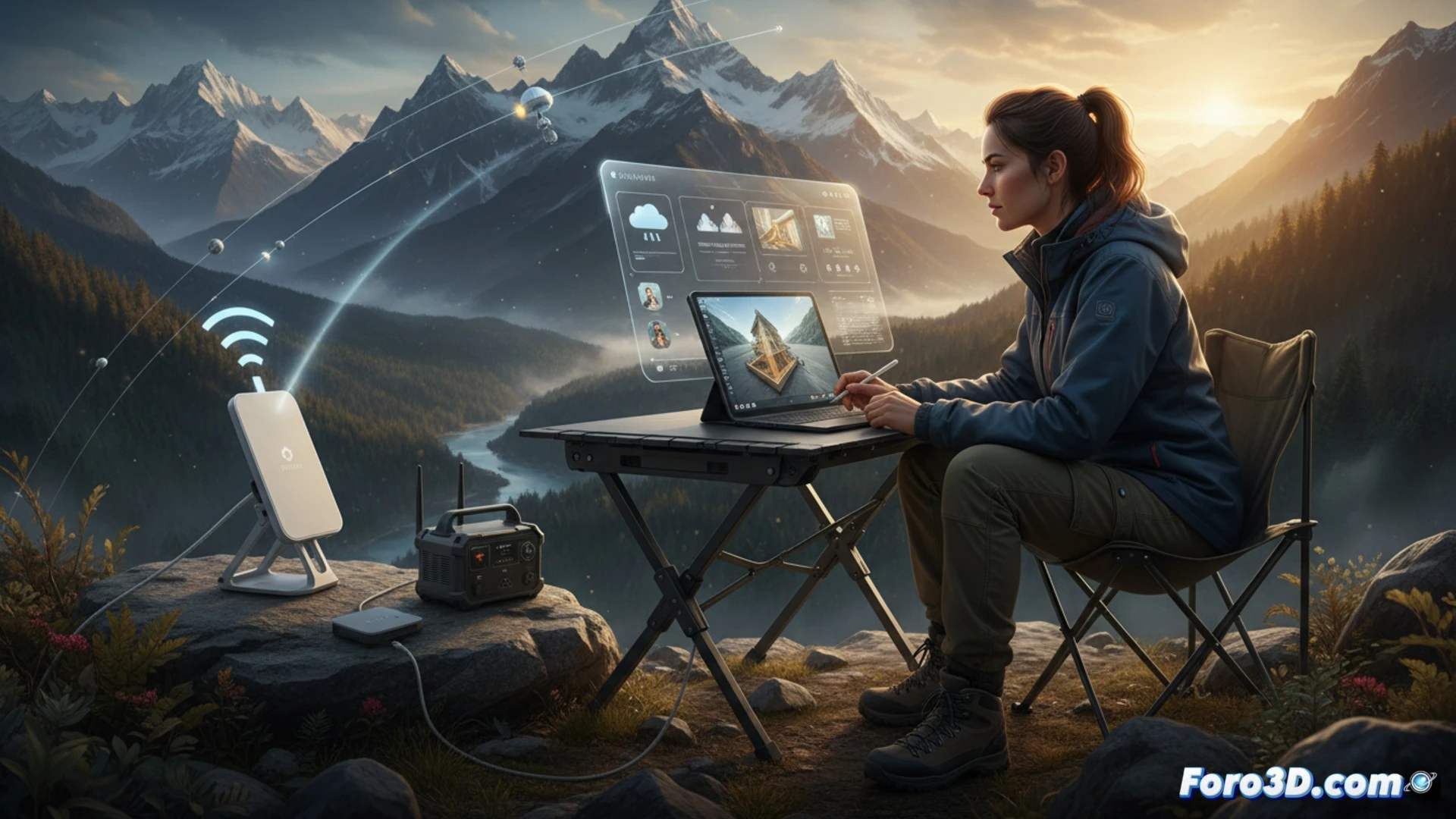
The arrival of the Starlink Mini on the market represents a radical change for 3D professionals working away from the office. This portable SpaceX terminal integrates a router and phased-array antennas into a compact chassis, powered solely via USB-C. Its main promise is to offer high-speed satellite internet from any remote location, a critical factor for those who need to transfer heavy files or collaborate in the cloud during shoots and scanning expeditions.
Technical analysis: bandwidth and latency for 3D workflows 🚀
From a hardware standpoint, the Starlink Mini leverages the low Earth orbit (LEO) satellite constellation to reduce latency to levels close to 20-40 ms, far below traditional geostationary satellites. For a 3D professional, this translates to the ability to stream renders from a cloud workstation or synchronize high-polygon models without frustrating wait times. USB-C power allows the use of high-capacity external batteries, facilitating full workdays in the field. However, the maximum download speed typically ranges between 50 and 100 Mbps in congested areas, sufficient to send a 10 GB project in about 15 minutes, but not enough to replace a fiber optic connection in the office.
Is the Starlink Mini the Swiss Army knife of the nomadic modeler? 🛠️
Compared to a 5G hotspot, the Starlink Mini wins in global coverage but loses in peak speed in urban areas. For a photogrammetry scanner working at an archaeological site with no mobile coverage, this device is a lifesaver. For an animation studio performing motion capture on a rural set, it allows uploading raw captures to central servers in real-time. The key is to understand it as a base connectivity tool, not a substitute for terrestrial networks. Its true value lies in eliminating total disconnection, allowing the 3D workflow to never stop, even in the most remote location.
Can the Starlink Mini provide the bandwidth and latency necessary for transferring heavy 3D modeling files and real-time collaboration with remote teams from outdoor locations without network infrastructure?
(PS: If your computer is smoking when opening Blender, maybe you need more than a fan and faith)