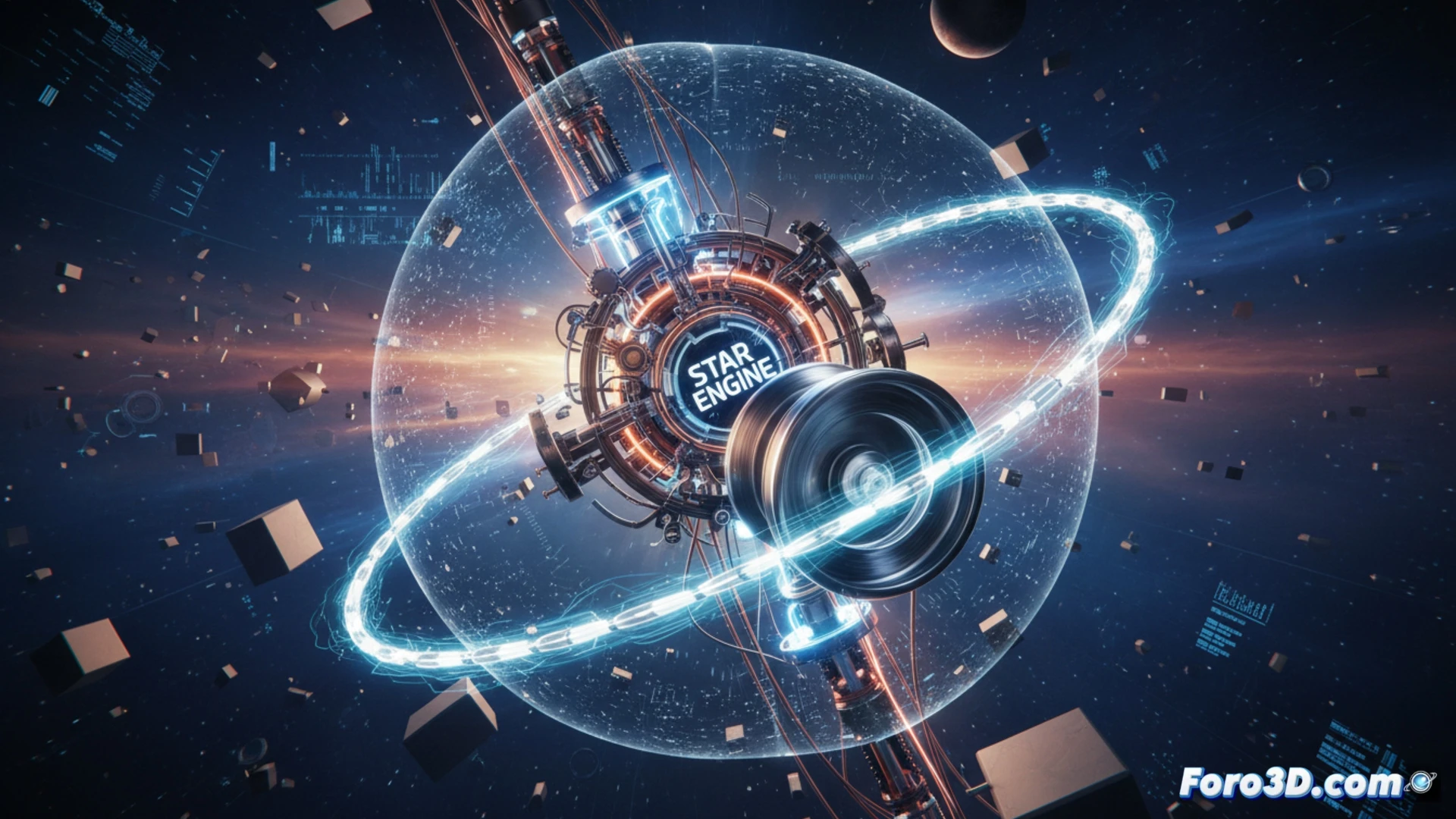
The return of 128-bit aesthetics is not just nostalgia; it is a technical decision. Evening Star has built Penny's Big Breakaway on Star Engine, a proprietary engine designed to prioritize high frame rates and deterministic physics. The real challenge was not modeling, but simulating the yo-yo, an object that combines rope constraints, inertia, and real-time collisions, requiring a custom physics system that breaks away from the conventions of generic engines.
Production Pipeline: StarSDK and Physical Rigging 🎮
The workflow relies on StarSDK, a set of tools that acts as a bridge between Blender and Star Engine. While Blender handles Penny's polygonal modeling and skeletal rigging, StarSDK allows exporting non-linear animation data and mass properties for the yo-yo. The key lies in the custom physics engine: not a generic rope solver is used, but a particle simulation with distance and torque constraints. This allows the yo-yo to react to the frame rate without desynchronizing, maintaining smooth 60 FPS even in scenes with multiple interactive objects.
128-Bit Aesthetics: Between Limitation and Freedom 🕹️
The decision to aim for a vibrant aesthetic, similar to Dreamcast and GameCube, is not arbitrary. By limiting texture resolution and using saturated color palettes, the team reduces the load on pixel shading, freeing up resources for the physics engine and dynamic lighting. It is a technical balance: sacrificing photorealism to ensure that every spin of the yo-yo feels precise and responsive. In an indie game, optimization is not a luxury; it is the very mechanics of the game.
As a developer, what real technical advantages does Star Engine offer over modern engines like Unity or Unreal for emulating the aesthetics and physics of 128-bit systems, and what specific engineering challenges did the yo-yo mechanic present in Penny's Big Breakaway?
(PS: 90% of development time is polishing, the other 90% is fixing bugs)