The Star Engine, developed by Cloud Imperium Games for Star Citizen, solves one of the biggest challenges in space simulation: rendering entire cities on a planetary scale without a single loading screen. Unlike traditional engines that segment the world into levels, Star Engine uses a 64-bit object streaming system that dynamically loads and unloads data based on the player's position and velocity. This allows a player to fly from deep space to a planet's surface, traversing atmospheres and landing in dense urban areas, all in a seamless and continuous transition.
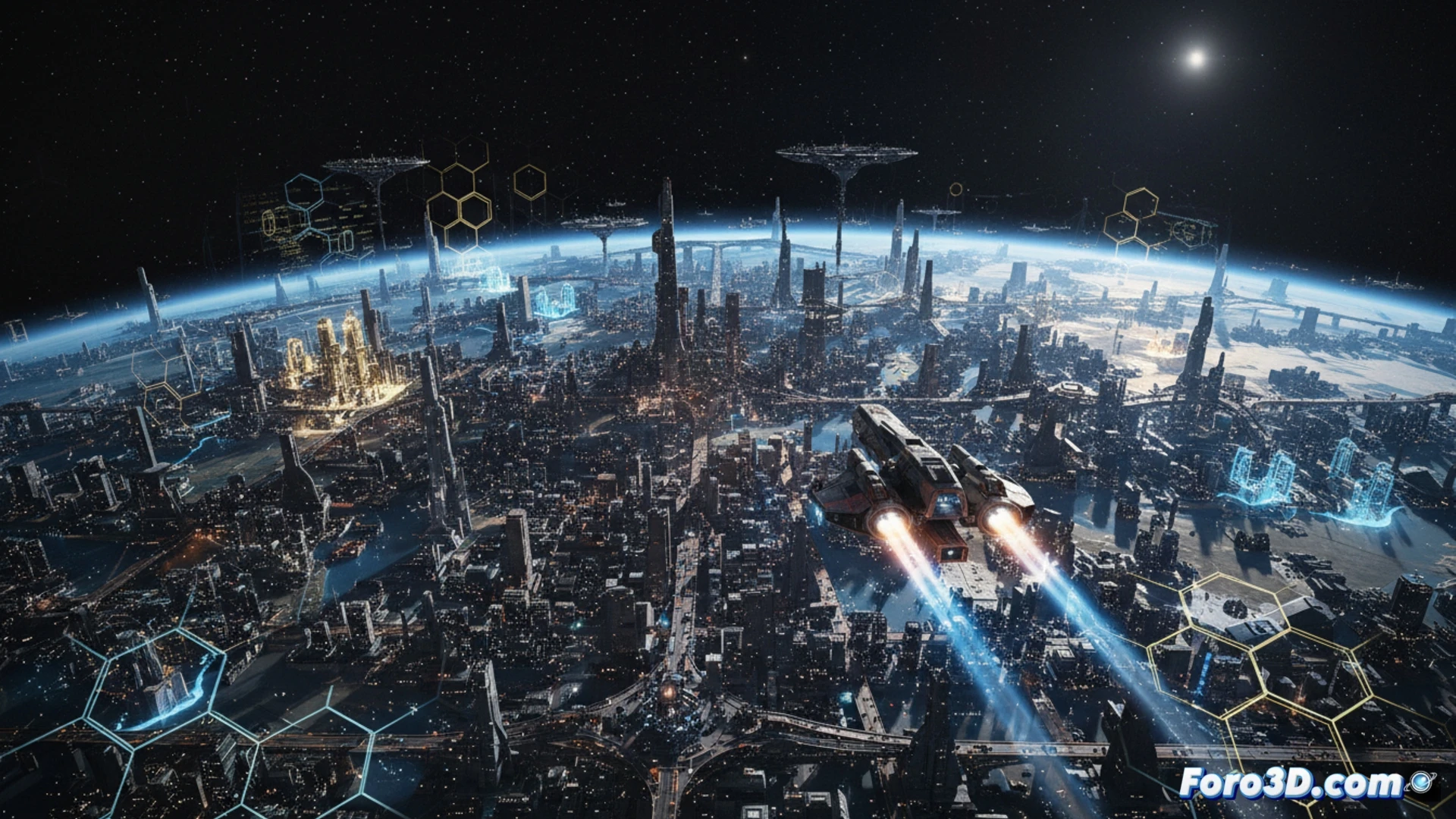
Procedural generation and real-time object streaming 🚀
The technical key lies in the combination of two systems: procedural planet generation and object streaming. The engine does not store every tree or building on disk; instead, it uses noise and fractal algorithms to generate topography, vegetation, and weather patterns in real-time. This is complemented by a system of points of interest (POIs) that prioritizes loading complex assets, such as hangars or shops, only when the player approaches. In comparison, Unreal Engine 5 uses Nanite for virtualized geometry, but it is not optimized for astronomical distances. Unity, on the other hand, requires third-party solutions like World Streamer to approximate this, but without the 64-bit coordinate precision that avoids floating-point precision errors at planetary scales.
The artistic workflow between AAA tools 🎨
To achieve this level of detail, the team combines Maya, ZBrush, and Substance Designer in a highly efficient pipeline. Artists model the base structure of ships and buildings in Maya, then sculpt high-resolution details in ZBrush. The magic happens in Substance Designer, where procedural materials are created that adapt to planetary conditions (temperature, humidity) without the need for unique textures. These materials are exported to Star Engine, where the shader system combines them with streaming data so that the same asset looks detailed at 10 meters and recognizable at 10 kilometers, optimizing performance without sacrificing immersion.
How does Star Engine achieve the procedural representation of billions of polygons in real-time to simulate planetary cities without visible loading times, and what specific technical limitations does the engine face in terms of memory and data streaming?
(PS: a game developer is someone who spends 1000 hours making a game that people complete in 2)