The catastrophic failure of a 10-ton cultivation carousel, which seized and tipped over, originated in the central bearing. Forensic analysis revealed spalling, or material detachment, on the bearing balls. This phenomenon, typical of surface fatigue, was triggered by inadequate lubrication that could not withstand the cyclic load of the rotating system. The technical question is: how to model and simulate this degradation process to prevent it.
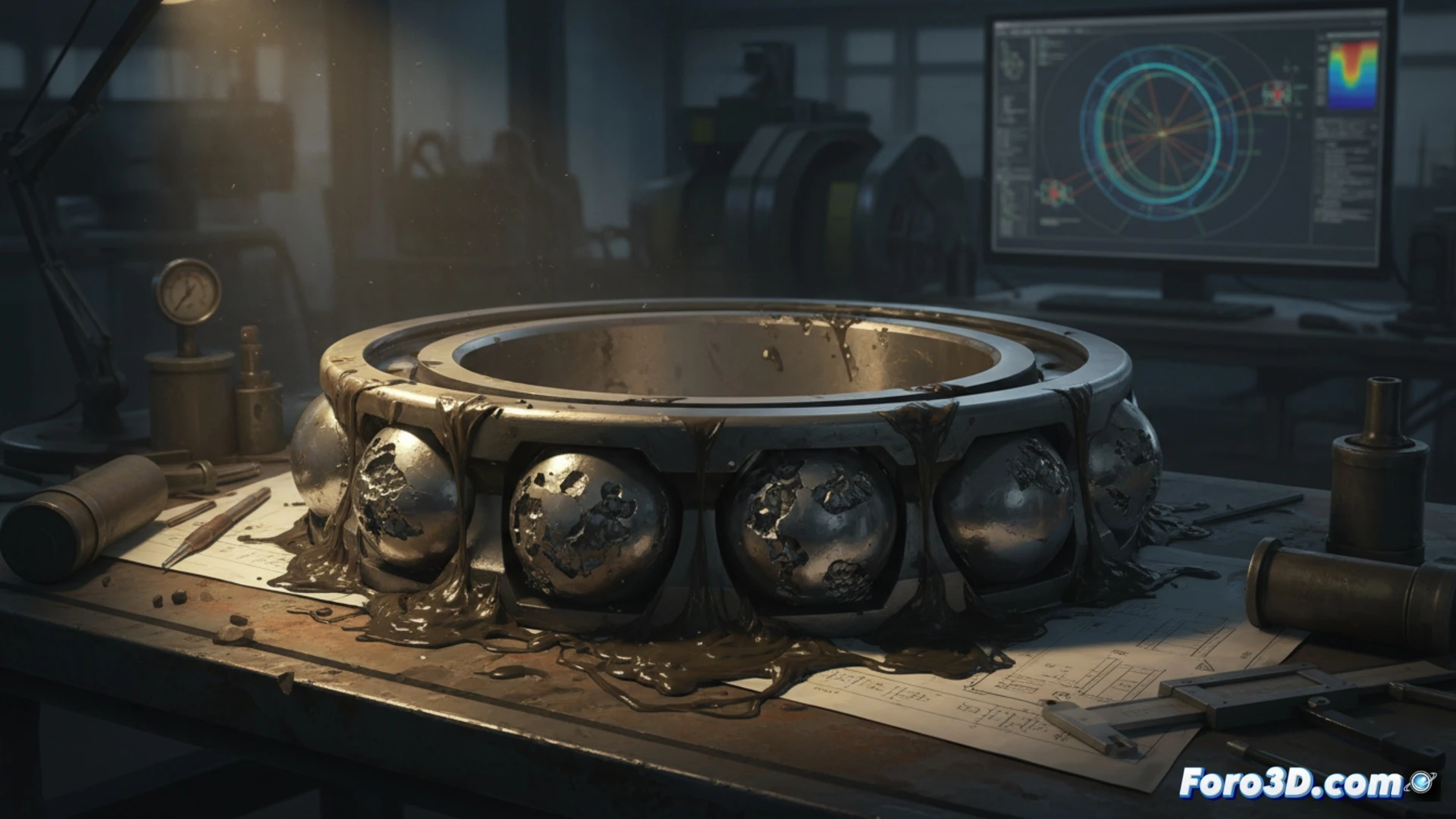
Modeling and simulation of spalling under cyclic load with Inventor, GOM Inspect, and Star-CCM+ 🔧
To replicate the failure, the process begins in Autodesk Inventor, where the ball bearing is modeled with its geometric tolerances. Then, GOM Inspect allows scanning and comparing the actual geometry of the damaged bearing against the CAD model, identifying areas of spalling wear. With Siemens Star-CCM+, Hertzian contact stresses between the balls and races under the 10-ton cyclic load are simulated. Poor lubrication is modeled as a high friction coefficient and insufficient oil film, generating subsurface shear stress peaks. These peaks, repeated each cycle, initiate microcracks that progress until metal flakes detach, visualizing the nucleation and propagation of spalling.
Wear visualization and lessons for bearing design 🎯
Blender becomes the key tool for visualizing the progression of spalling. Using texture maps and mesh deformation, the material loss on the balls is animated, showing how a subsurface crack expands to form a crater. This graphical representation, based on Star-CCM+ data, makes the concept of contact fatigue tangible. The lesson is clear: without lubrication to maintain surface separation, cyclic load concentrates stress at microscopic points, accelerating failure. Future design must prioritize automatic lubrication systems and finite element fatigue analysis to avoid these collapses.
As a structural engineer, what finite element simulation methodology do you recommend to accurately model the initiation and propagation of spalling due to surface fatigue in a carousel bearing subjected to 10-ton cyclic loads and poor lubrication?
(PS: Material fatigue is like yours after 10 hours of simulation.)