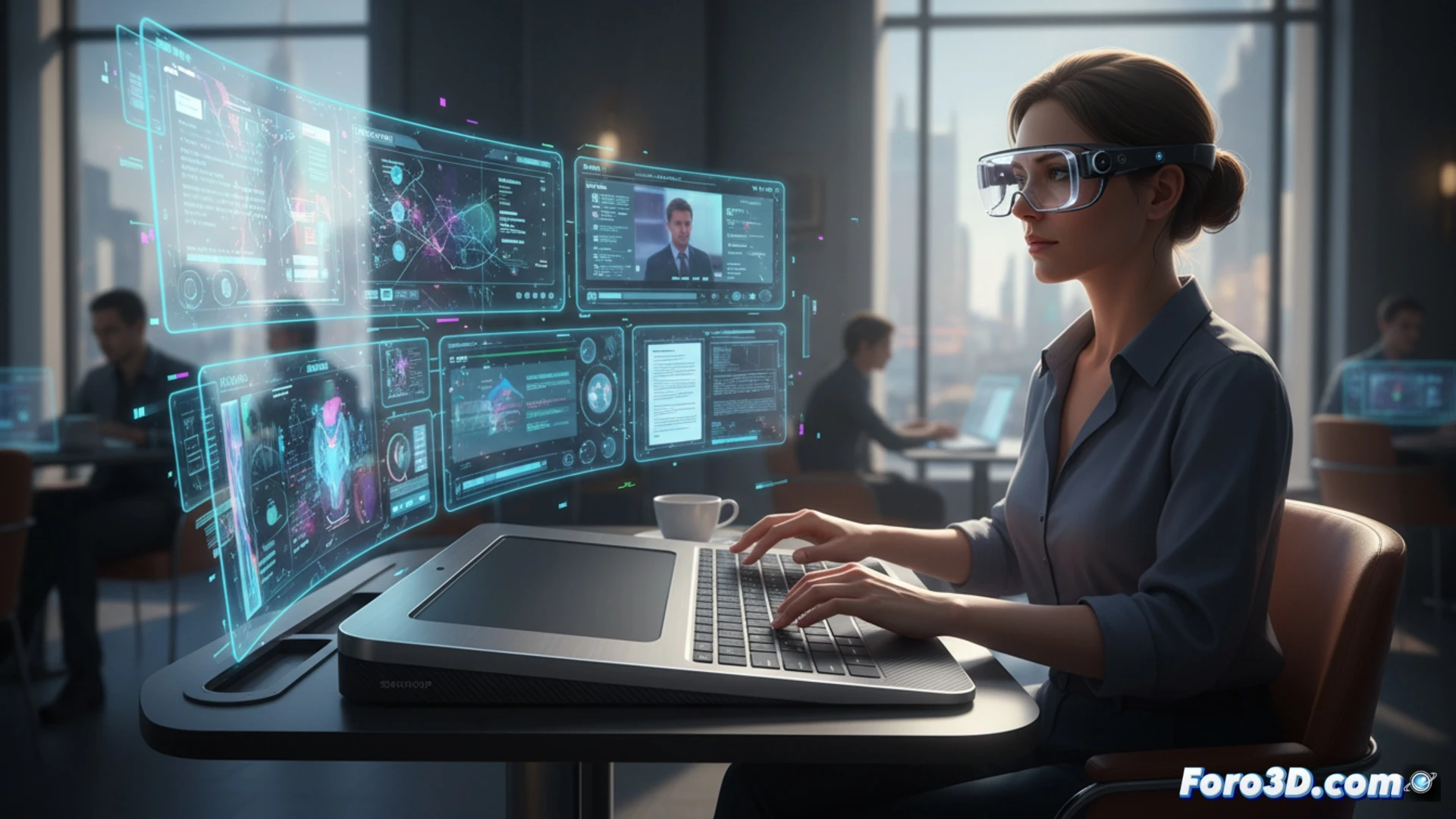
Sightful has unveiled the Spacetop G1, a laptop that challenges traditional design by completely eliminating the physical screen. Instead, it uses augmented reality glasses to project a giant virtual desktop in the space in front of the user. This device, powered by an Android-based spatial operating system, promises to redefine mobile productivity by offering multiple three-dimensional floating windows without the size limitations of an LCD monitor.
Snapdragon Architecture and Xreal SDK for Spatial Computing 🚀
The heart of the Spacetop G1 is a Qualcomm Snapdragon processor, designed to handle the graphical load of augmented reality and the multitasking of virtual windows. This hardware integrates with the Xreal SDK, which allows Android applications to render interfaces in a three-dimensional space. Unlike a conventional laptop, the GPU does not send data to a fixed screen, but instead calculates the position of each floating window relative to the user's head. The spatial operating system acts as a 3D window manager, allowing documents, browsers, and design tools to be anchored in the air. For a developer, this means that native Android apps can run without modifications, but with a depth layer that separates them from the real background.
Nomadic Productivity vs. Eye Strain: The Dilemma of the Aerial Desktop 🤔
For a nomadic professional or a 3D designer, the promise of an unlimited desktop is tempting. Being able to open a code window, a Blender model, and a terminal without needing an external monitor saves weight in the backpack. However, the current reality imposes limitations. The field of view of AR glasses remains narrow compared to a 32-inch monitor, and eye strain from prolonged use of transparent lenses can be an obstacle. In the future, if Sightful manages to improve the resolution of the glasses and reduce the weight of the set, the Spacetop G1 could be the first real step towards a fully virtual workstation, where the physical screen becomes a thing of the past.
Do you think the total elimination of the physical screen in the Spacetop G1 represents a real evolution towards immersive productivity, or on the contrary, a step backward in ergonomics and visual accessibility for the average user?
(PS: AR applied to maintenance allows you to see where the fault is... before the machine explodes.)