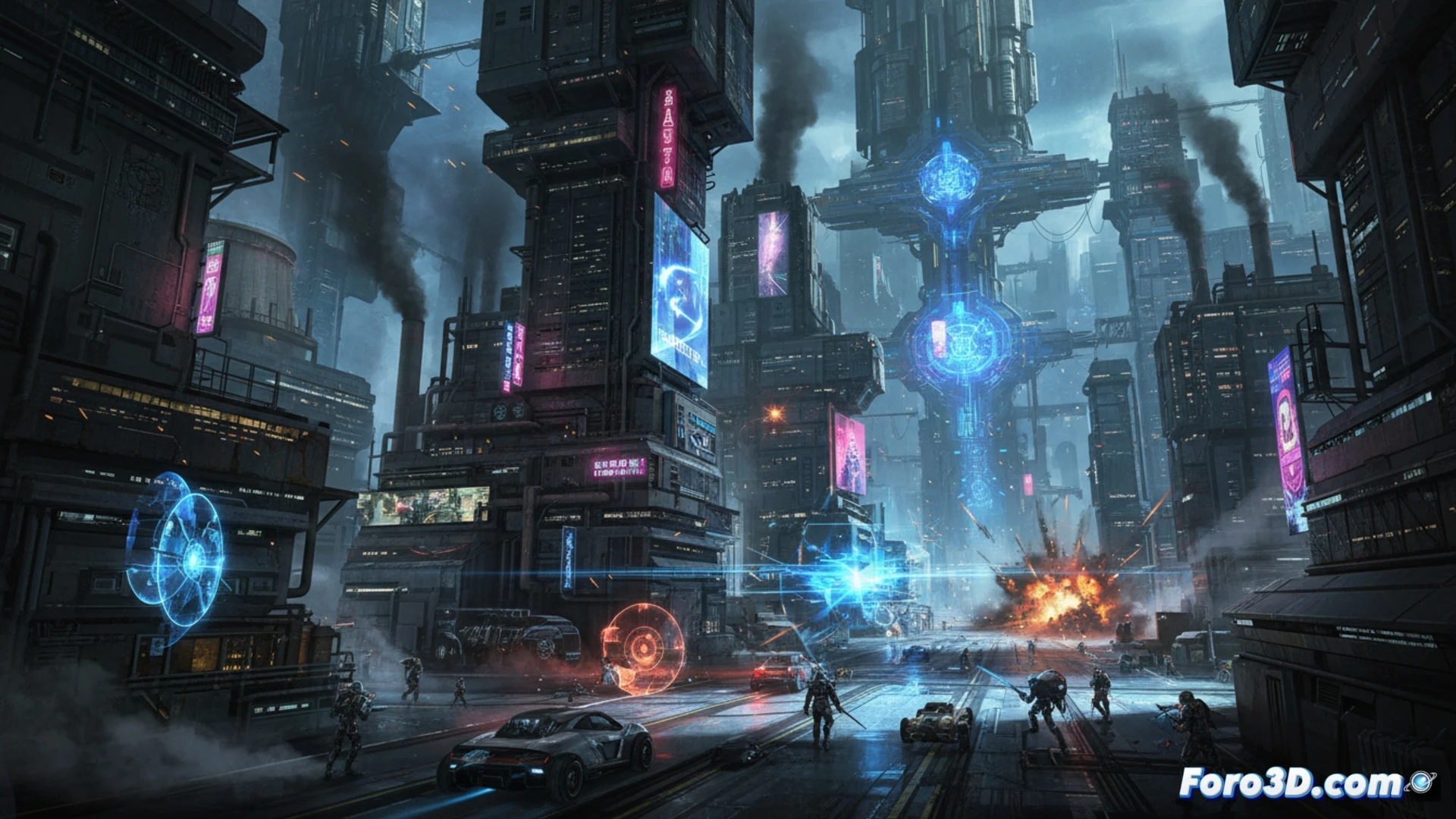
Valve has once again demonstrated its technical mastery with Deadlock, a title that fully exploits the capabilities of the Source 2 engine. The game features a fantastic industrial aesthetic supported by a next-generation lighting system. Far from being a simple shooter, Deadlock is an optimization laboratory for large urban environments, where every street and rooftop must be rendered with precision without sacrificing 60 FPS in multiplayer matches. 🎮
Production Pipeline: Maya, Substance Painter, and the Source 2 SDK 🛠️
The artistic pipeline of Deadlock follows a modular structure that prioritizes efficiency. Modelers use Autodesk Maya to create the base geometry of buildings and characters, applying clean topology that facilitates the engine's automatic LOD (Level of Detail). Subsequently, Substance Painter comes into play to generate PBR textures with a focus on industrial wear: rust, accumulated grime, and metal panels. These textures are imported into the Source 2 SDK, where dynamic lighting shaders interpret the roughness and metalness maps. The result is a city that reacts in real-time to the light from hero abilities, without the need for static baking.
The Challenge of VFX in Expansive Urban Maps 💥
The true technical achievement of Deadlock lies in its particle effects (VFX). Each hero ability generates a cascade of particles that, in an open urban map, could saturate the GPU. Valve has solved this by implementing an advanced occlusion culling system in Source 2. Particles are grouped into clusters that progressively fade out if the player moves away or if a building blocks the line of sight. Additionally, the engine uses billboards (camera-oriented 2D sprites) for distant effects, while full volumetric particles are only activated in close-quarters combat. This visual hierarchy allows Deadlock to maintain a chaotic and vibrant aesthetic without compromising performance during the most intense moments.
How does Source 2 balance real-time dynamic lighting and VFX without sacrificing performance on the massive urban maps of Deadlock?
(PS: shaders are like mayonnaise: if they break, you have to start all over again)