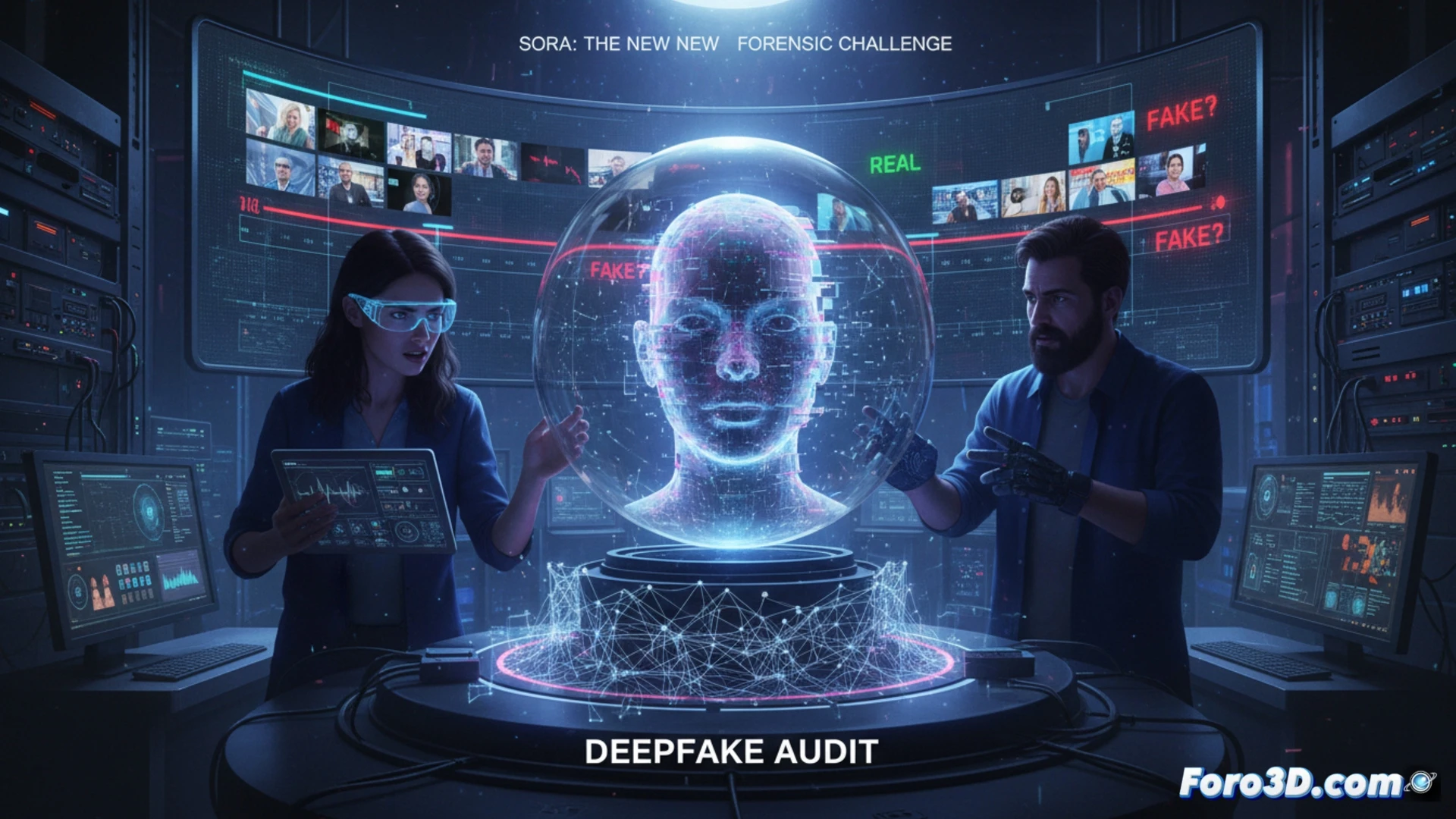
The arrival of Sora, OpenAI's generative video model, marks a turning point in the creation of deepfakes. Capable of producing hyper-realistic scenes of up to 60 seconds with complex camera movements and expressive characters from text, this technology elevates the risk of visual disinformation to an unprecedented level. For forensic auditors, Sora represents a qualitative leap in detection difficulty, as its videos can be virtually indistinguishable from reality, challenging traditional analysis methodologies.
Technical architecture and attack vectors in detection 🛡️
Sora is based on diffusion models and visual physics simulations to generate temporally coherent video. Unlike previous deepfakes, which often featured edge flickering or poor lip-sync, Sora handles global illumination and textures with near-perfect precision. However, its generative nature introduces specific artifacts that auditors must look for. Physical inconsistencies, such as an object's trajectory violating the laws of inertia, or shadow deformation on complex surfaces, are key signals. Additionally, file metadata (EXIF or XMP) can reveal the model's signature, although malicious creators often remove this layer. The most robust forensic technique is diffusion noise analysis: sub-millimeter pixel variations that follow statistical patterns characteristic of AI, detectable through adversarial neural networks specifically trained for this model.
Towards a new visual verification protocol 🔍
Deepfake auditing can no longer be limited to looking for obvious human errors. With Sora, the forensic expert must adopt a physical and statistical anomaly hunting approach. It is crucial to develop workflows that combine spectral frequency analysis with motion continuity verification. The security community must collaborate with AI developers to integrate imperceptible watermarks into generative models. Meanwhile, educating the public about the existence of perfect synthetic videos is the first line of defense against disinformation generated by Sora.
What specific forensic methodologies and tools are auditors developing to detect Sora's unique digital fingerprints compared to other generative video models such as Stable Video Diffusion or Runway Gen-2
(PS: Detecting deepfakes is like playing Where's Waldo? but with suspicious pixels.)