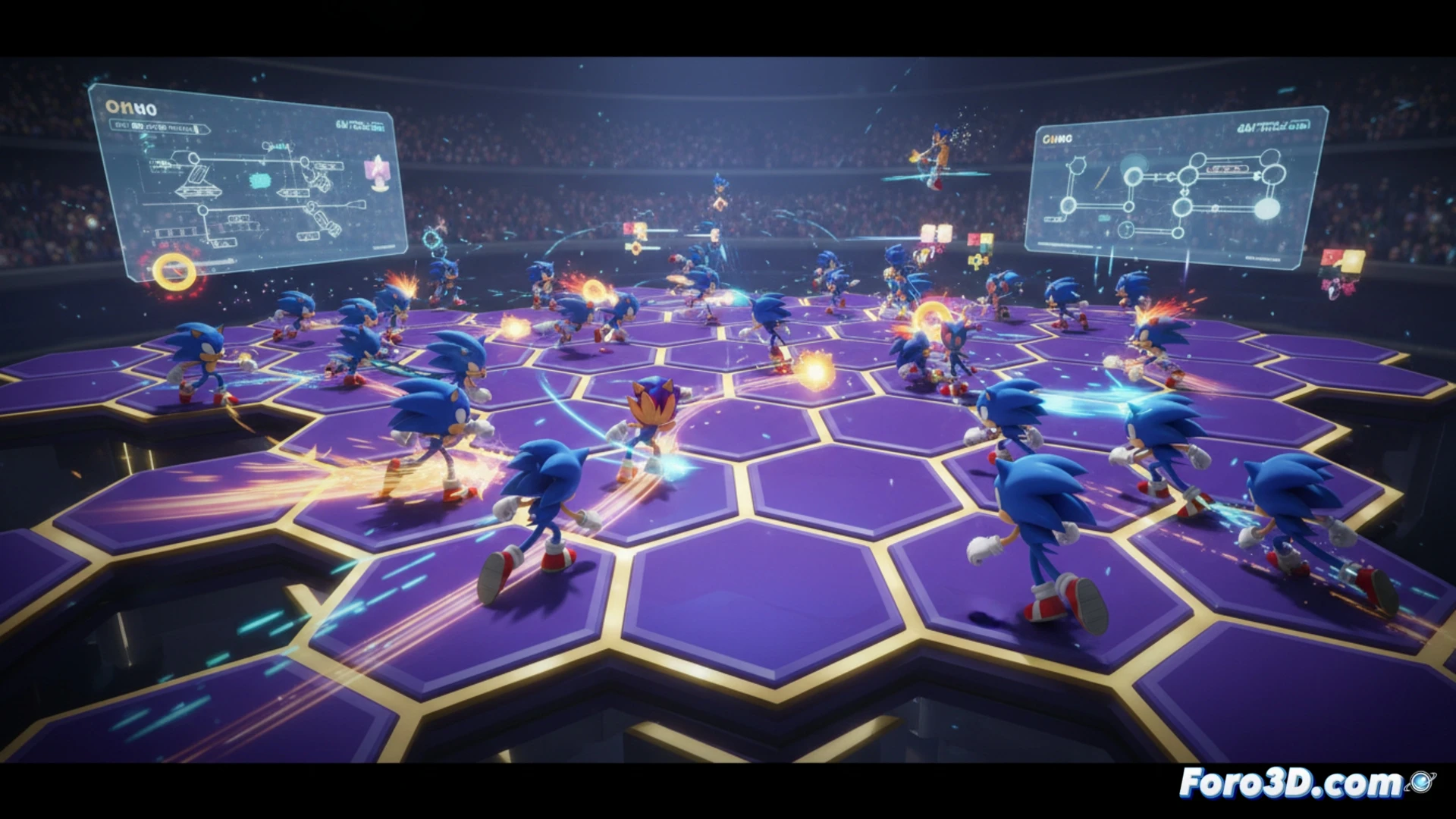
Sonic Rumble represents an interesting technical challenge for video game development: maintaining a smooth and visually appealing experience with up to 32 simultaneous players on screen. The solution chosen by the team behind this party game is based on careful optimization of the graphics pipeline in Unity, combining simplified models, bright shaders, and smooth animations. This approach not only guarantees performance stability but also preserves Sonic's visual identity, demonstrating that technical efficiency and artistic style can go hand in hand. 🎮
Asset optimization and LODs for massive multiplayer 🚀
The key to supporting 32 players in real-time lies in the intelligent management of geometry and materials. Character models in Sonic Rumble are simplified, with a reduced polygon count that perfectly suits the camera distance of an isometric party game. This is complemented by the use of Level of Detail (LODs) generated in Blender, which further reduce asset complexity when they are far from the visual focus. Additionally, the bright shaders are optimized to avoid costly calculations such as dynamic lighting or complex reflections; instead, precomputed textures and lightweight post-processing effects are used. For the UI, Adobe Illustrator allows creating vector elements that Unity rasterizes efficiently, avoiding unnecessary high-resolution textures. A practical tip for developers is to use Unity's profiler to identify GPU bottlenecks and adjust LODs dynamically based on the number of active players in the scene.
Lessons for multiplayer game development 💡
Sonic Rumble demonstrates that optimization is not an enemy of visual quality, but rather its strategic ally. By prioritizing smooth animations over hyper-realistic models, the game achieves a chaotic and fun experience without sacrificing stability. For any developer working on massive multiplayer titles, the lesson is clear: simplifying is not ugly, it's functional. Investing time in efficient pipelines, from Blender for modeling to Unity for integration, allows scaling the number of players without compromising gameplay. In the end, the best performance is the one the player doesn't even notice.
What network and rendering optimization techniques does Unity implement in Sonic Rumble to synchronize the state of 32 players in real-time without compromising the frame rate?
(PS: shaders are like mayonnaise: if they break, you start all over again)