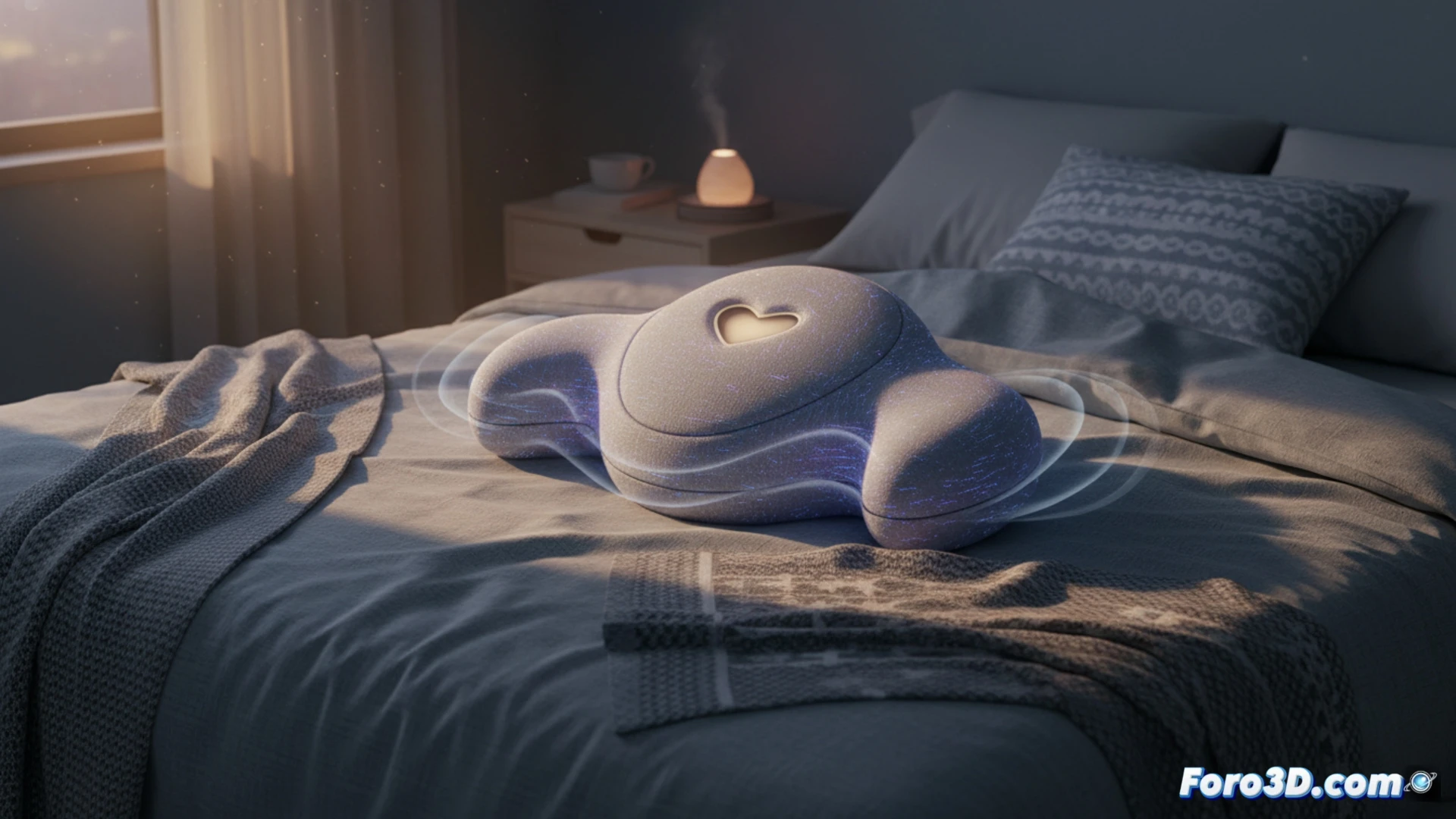
Somnox, developed by the startup of the same name, is not a conventional pillow but a biomimetic robot designed to combat insomnia. Its main innovation lies in an internal pneumatic mechanism that simulates the rhythmic movement of human breathing. By hugging this device, the user synchronizes their own respiratory cycle with that of the robot, inducing a state of calm. We analyze its mechanical architecture, the design of its ergonomic casing, and the sensor system that enables real-time physical interaction.
Mechanical design and precision pneumatics 🤖
The internal structure of Somnox is divided into two main modules. The first is the rigid polycarbonate chassis that houses the electronics, battery, and actuator. The second is a bellows or flexible air chamber system made of TPU (thermoplastic polyurethane), which expands and contracts to mimic inhalation and exhalation. The movement is generated by a DC motor with a cam or linear piston mechanism, controlled by an ARM Cortex microcontroller. The pillow shape was achieved through rapid prototyping with FDM 3D printing for the initial iterations, optimizing the geometry to distribute body pressure. Synchronization is based on a capacitive pressure sensor integrated into the surface, which detects the user's breathing to adjust the robot's frequency.
Implications for robotic simulation 🛠️
The Somnox case is relevant for soft robot simulation and additive manufacturing. 3D modeling the behavior of the flexible air chamber using finite element analysis (FEA) allows predicting the exact deformation and force exerted on the user. Furthermore, the modular design between the rigid electronics and the soft body is an integration challenge that can be replicated in simulation environments like ROS and Gazebo, where capacitive sensors and the closed control loop are modeled to validate the sleep experience before mass production.
What biomimetic control algorithms does Somnox use to synchronize its breathing pattern with the user's heart rate, and how is the effectiveness of this synchronization in reducing stress evaluated?
(PS: Simulating robots is fun, until they decide not to follow your orders.)