The remake of Solium Infernum (2024) not only rescues the political strategy of the cult classic but redefines its visual identity through an artistic pipeline centered on sculptural texture. The development team opted for an approach where 3D modeling does not seek photographic realism, but rather the sensation of volcanic stone and solidified ash, directly inspired by the apocalyptic lithographs of John Martin. This article breaks down the technical workflow used to transfer that dark epic to a Unity engine optimized for turn-based strategy. 🔥
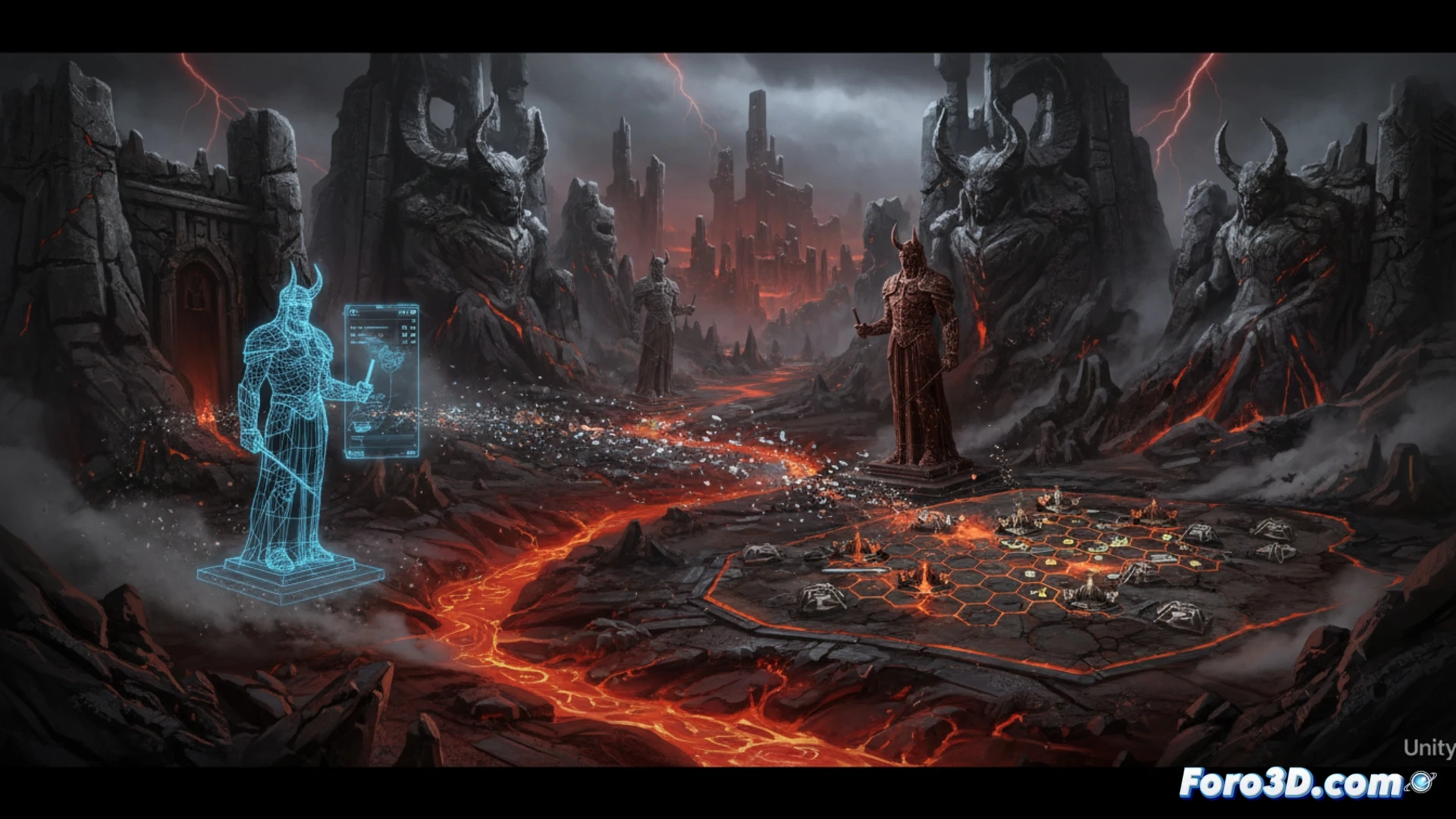
Modeling and Texturing: The Legacy of John Martin in ZBrush 🎨
The key to the visual style lies in the use of ZBrush to sculpt every element of the map and units as if they were hand-carved infernal monuments. Instead of relying on flat textures, artists generated assets with a high level of detail in the geometry of rocks, cracks, and sulfur-worn edges. Subsequently, an aggressive retopology process was applied to reduce the polygon count, preserving sculptural details through normal and displacement maps. This method allowed the map, composed of three-dimensional hexagons, to maintain the appearance of a real stone model, where each lava column or fallen statue retains the gesture of the digital brush. Lighting in Unity was configured with dim directional sources and high-contrast shadows to emulate the dramatic chiaroscuro of romantic paintings, avoiding the use of real-time global illumination to prioritize performance in multiplayer matches.
Optimization and Atmosphere: The Challenge of the Infernal Scale ⚙️
The greatest technical challenge was balancing the visual density of the sculptures with the fluidity required for a strategy game. Instead of loading complete assets in each match, an aggressive level of detail (LOD) system and occlusion culling in Unity were implemented, hiding map pieces not within the isometric camera's field of view. Ash and fire particles were managed through GPU particle systems, freeing the CPU for infernal diplomacy calculations. The result is a hell that feels monumental and heavy, yet runs stably even on modest hardware, demonstrating that the dark painter aesthetic is perfectly compatible with the technical demands of a modern remake.
How was the transition of models sculpted in ZBrush to an optimized pipeline in Unity managed to maintain the infernal aesthetic of Solium Infernum without sacrificing real-time performance?
(PS: game jams are like weddings: everyone is happy, no one sleeps, and you end up crying)