During a vacuum chamber simulation, the sample collection robotic arm of a space rover suffered a critical lockup. The engineering team turned to a 3D pipeline consisting of MSC Adams, Autodesk Fusion 360, and Blender to analyze the cause. The main hypothesis pointed to cold welding between titanium gears, a phenomenon that occurs in the total absence of atmosphere and lubricants, common in environments like the surface of Titan.
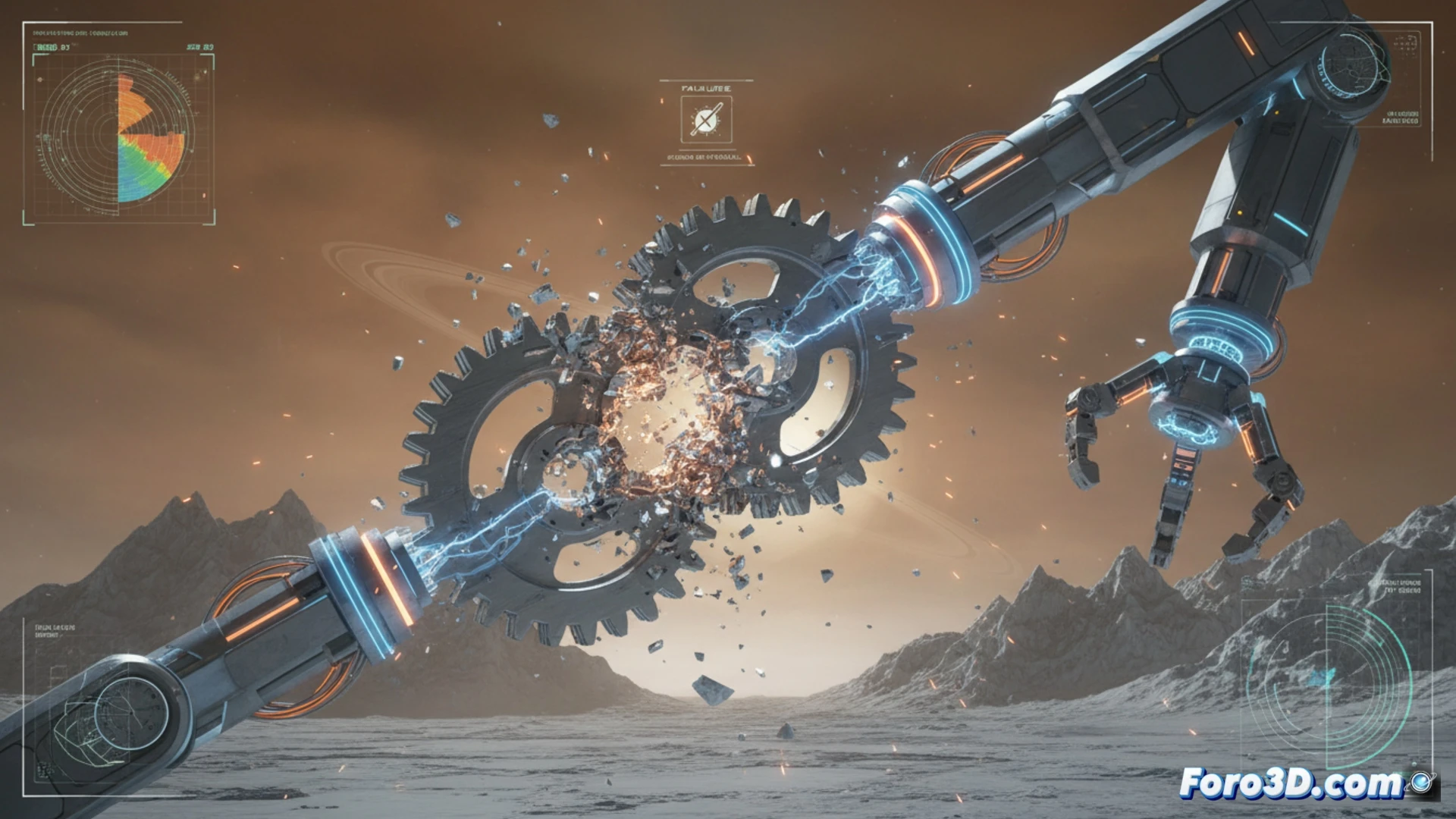
3D Pipeline: Modeling, simulation, and detection of cold welding 🛠️
The process began in Autodesk Fusion 360, where the titanium gear assembly was modeled with micrometric tolerances. Subsequently, the geometry was exported to MSC Adams to establish boundary conditions: absolute vacuum, cryogenic temperature, and dry friction coefficient between metallic surfaces. The multibody simulation detected an anomalous torque peak on the actuator shaft, coinciding with the lockup observed in the physical test. Blender was used to render the failure animation and visualize plastic deformation on the gear teeth, facilitating the identification of the exact point of atomic adhesion.
Lessons for automation in extreme conditions 🤖
This case demonstrates that 3D simulation not only allows replicating failures but also preventing them. The combination of Adams for dynamics, Fusion 360 for parametric design, and Blender for visual post-processing creates a robust workflow for automated manufacturing environments. In missions to Titan, where the nitrogen and methane atmosphere prevents the use of conventional lubricants, this methodology is essential for validating materials and coatings before launch.
As an expert in space robotics, which parameters of the 3D simulation in a vacuum chamber do you consider most critical for predicting and avoiding cold welding failure in the robotic arm actuators?
(PS: Simulating robots is fun, until they decide not to follow your orders.)