The catastrophic failure of a deployable antenna during a space mission revealed an invisible enemy: cold welding. In a vacuum, the absence of oxide layers allows metal atoms from two contacting surfaces to fuse at an atomic level, blocking critical mechanisms. This article analyzes how material fatigue simulation enables identifying these atomic friction points and preventing failures in space design.
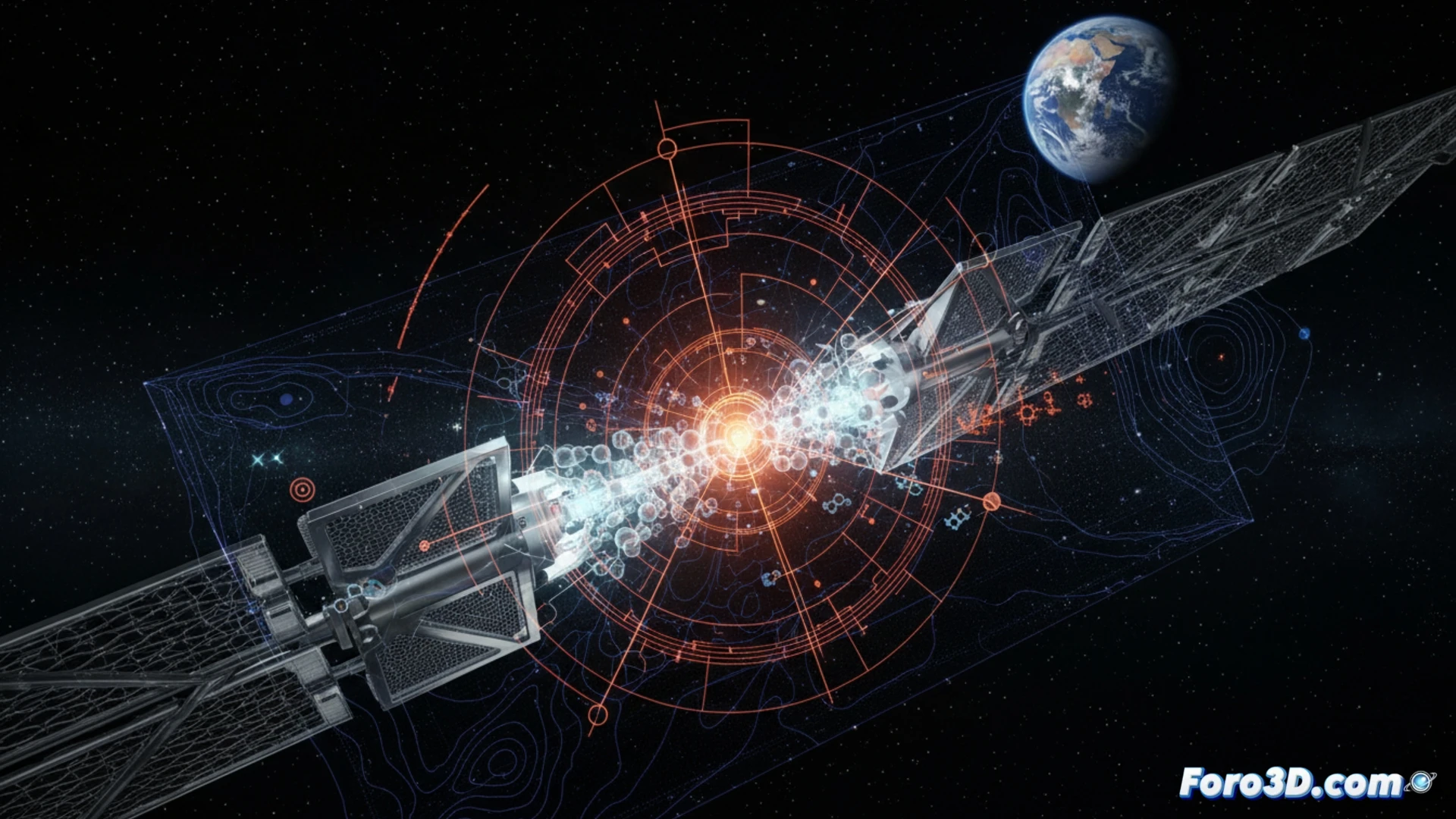
3D Reconstruction and Atomic Contact Analysis 🛰️
To locate the exact locking point, a reverse engineering of the mechanism was performed. In Ansys SpaceClaim, the antenna geometry was reconstructed from telemetry data, identifying nominally smooth surfaces. Using Autodesk Fusion 360, manufacturing tolerances were modeled and deployment loads were applied. The simulation was transferred to Rhino with Grasshopper, where a parametric script replicated the deployment kinematics. The results revealed a contact zone where surface pressure exceeded the elastic limit of the coating, exposing base metal to cold welding. Cyclic fatigue during ground tests did not replicate this condition due to the atmospheric oxide layer.
Lessons for Space Design: Controlled Friction 🔧
The simulation in KeyShot allowed visualizing heat transfer and plastic deformation at the failure point. The main lesson is that material fatigue in a vacuum depends not only on cyclic loading but also on surface chemistry. Designers must specify solid lubricant coatings (such as molybdenum disulfide) or geometries that prevent pure metal-to-metal contact. Incorporating atomic contact analysis in Ansys Mechanical and Grasshopper from the conceptual phase is now a standard to prevent an antenna from becoming a monolithic structure in orbit.
Is it possible to accurately model cold welding in a vacuum through contact fatigue simulations to predict the life cycle of a deployable satellite antenna, or does this phenomenon remain unpredictable due to the lack of experimental data in real space conditions?
(PS: Material fatigue is like yours after 10 hours of simulation.)