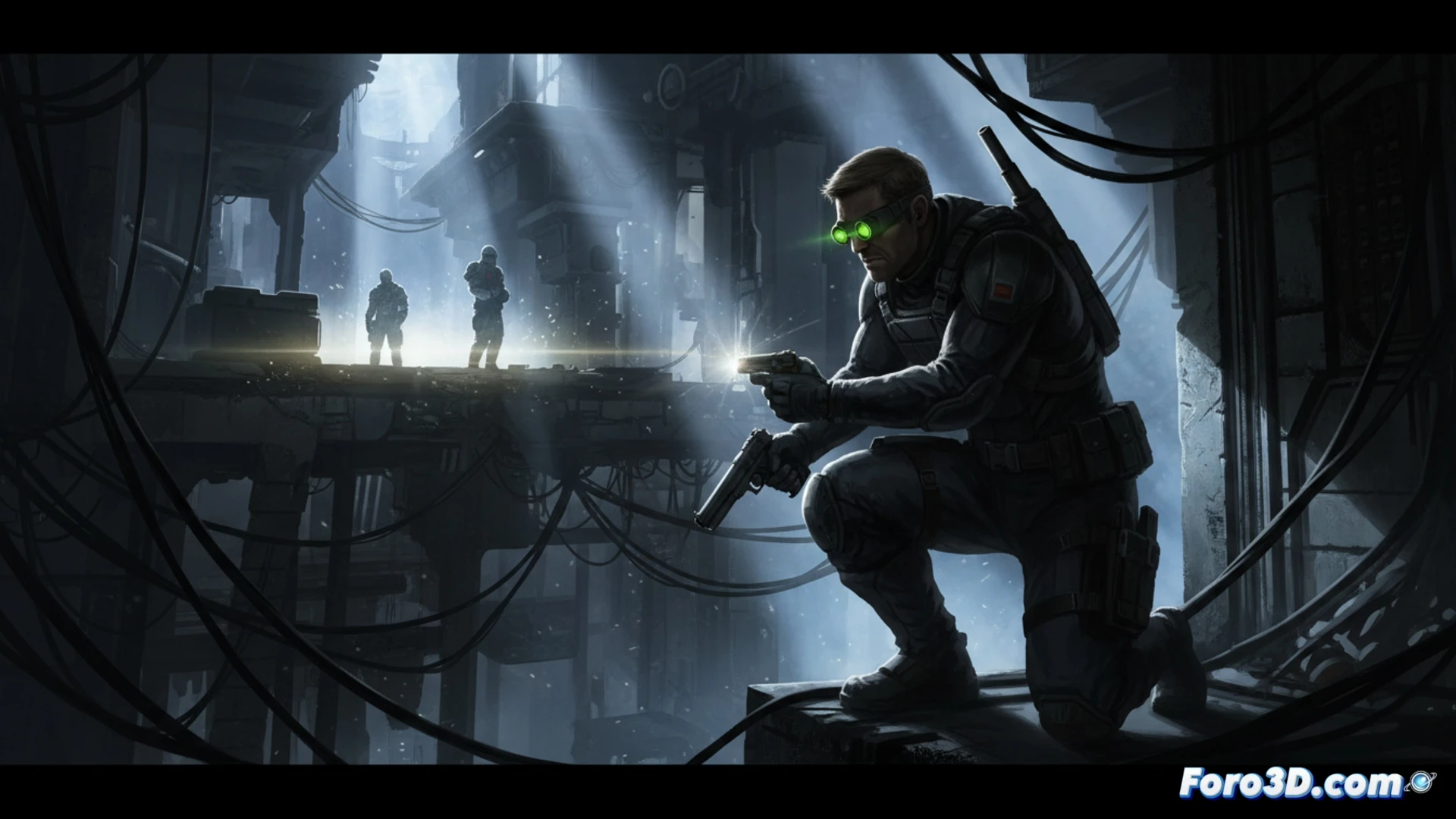
Ubisoft Toronto has confirmed that the Splinter Cell remake is being developed entirely on the Snowdrop engine, the same one that powers The Division or Avatar: Frontiers of Pandora. The major technical innovation lies in a dynamic lighting and next-gen shadow system that not only seeks visual realism but directly conditions stealth gameplay. Every beam of light and every projected shadow will be active gameplay elements.
Technical pipeline: reactive lighting from Houdini to Snowdrop 🛠️
The technical art team has implemented a workflow where Maya is used for scene modeling and arranging static light sources. However, the true qualitative leap comes with Houdini, employed for the procedural simulation of smoke and dust particles. These particles are not mere decorative elements: they interact with Snowdrop's dynamic lighting, creating volumes of scattered light that the player must read to anticipate enemy vision. The engine calculates in real-time how smoke density attenuates light beams, generating moving shadow zones that affect stealth. Ubisoft's internal tools allow designers to label each light source as safe or dangerous, linking its behavior to enemy AI.
Shadow as a gameplay mechanic, not just a visual effect 🎮
This technical approach transforms lighting into a system of rules. It's not about the player seeing better or worse, but about the environment reacting to their actions. If a bullet breaks a lamp, the Houdini dust particle simulation activates, altering the light volume and revealing the player's position. Snowdrop manages dynamic ambient occlusion so that character shadows lengthen or shrink according to the level's virtual time, a detail developers consider essential for recovering the tactical essence of the saga.
How is Ubisoft Toronto adapting the Snowdrop engine to recreate the classic stealth mechanics of Splinter Cell, considering it was originally designed for games like The Division?
(PS: a game developer is someone who spends 1000 hours making a game that people complete in 2)