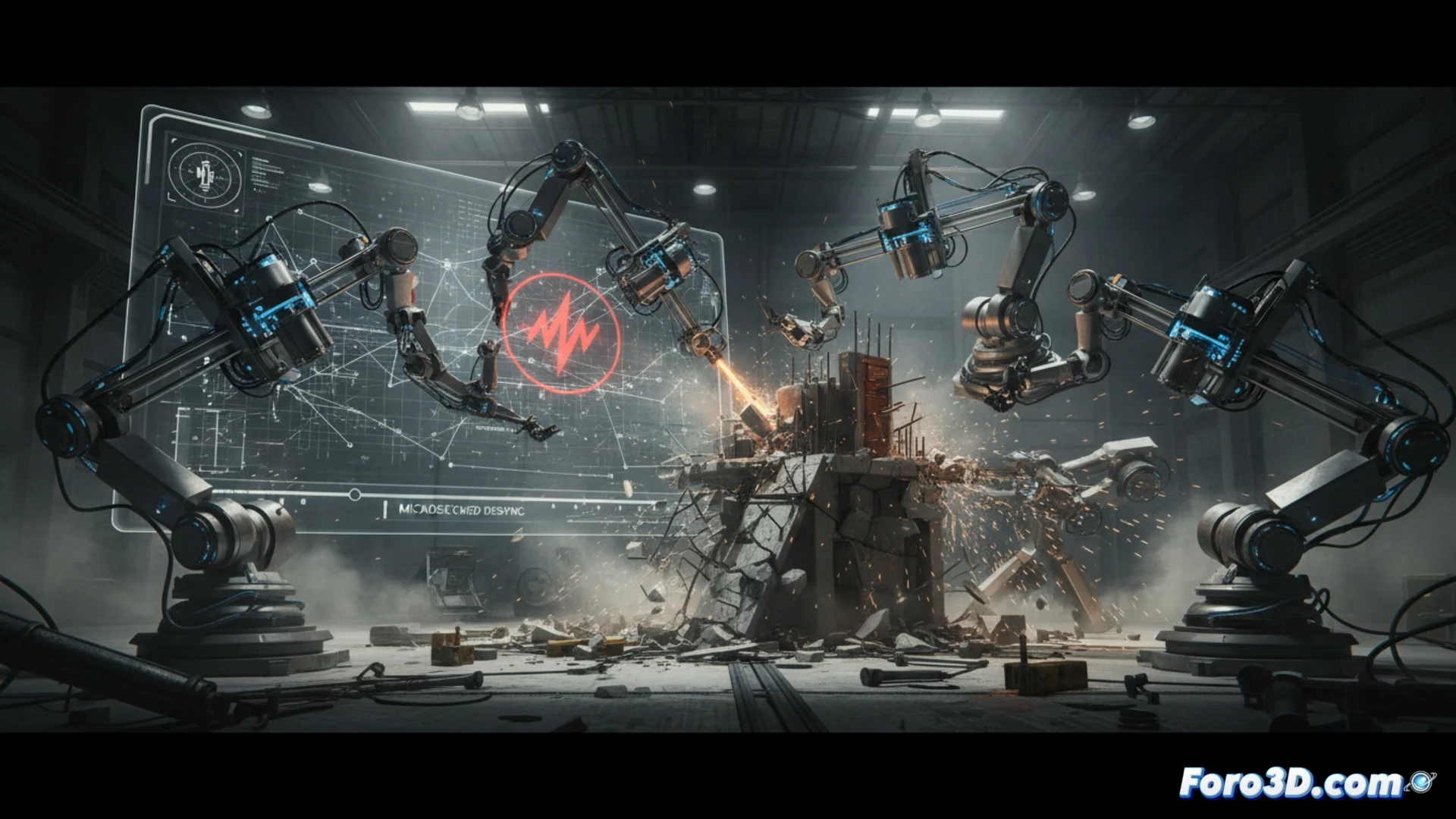
A swarm of four 3D printing robots collapsed a concrete structure after colliding with each other during construction. Reconstruction of the motion logs and scanning of the unfinished site revealed a time lag in the industrial Wi-Fi network. This incident demonstrates that synchronization in collaborative robotics does not allow millisecond tolerances.
Technical analysis of the time lag in the industrial Wi-Fi network 🛠️
The engineering team used Gazebo to replicate the sequence of movements and confirmed that the error resided in the communication layer. Instead of a mechanical failure, the culprit was a lag of just 850 microseconds between the robots' internal clocks. When comparing the trajectory data in CloudCompare with the 3D scan of the structure, it was observed that the lead robot executed a forward instruction 0.8 ms before its followers. This lag caused two robotic arms to occupy the same workspace simultaneously, knocking down the freshly deposited framework. The simulation in Siemens NX confirmed that the safe synchronization window was less than 200 microseconds for that specific geometry.
Lessons for autonomous construction with swarms 🤖
The incident underscores the need for networks with hardware-based synchronization, such as TSN (Time-Sensitive Networking), in 3D construction environments. Although the industrial Wi-Fi network is flexible, its variable latency makes it dangerous for operations where the error tolerance is micrometric. The combination of Gazebo for predictive simulation and CloudCompare for post-mortem analysis is becoming the essential workflow for debugging these failures. For future implementations, a closed control loop with real-time correction based on LIDAR scans is recommended, avoiding exclusive reliance on network time synchronization.
What lessons about synchronization tolerance in robotic swarms can be drawn from this microsecond failure to avoid collisions in future large-scale 3D printing projects?
(PS: Simulating robots is fun, until they decide not to follow your orders.)