In September 1950, following the devastating forest fires in Alberta, Canada, a unique optical phenomenon turned the Sun and Moon bright blue across the entire Northern Hemisphere. It was not an astronomical event, but a precise physical interaction between sunlight and smoke particles of a specific size. This article explores how modern scientific visualization, using tools like VGSTUDIO MAX and COMSOL Multiphysics, allows us to recreate and understand this rare Mie scattering event.
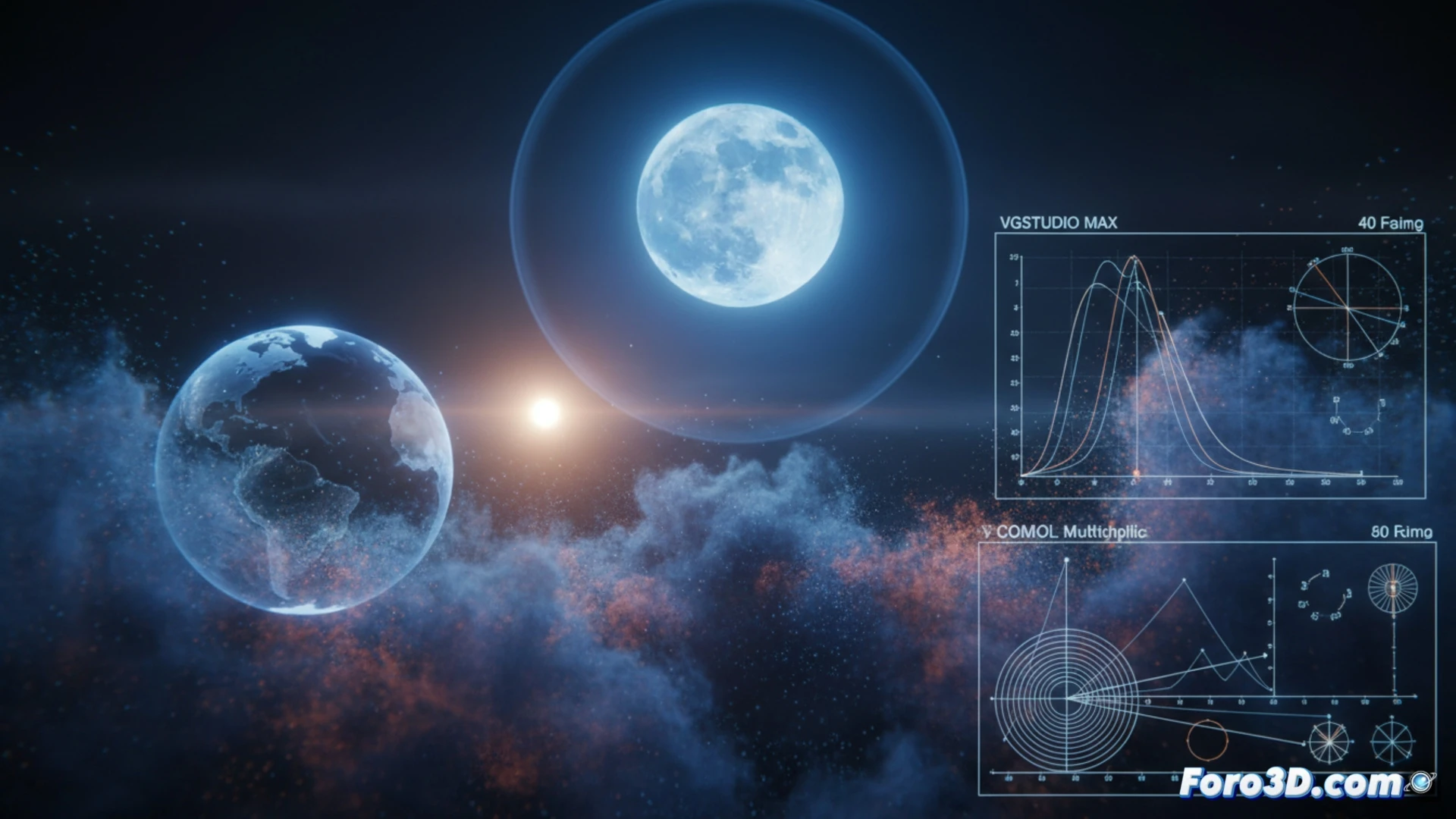
Particle modeling and Mie scattering in COMSOL Multiphysics 🌌
The secret behind the Blue Moon lies in the exact diameter of the smoke particles, close to 0.5 micrometers. To simulate this phenomenon, we first used Materialise Mimics to segment and extract the geometry of real ash particles from microtomographies. Then, in COMSOL Multiphysics, we configured a bio-electromagnetism model to calculate Mie scattering. The software solves Maxwell's equations for a plane wave incident on a dielectric sphere. The results show that these particles act as a selective filter: they strongly scatter red light (long wavelengths) in all directions, while blue light (short wavelength) passes through almost unimpeded, reaching the human eye directly.
Volumetric visualization of the atmospheric filter in VGSTUDIO MAX 🔬
To communicate this phenomenon in a striking way, we brought the far-field data from COMSOL into Volume Graphics VGSTUDIO MAX. Here, we imported the particle volume and overlaid the scattering intensity maps. The 3D visualization allows rotating the smoke cloud and observing how the red component of the solar spectrum is absorbed and redirected, while the blue component remains collimated. The result is an interactive scientific infographic that not only explains the historical event of 1950 but also demonstrates how light, matter, and size matter in atmospheric optics.
Since the simulation combines COMSOL's multiphysics models with VGSTUDIO MAX's volumetric visualization, the optical parameters of the ash particles from the Alberta fires were critical for reproducing the blue hue of the sun and moon in the final render.
(PS: the fluid physics for simulating the ocean is like the sea: unpredictable and you always run out of RAM)