In May 1976, the inhabitants of Messkirch, Germany, witnessed an inexplicable phenomenon: a violent storm that rained thousands of ancient coins from the sky. The most accepted hypothesis suggests that a tornado sucked up a private collection stored in an attic, scattering the treasure for kilometers. This event, although anecdotal, is a perfect case study for simulating the dispersion of objects by extreme winds.
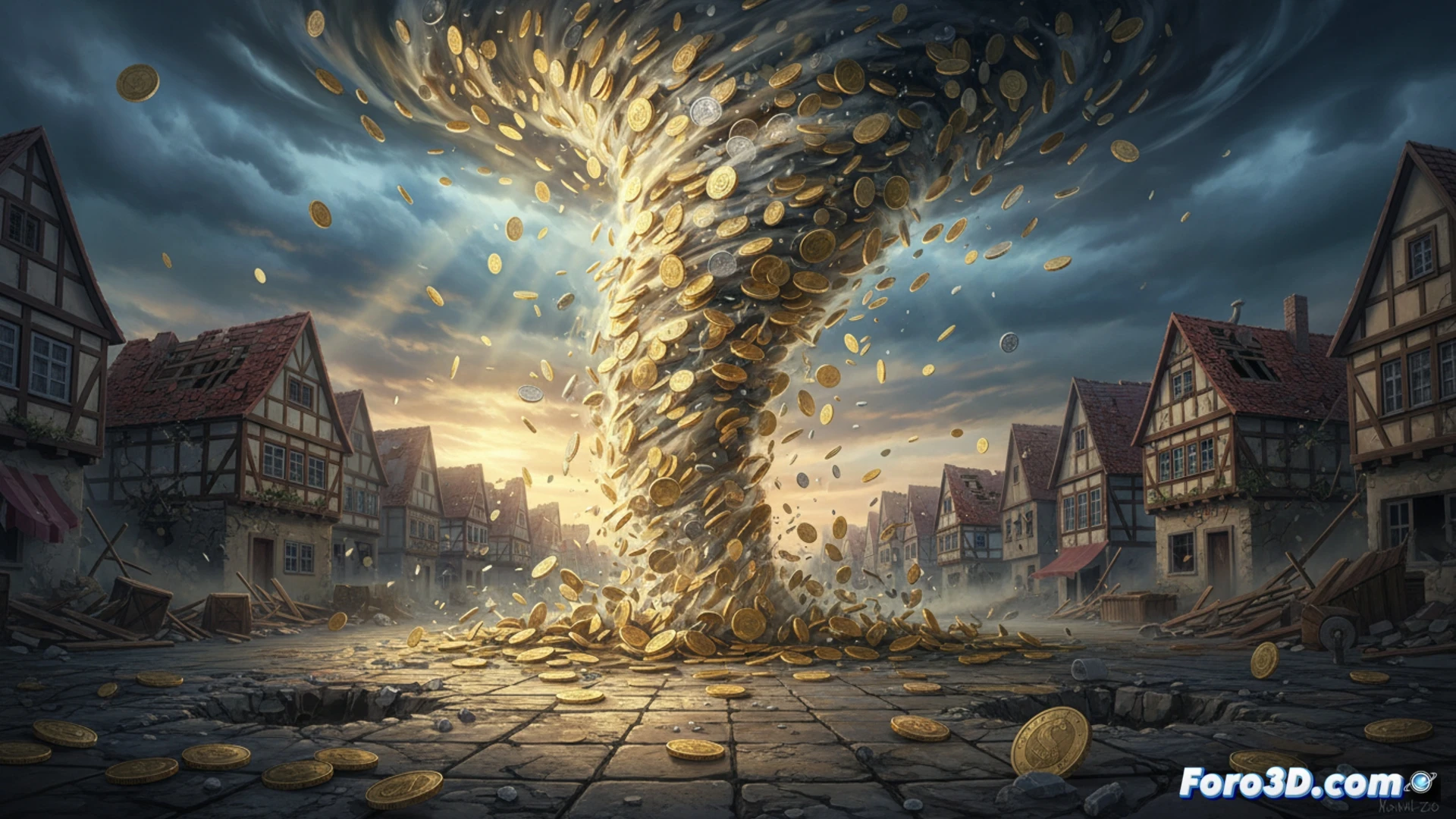
Technical setup of the dispersion simulation 🌪️
To recreate this phenomenon, the workflow is divided into two engines: in Houdini, we use the Bullet Physics solver within a POP Network. We generate thousands of points with random rotation and mass attributes, and propel them with a turbulent wind field (Wind Force and Turbulence Force). Collisions are resolved against an imported terrain and simple buildings. In Blender, the Rigid Body World allows a similar approach: objects are emitted from a central point with animated wind forces (Wind Force Field) and noise (Turbulence). The key is calibrating the force scale so that the coins travel hundreds of meters, mimicking the actual trajectory of the tornado. Rendering in both programs is optimized using geometry instances to avoid memory collapse.
Forensic and disaster prevention applications 🛡️
Beyond technical fetishism, this simulation has practical value in emergency planning. Modeling how a tornado disperses objects of a certain weight (coins, debris) allows predicting impact zones and optimizing evacuation routes. For forensic analysis, adjusting wind parameters until the simulation matches the testimonies of the Messkirch event helps validate hypotheses about the actual strength of the phenomenon. In summary, the coin rain is not just a historical curiosity, but a test bed for disaster physics.
What specific technical challenges did the simulation of the Messkirch coin rain present in Houdini and Blender, and how were they resolved to achieve credible physical and atmospheric realism within the context of a catastrophe?
(PS: Simulating catastrophes is fun until your computer melts down and you are the catastrophe.)