The white rainbow, known as the fogbow, is a fascinating optical phenomenon that challenges traditional color perception. Unlike a conventional rainbow, this luminous arc lacks color due to the diffraction of light in extremely small fog droplets, less than 50 microns. To understand its formation, we turn to advanced simulation tools such as COMSOL Multiphysics and VGSTUDIO MAX.
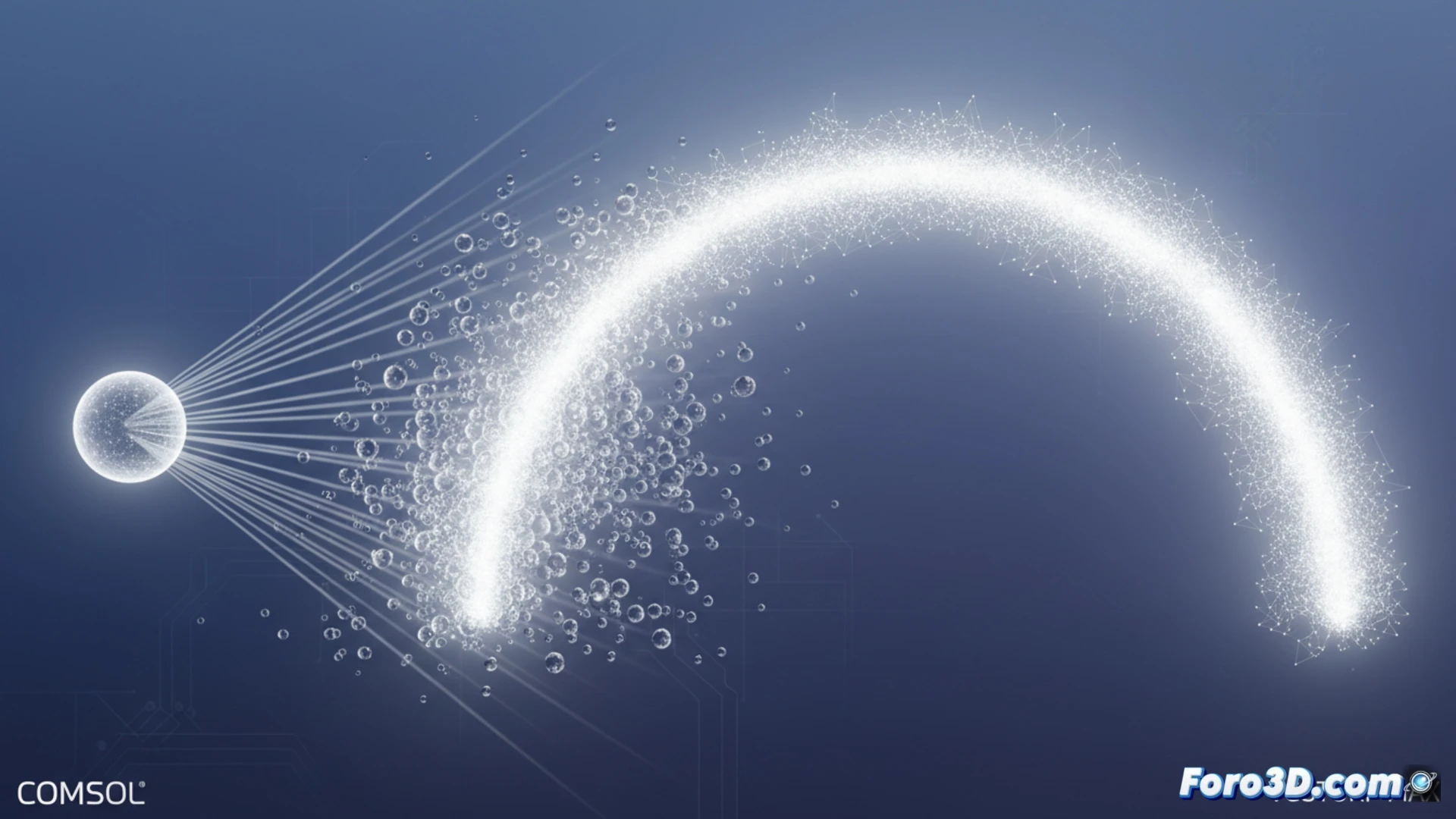
Modeling Diffraction in Microdroplets with COMSOL 🌫️
In COMSOL Multiphysics, specifically within the Bio-electromagnetism module, we can model the interaction of electromagnetic waves with spherical particles of submillimeter size. By simulating a cloud of fog droplets with a radius of 10 microns, the software solves Maxwell's equations to predict the scattering of white light. Unlike raindrops (larger than 500 microns) that generate a visible spectrum through refraction, these microdroplets produce a diffraction pattern that nullifies chromatic separation. The results are exported as scalar data volumes of light intensity, ready for visualization in VGSTUDIO MAX.
Volumetric Visualization and Optical Lessons 🔬
Using VGSTUDIO MAX, we import the calculated scattering fields to generate a three-dimensional representation of the fogbow. The tool allows applying transfer functions that highlight the homogeneous white intensity of the arc, contrasting it with a simulated rainbow from large droplets, where wavelength peaks separate into red, green, and blue. This exercise not only validates optical physics but also demonstrates how scientific visualization converts abstract data into understandable visual experiences, bringing complex atmospheric phenomena closer to technical analysis.
What technical limitations do the COMSOL and VGSTUDIO MAX models face when simulating the diffraction of submillimeter water droplets responsible for the lack of color in the fogbow, and how can they be overcome to achieve a more realistic visual representation?
(PS: fluid physics for simulating the ocean is like the sea: unpredictable and you always run out of RAM)