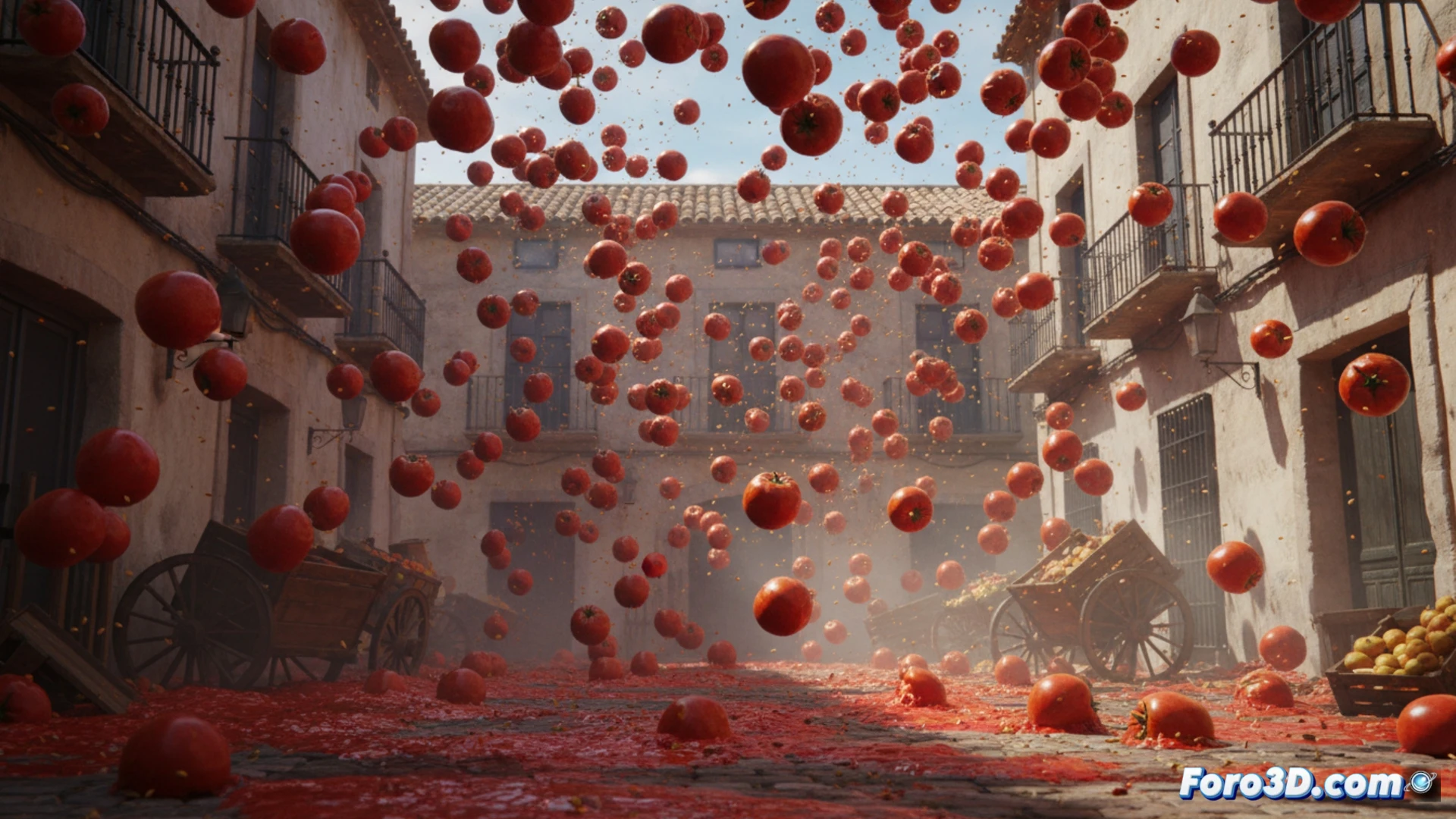
In the summer of 1954, the city of Alicante witnessed an unusual meteorological phenomenon: a storm that dumped hundreds of ripe tomatoes onto the streets. The most accepted theory suggests that a local tornado sucked up the contents of a farm field, transporting and releasing them over the city. For a visual effects artist, this event represents a fascinating technical challenge that combines fluid dynamics, soft bodies, and atmospheric particles.
Technical Workflow between Maya, Houdini, and Blender 🍅
To recreate the scene with scientific accuracy, the workflow is divided into three phases. First, in Maya, the mother particle cloud simulating the tornado's suction is generated; using the nParticles system, they are emitted from a rotating cylindrical volume to mimic the vortex. This particle cache is then exported to Houdini, where Bullet Physics is applied to convert each point into a soft body (tomato). Key parameters such as mass, elasticity, and friction are adjusted here so that the tomatoes bounce realistically against the ground and buildings. Finally, the deformed geometry is rendered in Blender using Cycles, where procedural tomato skin textures, displacement maps for dents, and a volumetric fog system are added to capture the storm's humidity.
Technical Reflection on the Authenticity of the Phenomenon 🌪️
The key to realism lies not only in the physics of the objects but in the atmosphere that surrounds them. Houdini excels at simulating the fluid dynamics of the wind, Maya is ideal for the massive generation of seed particles, and Blender offers the best balance between render quality and memory management for dense scenes. However, the greatest challenge is simulating the transition of a tomato from a rigid to a soft body after impact, a detail that distinguishes amateur VFX from professional work. The Alicante rain reminds us that nature always surpasses imagination, and our job is to translate that improbability into believable pixels.
What is the most effective technical approach to simulate the dispersion, collision, and breakage of tomatoes in a VFX storm, considering fluid physics and soft body dynamics?
(PS: VFX is like magic: when it works, no one asks how; when it fails, everyone sees it.)