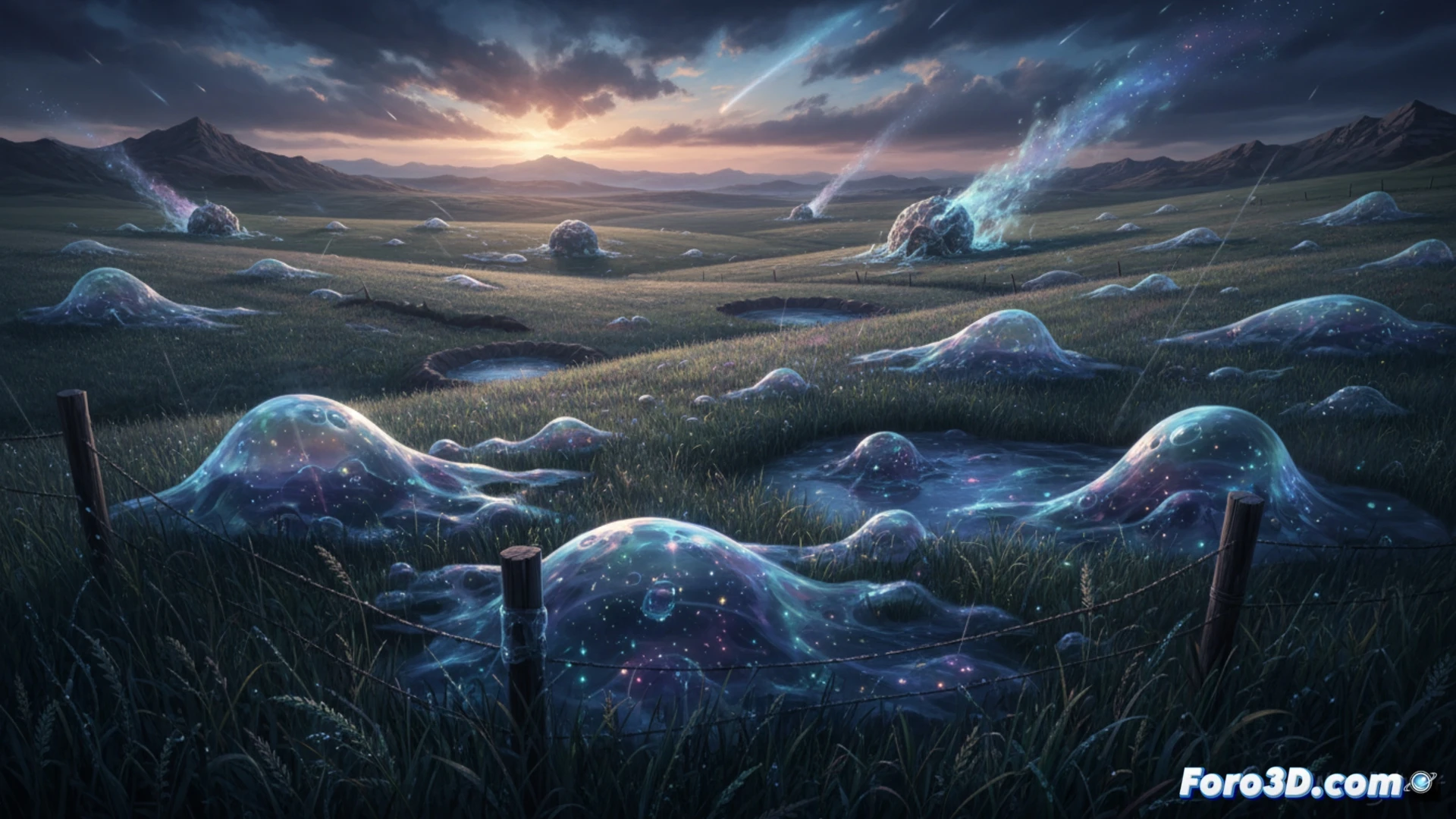
In September 2009, the fields of Fife, Scotland, awoke covered by a mysterious translucent and viscous substance: star jelly. Witnesses reported that this material, which fell after a meteor shower, evaporated without leaving any biological trace. For the VFX team, this phenomenon represents a fascinating technical challenge: recreating a substance that behaves like a non-Newtonian fluid, with dynamic transparency and progressive disappearance, using advanced physical simulation tools.
Technical workflow: Soft bodies, fluids and procedural evaporation 🧪
The pipeline begins in Blender, where the jelly fragments are modeled as base meshes. Applying soft body dynamics, high elasticity and low friction are configured to simulate the impact and deformation upon touching the ground. This data is exported to RealFlow, where the material is defined as a viscous fluid with high surface tension, replicating the sticky and semi-transparent texture. The main challenge is evaporation: in Houdini, a procedural particle system is implemented that gradually reduces the object's size while fading its opacity. Using a volumetric scattering shader, the gelatinous appearance that reflects ambient light is achieved, as documented in the Scottish reports. Finally, compositing in Nuke integrates refraction layers and specular reflections to add realism to the scene.
Lessons for the art of the ephemeral in VFX �/h3>
Simulating star jelly reminds us that the most difficult phenomena to recreate are those that defy everyday physical logic. Evaporation without a trace forces us to think about the transition between matter and energy, something that in VFX translates into controlling the disappearance of particles without abrupt cuts. This case demonstrates that combining soft bodies, fluids, and procedural simulation not only solves a technical brief but also allows capturing the visual poetry of the inexplicable.
How to ensure that the simulation of a viscoelastic substance like star jelly maintains its translucency and unique physical properties when interacting with solid surfaces in Blender, RealFlow, and Houdini, considering factors such as surface tension and light refraction?
(PS: VFX are like magic: when they work, no one asks how; when they fail, everyone sees it.)