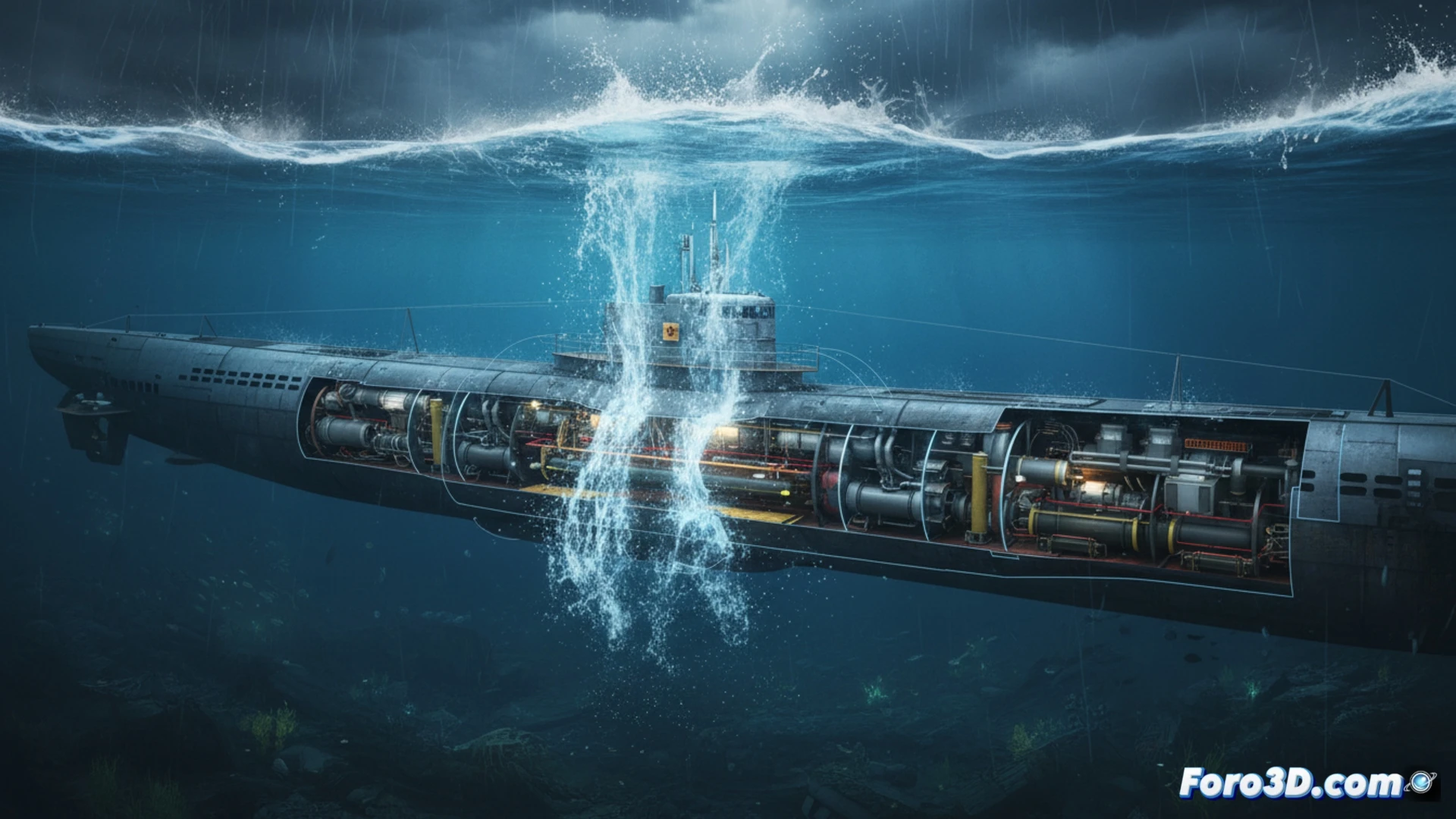
Uboat, developed in Unity, represents a fascinating case study for indie developers looking to implement deep technical simulation without sacrificing performance. The game not only models submarines with historical accuracy but integrates dynamic cross-sections that respond to damage and water pressure. This approach, combined with an advanced ocean system, allows for simulating storms, variable visibility, and underwater lighting effects, all orchestrated from the asset pipeline created in Maya and 3ds Max.
Asset pipeline and dynamic cross-sections 🌊
The submarine models are created in Maya and 3ds Max, where each hull section is designed as an independent object with specific connection points. In Unity, these assets are imported and linked to a damage system that calculates structural integrity in real-time. When a section receives an impact, the engine activates a predefined deformation mesh and adjusts buoyancy. For the ocean, a surface shader with multiple layers of foam and refraction is used. Storms are generated using a particle system that modifies wave height and fog density, directly affecting underwater visibility. Developers must optimize meshes in Maya using manual LODs, as Unity handles simple geometry with detailed textures better than complex polygons without level of detail.
Lessons for technical simulations in indie projects ⚙️
Uboat demonstrates that deep technical simulation does not require an AAA engine, but rather careful design of interdependent systems. The trick is to separate damage logic from rendering: cross-sections are updated on a secondary thread, while the ocean is processed with a mesh LOD based on the camera. For indie, I recommend starting with a simple buoyancy prototype in Unity and then adding layers of complexity, such as underwater visibility using a color buffer that attenuates light based on depth. Avoid expensive shaders; use noise textures to simulate turbulence in storms.
As an indie developer, what are the main technical challenges when implementing a dynamic wave system and real-time ocean reflection with Unity, and how can they be optimized to maintain stable performance on mid-range hardware?
(PS: 90% of development time is polishing, the other 90% is fixing bugs)