A critical leak in the cryogenics system of an organ bank has destroyed irreplaceable biological samples. The failure originated from thermal fatigue fractures in the expansion joints of the liquid nitrogen piping. To understand the fracture mechanism, a 3D reverse engineering pipeline has been deployed, combining photogrammetry scanning with finite element analysis, allowing precise localization of stress concentration points induced by extreme cold cycles.
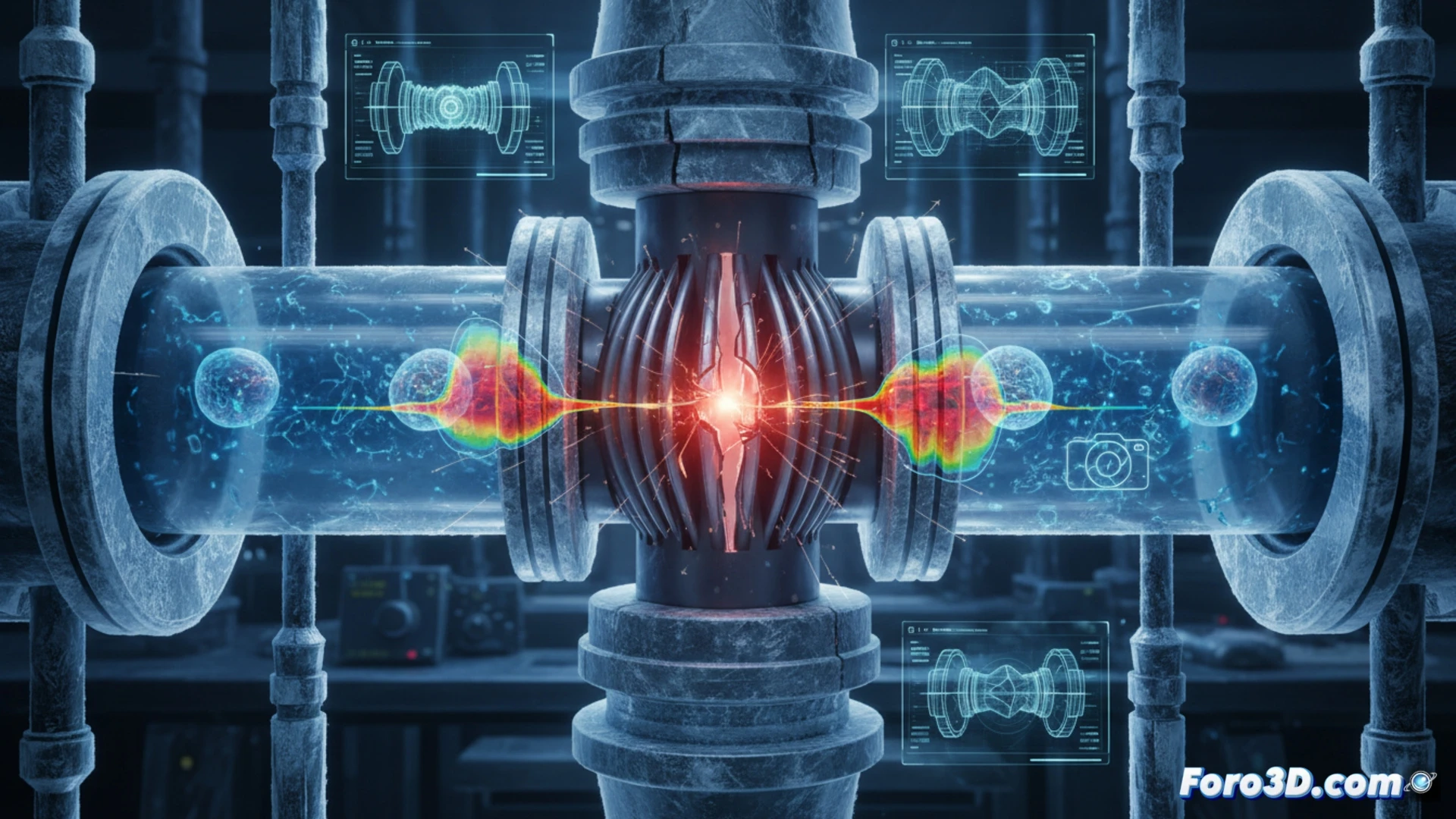
Simulation Pipeline: Modeling, Meshing, and Structural Validation 🛠️
The process begins with capturing the actual geometry of the vacuum piping network using Bentley ContextCapture, generating a high-fidelity point cloud. This model is imported into SolidWorks Simulation to reconstruct the metallic expansion joints and define the properties of cryogenic stainless steel. The file is transferred to Abaqus (FEA) to apply cyclic thermal loads simulating the passage of liquid nitrogen at -196 degrees Celsius. The finite element analysis reveals that microfractures initiate at the internal radii of the joints, where thermal fatigue exceeds the material's yield strength after thousands of cooling and expansion cycles.
Prevention of Catastrophic Failures in Critical Infrastructure ⚠️
Visualizing the results in Blender allows engineers to inspect the residual stress distribution over the actual geometry, identifying risk zones undetectable in 2D blueprints. This preventive approach is vital for organ banks and cryogenic laboratories, where a leak not only destroys samples but also compromises human lives on the waiting list. FEA simulation thus consolidates itself as an indispensable tool for certifying the integrity of expansion joints subjected to extreme thermal conditions.
How to accurately model in FEA the effect of rapid thermal cycles between cryogenic and ambient temperature on the fatigue resistance of a metallic joint in an organ bank to prevent critical leaks?
(PS: Material fatigue is like yours after 10 hours of simulation.)