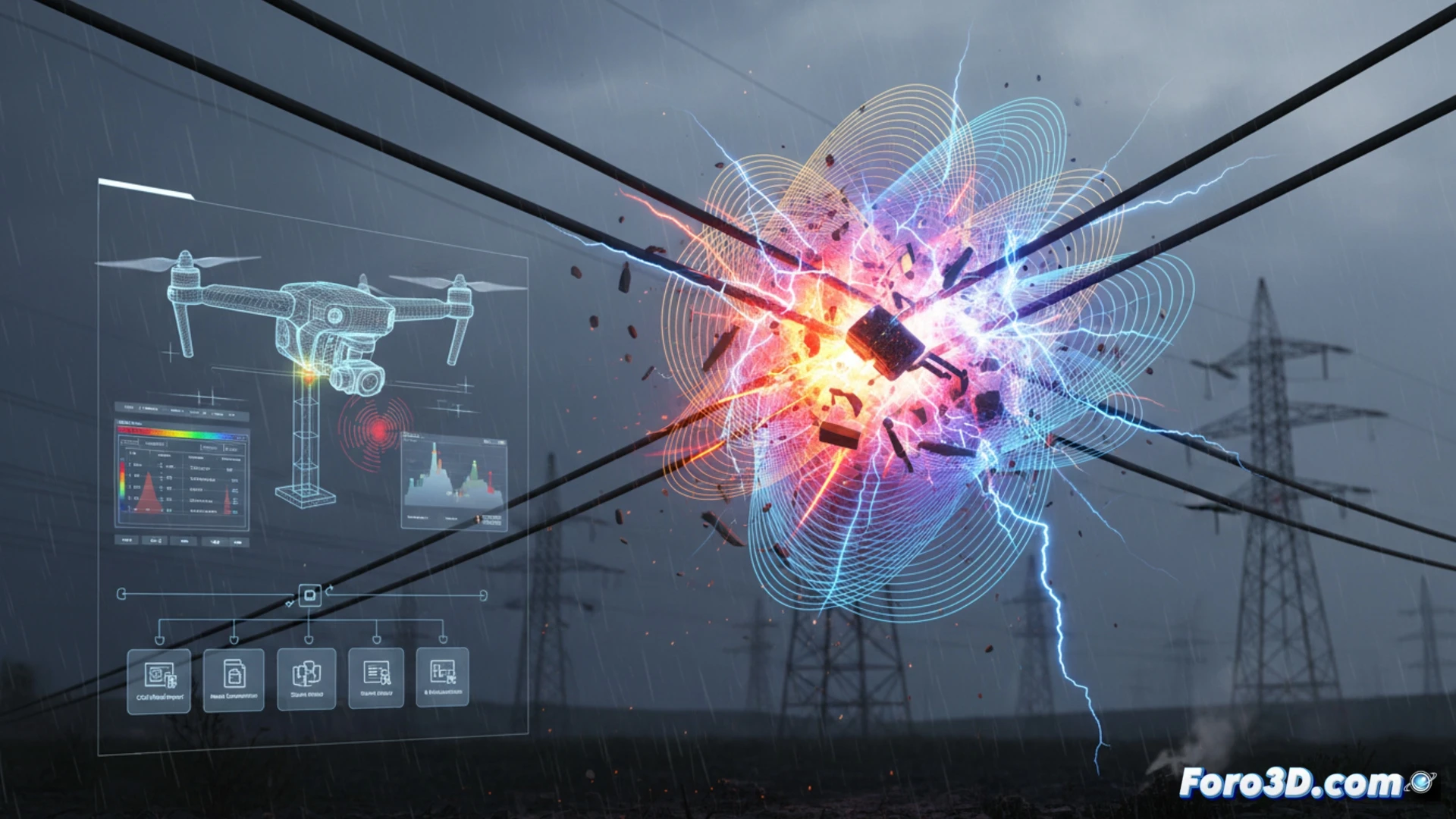
A real incident where a commercial drone collided with high-voltage power lines triggered a short circuit that left thousands of users without service. Beyond the physical impact, the real danger lay in the loss of control prior to the crash, caused by electromagnetic interference. This article breaks down the technical workflow used to model and analyze the phenomenon using process simulation tools.
Technical workflow: From survey to electromagnetic model ⚡
The process began with capturing environmental data using DJI Terra, generating an orthomosaic and a digital surface model of the power line corridor. This data was imported into CloudCompare to align point clouds and extract the precise geometry of the towers and conductors. With the clean geometry, the model was exported to Altair Feko, where the electrical properties of the materials were defined and the field sources were configured. The electromagnetic simulation in Feko allowed calculating the field intensity near the line and modeling the interference on the drone's navigation and control systems. The results confirmed that the electric field gradient near the conductors exceeds the immunity thresholds of standard components, causing failures in the compass and radio link before physical contact.
Visualization and application in safety protocols 🛡️
To effectively communicate the findings, current density maps and interference paths were visualized in 3ds Max, integrating the drone model into the scene to recreate the failure sequence. This process simulation not only explains the incident but also allows predicting risk zones in other infrastructures. Engineers can now design safety protocols that include alternative flight routes and minimum distance thresholds, drastically reducing the likelihood of new short circuits and blackouts.
How would you model in an electromagnetic simulation the electric arc generated by the collision of a commercial drone against high-voltage power lines to predict its impact on the distribution network.
(PS: Simulating industrial processes is like watching an ant in a maze, but more expensive.)