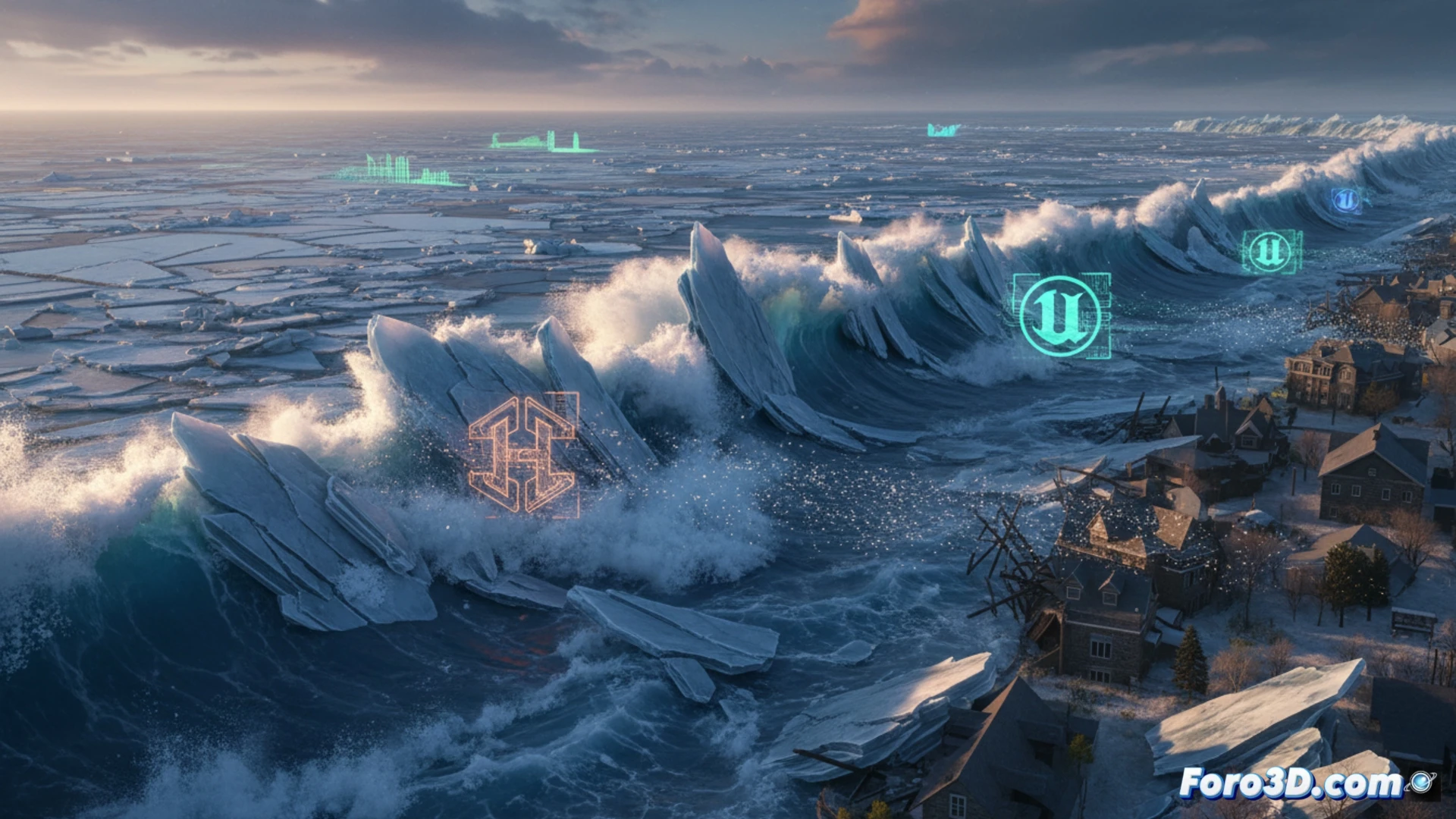
In February 2019, Lake Erie was the scene of a devastating phenomenon: an ice tsunami. Masses of ice, driven by hurricane-force winds, advanced inland, destroying homes and ravaging the coast. This extreme natural event, combining hydrodynamic forces and solid mechanics, represents a perfect challenge for computer simulation. Recreating its physics allows engineers and urban planners to understand the dynamics of the disaster and plan effective coastal defenses.
Technical Pipeline: RBD in Houdini and Visualization in Unreal Engine 🎬
The simulation was approached in Houdini using Rigid Body Dynamics (RBD). The first step was to generate a layer of irregular ice fragments using Voronoi fracture, assigning variable densities to mimic real ice. A vector force field was defined to emulate hurricane-force winds and lake currents, applying massive pushes to the fragments. Collisions against a target structure (a coastal house) were resolved using the Bullet solver, calibrating friction and bounce to prevent penetrations. Data caching was exported in Alembic format to maintain transformation integrity. Subsequently, in Maya, a particle system was added to simulate splinters and ice dust, enhancing the impact feel. Finally, in Unreal Engine, a coastal landscape was set up with dynamic materials, and a vertex damage system was applied to the house mesh, triggered by the impact velocity of the RBDs. The final result was an interactive sequence that allowed analyzing the pressure exerted on the walls.
Lessons for Coastal Disaster Mitigation 🌊
Beyond visual realism, this simulation offers critical data for prevention. By varying parameters such as wind speed or ice thickness, risk scenarios can be modeled and the force needed for a barrier to contain the advance can be calculated. The use of Houdini and Unreal Engine is not only for film or video games; it is a civil engineering tool. Understanding how the kinetic energy of these masses is distributed allows for designing smarter dikes and breakwaters, saving lives in future extreme weather events.
How would you model the physical behavior of fragmented ice plates in Houdini to simulate the destructive impact of an ice tsunami in Unreal Engine, while maintaining optimal real-time performance?
(PS: Simulating disasters is fun until your computer melts down and you become the disaster.)