A recent clinical case has highlighted one of the major limitations of 3D bioprinting: vascular integration. A skin graft manufactured using additive techniques failed because it could not connect its internal microchannels to the patient's circulatory system. This problem, far from being an isolated incident, represents the main bottleneck in thick tissue regeneration. The absence of a functional vascular network prevents the exchange of nutrients and oxygen, condemning the graft to necrosis.
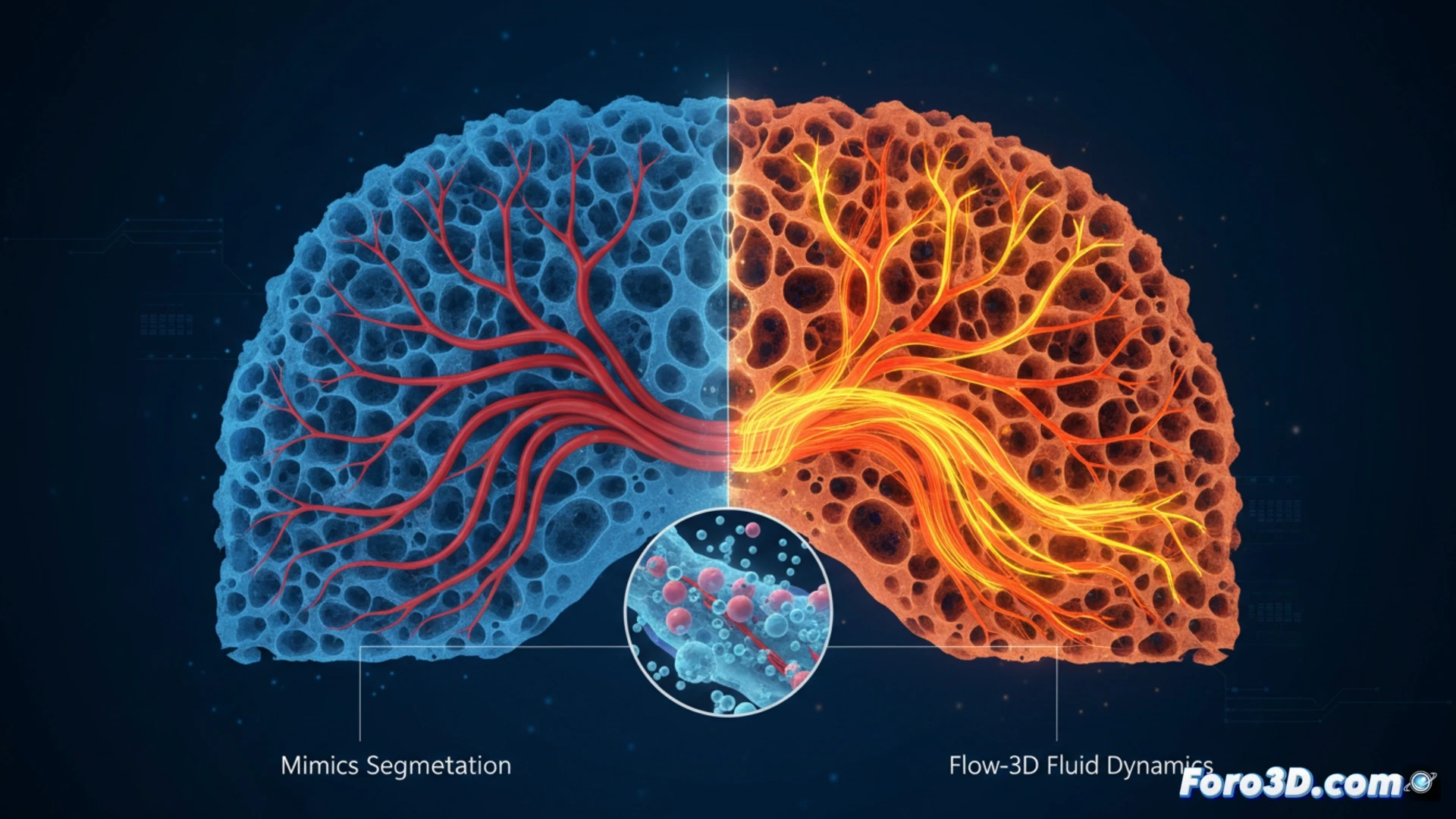
Technical Workflow: Segmentation, CFD, and Visualization 🧬
To prevent these failures, a multidisciplinary workflow has been implemented that combines three key tools. First, Mimics is used to segment the patient's vascular anatomy from DICOM images, generating a precise 3D model of the recipient arteries and veins. Then, that model is integrated into Flow-3D, a computational fluid dynamics (CFD) software that simulates hemodynamic behavior within the graft's microchannels. Here, critical variables such as pressure, flow velocity, and shear stress are evaluated, identifying stagnation zones that predict failure. Finally, Blender is used for visualization and animation of the problem, allowing surgeons to observe in 3D how the graft's geometry disrupts the vascular connection.
The Lesson: Design to Connect, Not Just to Print 🔬
This case demonstrates that the success of a bio-printed graft depends not only on the bioink or cellular architecture, but on its ability to integrate as a functional organ within the host. Simulation with Flow-3D and Mimics allows iterating the design of the microchannels before printing, adjusting diameters and bifurcation angles to ensure adequate blood perfusion. Ultimately, 3D technology serves not only to manufacture, but to predict and optimize tissue survival.
Is it possible to accurately predict the permeability and hemodynamic behavior of a bio-printed capillary network using the integration of Mimics and Flow-3D, or do experimental results still show significant deviations from the simulation?
(PS: If you print a 3D heart, make sure it beats... or at least that it doesn't cause copyright issues.)