Fire whirls, also known as fire whirls, are rotating columns of flames generated by intense fires that combine updrafts with lateral winds. In the world of Visual Effects, replicating this phenomenon requires a balance between real physics and cinematic aesthetics. While scientific tools like Volume Graphics VGSTUDIO MAX and COMSOL Multiphysics model the exact fluid dynamics, VFX artists turn to particle engines in Houdini to achieve the visual drama demanded by the screen.
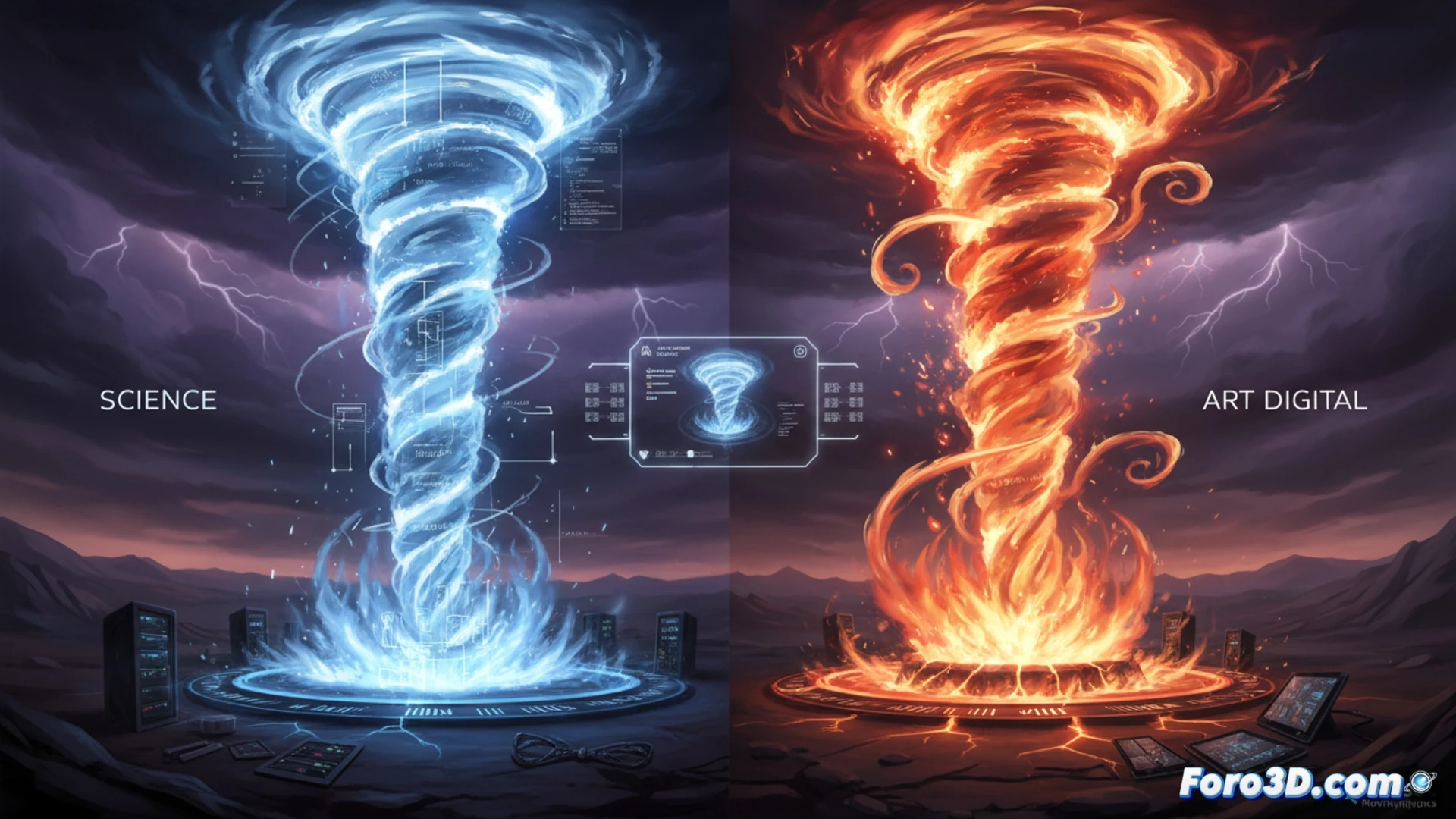
Technical Workflow: From COMSOL to Houdini 🔥
For an accurate simulation, one can start with data from COMSOL Multiphysics, specifically its Bio-electromagnetism and fluid dynamics module, which calculates vorticity and heat transfer in the whirl's core. These results are exported as volumetric meshes or vector fields. Then, VGSTUDIO MAX allows visualizing and segmenting this data into voxels, defining smoke density and temperature. In Houdini, these fields are imported via VDB volumes to guide pyro solver simulations, adjusting turbulence and wind shear. The main challenge is translating the mathematical rigidity of COMSOL into an organic and chaotic behavior that the human eye perceives as real fire, sacrificing scientific precision for visual impact in action scenes or natural disasters.
The Realism Dilemma in the Industry ⚖️
Although the science behind fire whirls is fascinating, in VFX practice COMSOL is rarely used directly. Studios like Industrial Light & Magic or Weta Digital prefer artistic simulations in Houdini or Maya Bifrost, where the artist controls the vortex shape with noise nodes and rotational forces. However, understanding the underlying physics allows creating more credible references for fires in video games like The Last of Us or in movies like Inferno. The true art lies in knowing when to ignore thermodynamics to achieve a flame that dances exactly as the story requires.
What is the greatest technical challenge when simulating the vortex physics of a fire whirl without sacrificing the visual realism that the viewer expects?
(PS: VFX are like magic: when they work, no one asks how; when they fail, everyone sees it.)