The phenomenon of Milky Seas, sporadically sighted in the Indian Ocean since 1864, presents a constant whitish glow visible from space stations. This effect, caused by massive colonies of bioluminescent bacteria such as Vibrio harveyi, challenges digital simulation due to its oceanic scale and homogeneous light dispersion. Below, I detail a technical pipeline to recreate this event using Niagara particle systems, fluid dynamics in Houdini, and volumetric rendering with V-Ray.
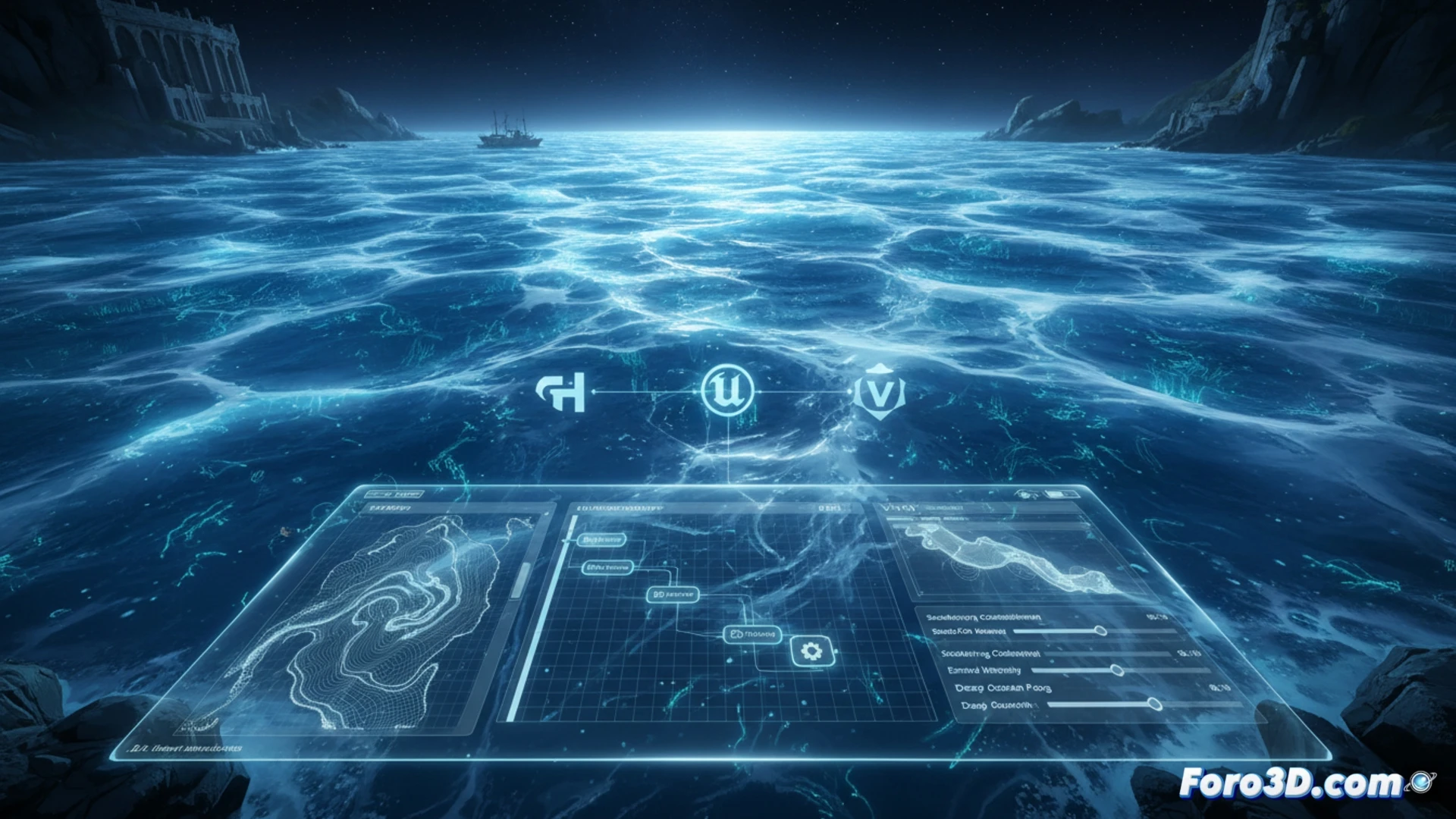
Technical Pipeline: Bacterial Density and Light Dispersion 🌊
In Unreal Engine, the Niagara Water system must be configured with a low-speed, high-density underwater particle emitter, using a translucent material with anisotropic scattering. Key parameters include an albedo close to 0.95 in the blue-green spectrum and a minimal absorption coefficient. For historical validation, MODIS satellite reflectance data is imported as density textures, activating emission only in areas with bacterial concentrations exceeding 10^7 cells per milliliter. In Houdini, a VEX solver processes bacterial propagation through a diffusion field based on simulated ocean currents, generating VDB volumes that are exported to V-Ray. There, a participating medium shader with Rayleigh scattering is applied to emulate the light emitted by the bacteria, adjusting the glow with spectral response curves extracted from 19th-century observations.
Reflection on Visual Validation and Science 🔬
The complexity lies in balancing physical realism with human perception of the phenomenon. Satellite data confirms that the glow covers areas up to 15,000 km², but bacterial fluorescence is continuous, not pulsating like in dinoflagellates. To avoid an artificial result, it is crucial to map bacterial bioluminescence as a constant low-intensity emission, not a flash. This approach not only recreates the historical sighting documented by sailors but also allows scientific visualizers to study algal bloom patterns on a planetary scale, bridging the gap between 3D simulation and observational oceanography.
How can the complex interaction of bioluminescent bacteria Vibrio harveyi with the nocturnal swell be translated into a procedural simulation that maintains the physical coherence of the milky sea phenomenon both in Unreal Engine for real-time and in Houdini and V-Ray for offline rendering?
(PS: if your manta ray animation doesn't excite, you can always add documentary music from channel 2)