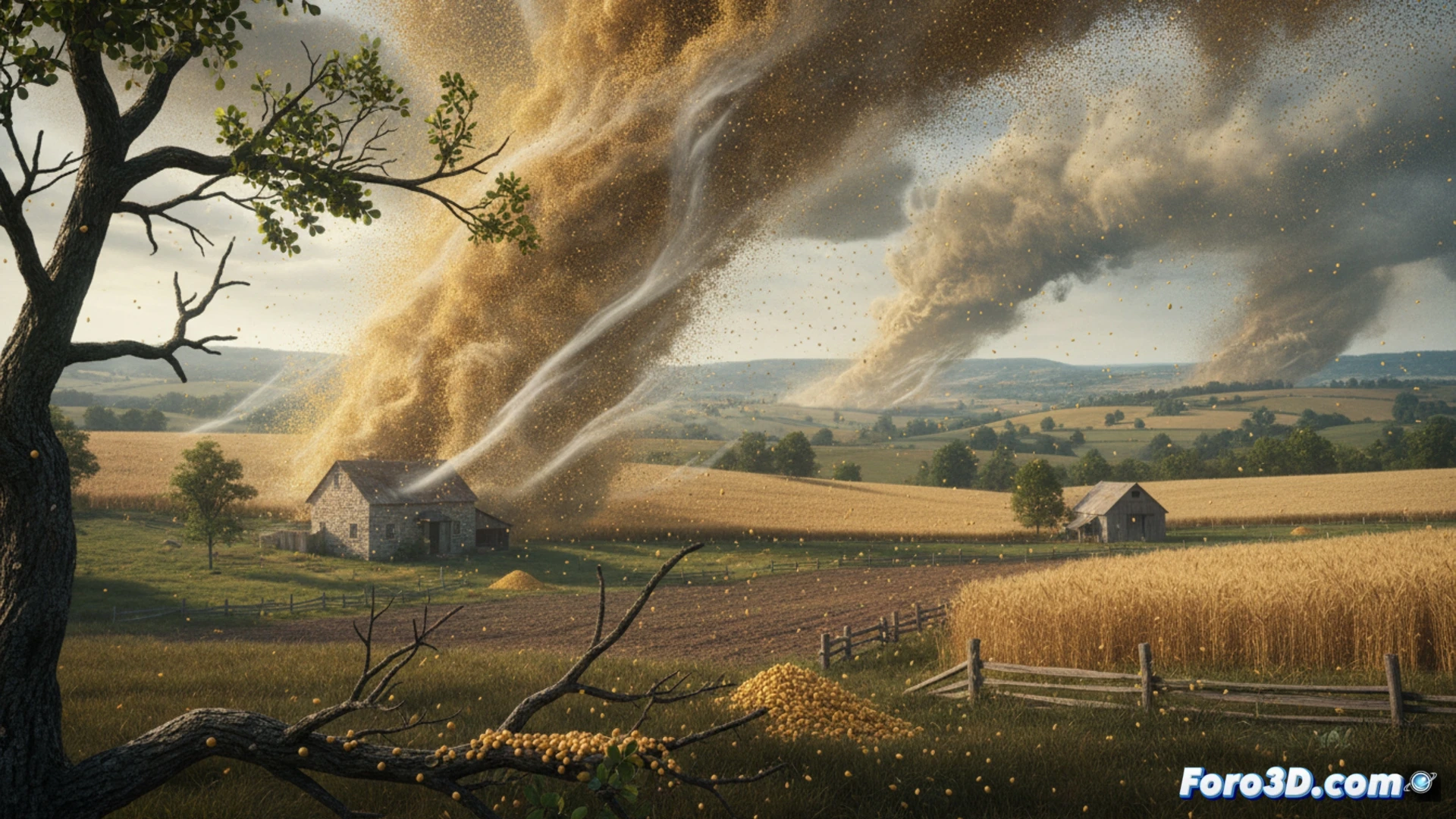
In July 1870, Pennsylvania witnessed an unusual meteorological phenomenon: a rain of mustard seeds that covered local farms, likely carried by updrafts from nearby crops. This event, documented as a climatic rarity, today becomes a fascinating technical exercise for VFX artists. Recreating this organic precipitation requires mastering particle systems, wind simulations, and collisions with rural geometry, combining tools like Houdini Grains, Maya XGen, and Blender to achieve believable physical realism.
Technical Workflow: Grains, Wind, and Collisions 🌱
The foundation of the simulation lies in Houdini, where the Grains system is used to model the granular behavior of the seeds. A procedural wind field is generated using POP Wind nodes and a turbulence noise volume to replicate updrafts. The seeds collide with a proxy geometry of farms (roofs, silos, and fields) via the POP Collision Detect solver, adjusting friction so seeds accumulate on sloped surfaces. In Maya, XGen adds morphological variation: seed patches are created with different scales and random rotations, instancing high-resolution geometry onto collision points. Blender complements the workflow with its particle engine for quick dispersion tests in open environments, using the Hair node to distribute seeds over ground and rooftops. Final rendering is done with natural sky lighting (HDRI) to capture soft shadows and diffuse reflections, essential for integrating the seeds into an agricultural landscape.
Performance and Application Comparison ⚙️
When comparing engines, Houdini excels in massive simulations (over 10 million seeds) thanks to its GPU support with OpenCL, though it requires high RAM consumption for wind fields. Maya XGen is more efficient for shape variations and fine details but slows down with complex collisions. Blender offers the best speed-quality ratio for prototypes, but its particle solver lacks the physical sophistication of Houdini. This workflow not only recreates a historical phenomenon but also demonstrates how procedural simulation can transform meteorological data into impactful visual narratives for documentaries or film.
How would you implement in Houdini, Maya, and Blender the physical simulation of a seed rain that respects the chaotic dispersion and granular behavior observed in the real 1870 phenomenon, and what specific challenges of each software would you address to achieve a realistic result?
(PS: VFX are like magic: when they work, nobody asks how; when they fail, everyone sees it.)