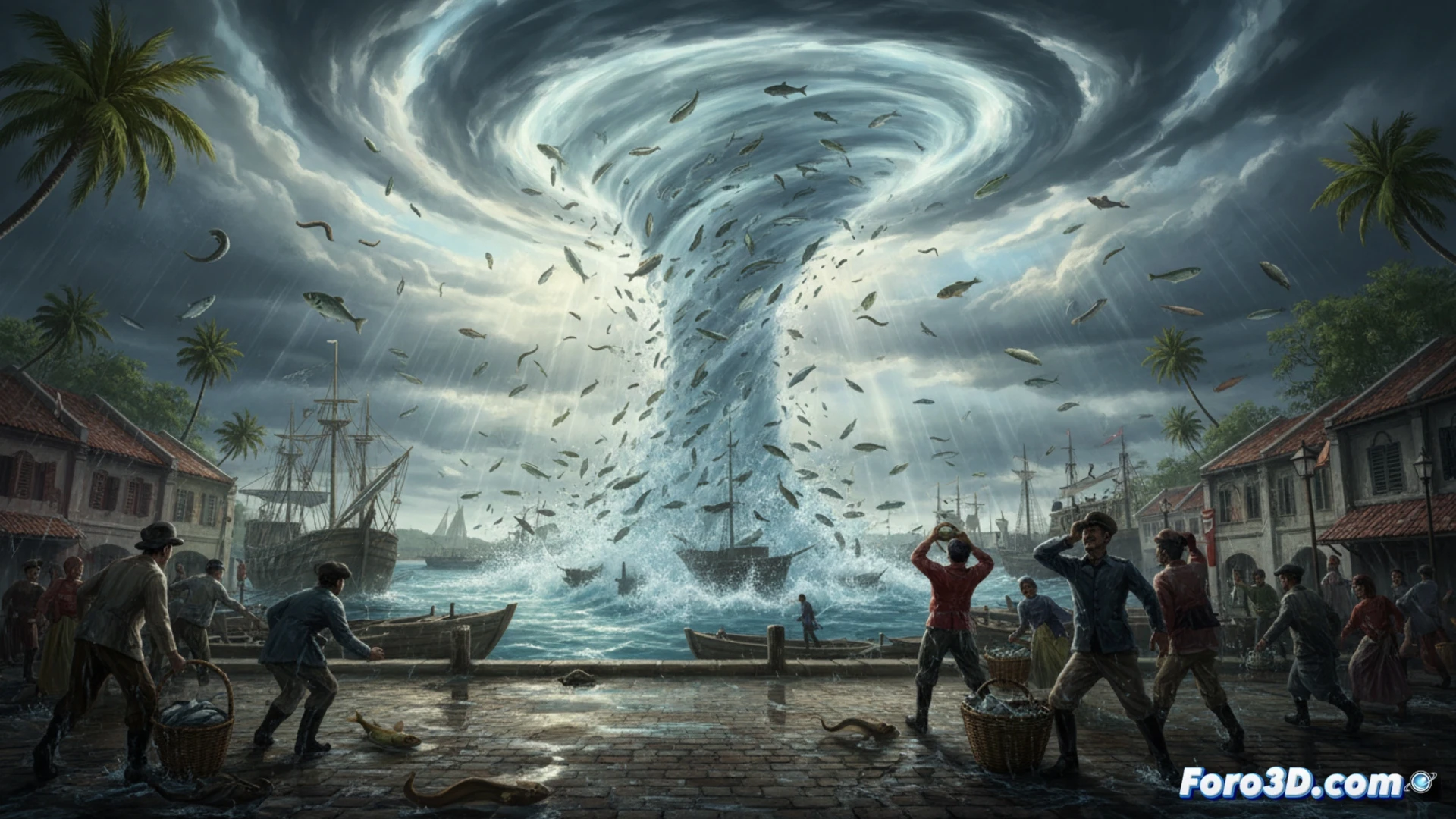
On February 22, 1861, the streets of Singapore were covered in fish after a monsoon storm. Far from being a miracle or divine punishment, science explains that strong winds sucked specimens from nearby bodies of water, transporting them for kilometers before releasing them with the rain. This event is a perfect case study for fluid and particle simulation in disaster environments.
Technical Pipeline: From Suction to Dispersion 🌪️
To recreate the phenomenon, the workflow is divided into three phases. First, in Houdini, the monsoon vortex is modeled using a fluid system (FLIP) to simulate the suction column that lifts water and fish from a virtual lake. Second, in RealFlow, the water mass is converted into hybrid particles (Hybrido) that act as carriers, dragging rigid objects (the fish) through drag forces. Finally, in Maya, the 1861 urban scene is rendered, applying rigid body dynamics to the fish so they collide with rooftops and streets as they fall, replicating the dispersion pattern recorded in historical chronicles.
Debunking Myths with Data 🐟
The simulation rules out conspiracy theories such as sea tornadoes or dimensional portals. By adjusting wind speed to 80 km/h and atmospheric pressure, the system shows that only freshwater species up to 15 cm in size can be transported without dying from decompression. This technical approach not only validates the 1861 report but also demonstrates how the combination of Houdini and RealFlow can educate the public about natural disasters, transforming a myth into a lesson in applied meteorology.
Is it possible to accurately replicate the chaotic dispersion and hydrodynamics of the 1861 Singapore Fish Rain by combining Houdini's particle systems with RealFlow's fluid simulation, or is there a technical limit that forces certain atmospheric and biological phenomena of the original event to be simplified?
(PS: Simulating disasters is fun until your computer melts down and you become the disaster.)