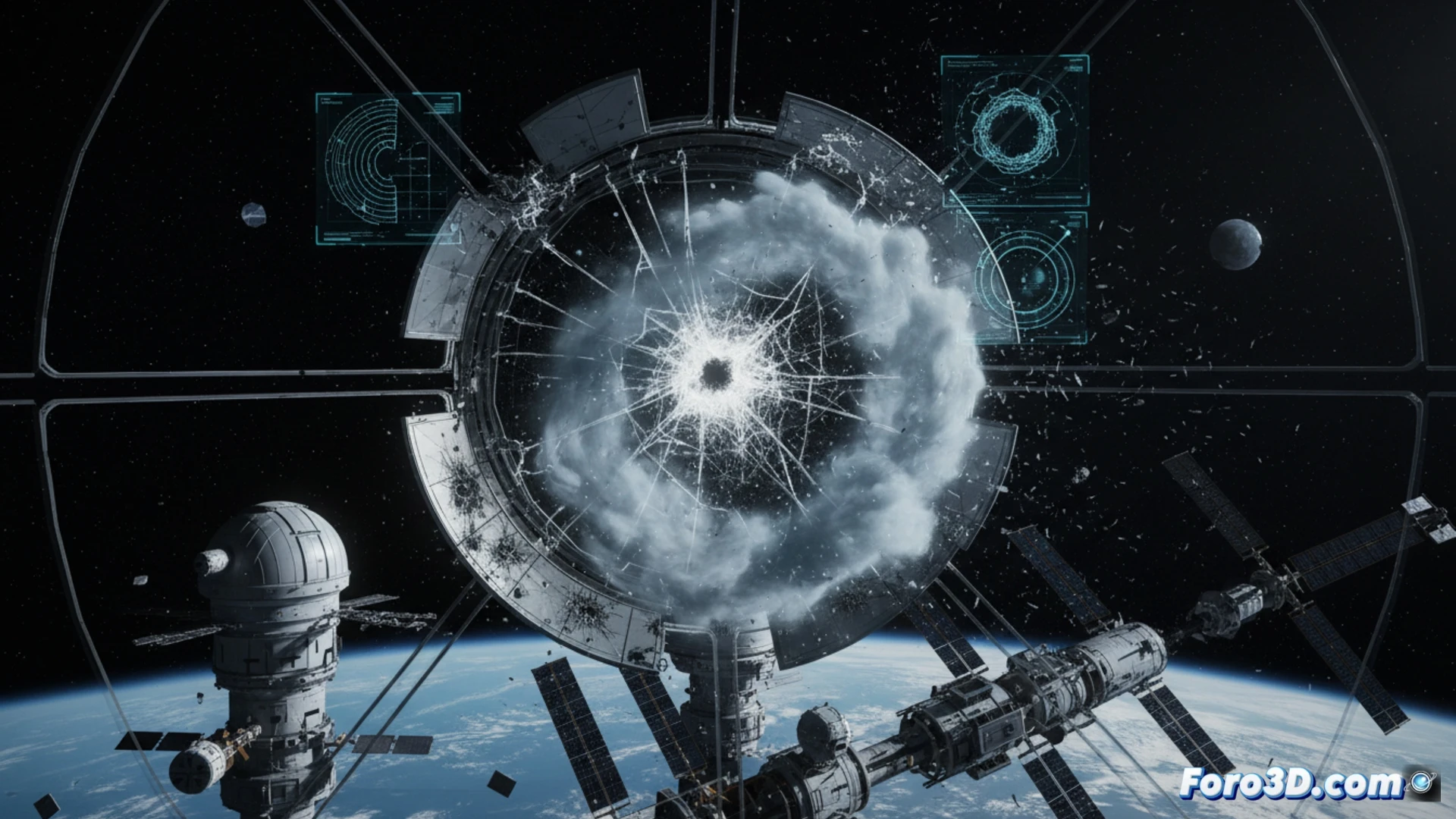
A micrometeorite impact has punctured the transparent polymer of a space station dome, overcoming the Whipple shield designed to fragment these projectiles. This event, occurring in a microgravity environment, represents a technical catastrophe requiring a detailed forensic analysis. 3D simulation tools allow for reconstructing the incident, evaluating the dynamics of depressurization, and proposing critical improvements to orbital window shielding.
Digital reconstruction and fluid dynamics in depressurization 🚀
Using Catia, the exact geometry of the dome and the Whipple shield system is modeled, including the transparent polymer and sacrificial metal layers. Damage analysis is performed in VGSTUDIO MAX, where tomographic data from the actual impact is imported to visualize the perforation and radial cracks in the polymer. The leak is simulated in Star-CCM+, solving compressible fluid dynamics under vacuum conditions. Results show a supersonic gas jet that depressurizes the module in seconds, validating the need for internal emergency barriers and redundant pressure sensors.
Lessons for orbital habitat design 🛡️
The simulation reveals that the Whipple shield, although effective against small particles, does not guarantee the integrity of fragile materials like transparent polymers subjected to high-velocity impacts. The integration of Catia and Star-CCM+ allows proposing a hybrid design: adding a second retractable polycarbonate layer and an active sealing system activated by micro-leak detection. This multidisciplinary approach is key to mitigating catastrophes in future long-duration missions.
What computational fluid dynamics (CFD) simulation parameters are critical for accurately modeling the depressurization rate and vortex formation in a leak caused by a micrometeorite in a transparent polymer space dome, considering radiation-induced material degradation and the effect of the external vacuum?
(PS: Simulating catastrophes is fun until the computer crashes and you are the catastrophe.)