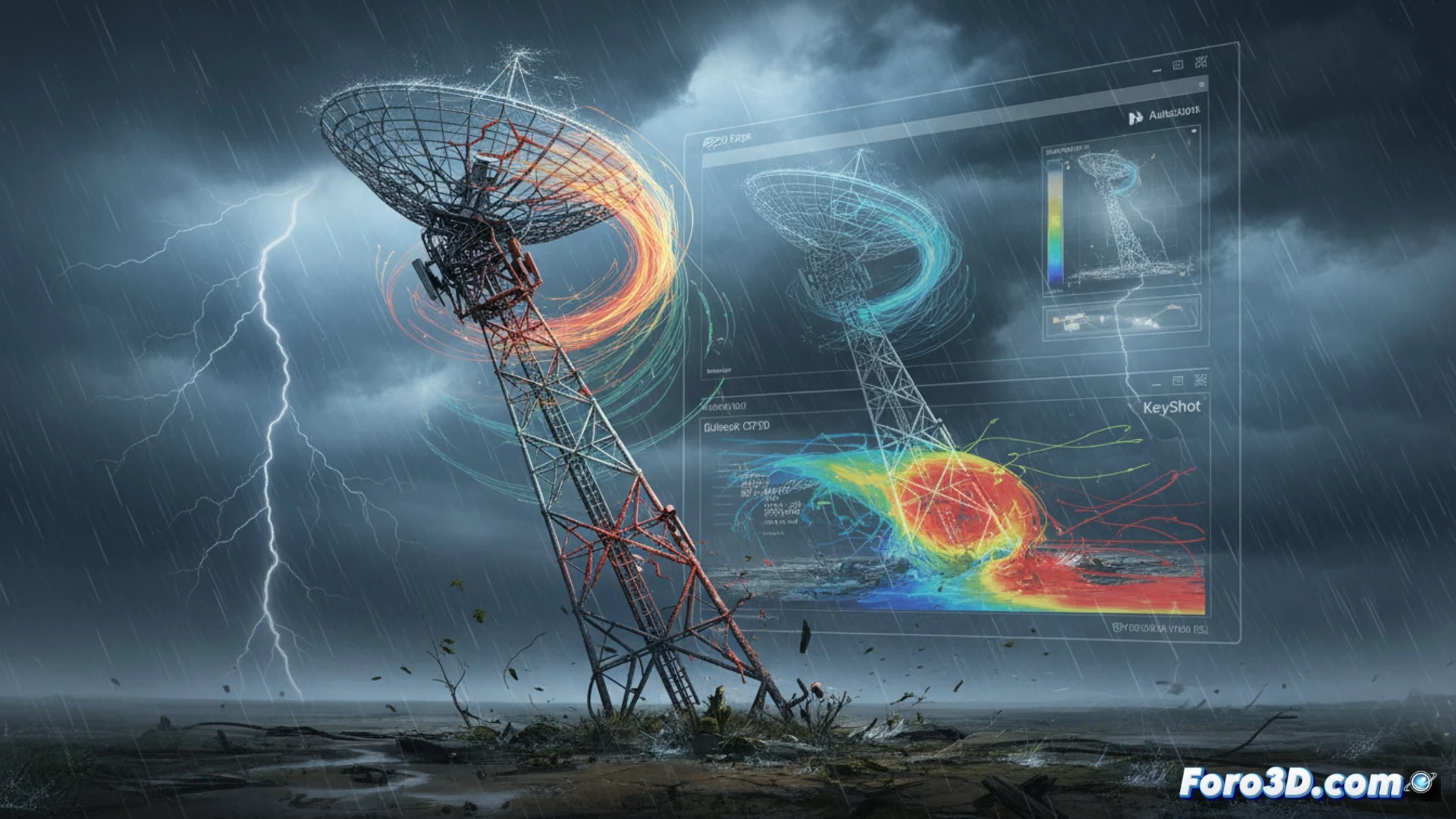
The overturning failure of a mobile surveillance tower during a storm revealed a critical design flaw: the antenna, acting as a sail, generated an overturning moment that exceeded the structure's stabilization capacity. This incident, analyzed through a workflow integrating Solid Edge, Autodesk CFD, and KeyShot, demonstrates how material fatigue simulation allows anticipating collapses in infrastructures exposed to extreme weather conditions, avoiding costly field failures.
Modeling of Wind Loads and Stress Analysis in Solid Edge and Autodesk CFD 🌪️
The process began in Solid Edge, where the complete geometry of the tower, including the large-surface antenna, was modeled. This model was exported to Autodesk CFD to simulate wind flow at storm speeds (120 km/h). The simulation revealed that the antenna generates a disproportionate drag force, concentrating stresses at the tower base and anchor points. The pressure data was imported back into Solid Edge for a finite element analysis, identifying the zones where the overturning moment exceeds the yield strength of the structural steel. Cyclic fatigue, induced by gusts, accelerates material degradation at these critical points.
Collapse Visualization and Lessons for Preventive Design 🛠️
KeyShot was used to generate renders and animations that visualize the progressive deformation and the exact point of collapse, facilitating communication of the failure among engineers. The main lesson is that antennas on mobile towers must be designed with wind relief systems or structural reinforcements calculated through fatigue simulation. Ignoring the sail effect in extreme conditions turns a functional design into an overturning risk. This case underscores the need to integrate fatigue analysis from the early design phases in Solid Edge, validated with CFD, to ensure safety in critical infrastructures.
Which finite element simulation methodology allows for more accurately modeling the effect of the antenna as a sail on the structural fatigue of the mobile tower during extreme wind conditions?
(PS: Material fatigue is like yours after 10 hours of simulation.)