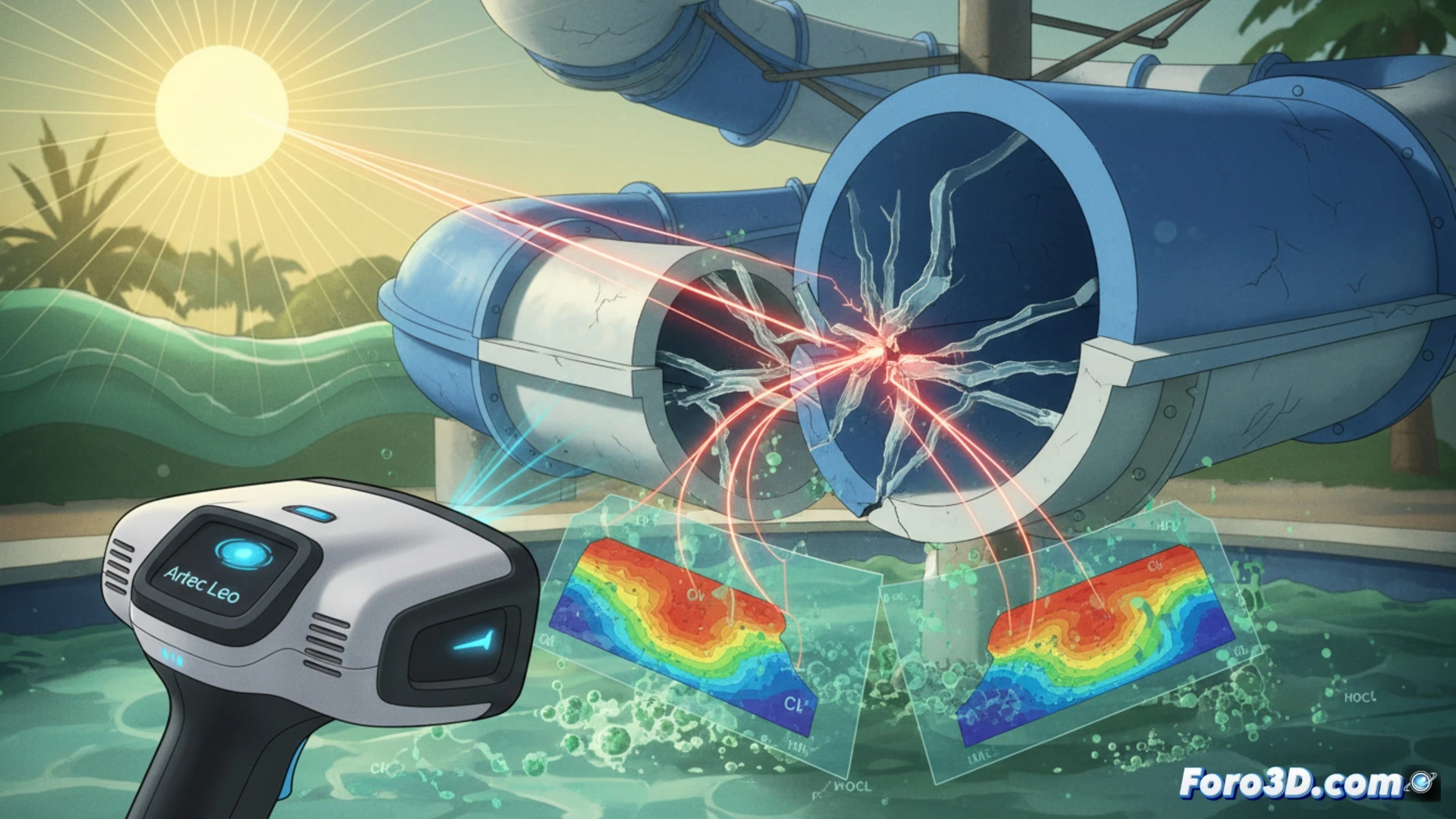
A tragic incident at a water park uncovered a critical vulnerability in leisure engineering: a section of a fiberglass slide detached during use, causing fatalities. The technical investigation went beyond visual inspection; 3D scanning with an Artec Leo was used to capture the microgeometry of the fracture, revealing a progressive fatigue failure. Subsequent analysis in Abaqus demonstrated that cyclic dynamic loading, combined with chemical degradation from chlorine and UV radiation, had exceeded the strength limits of the joints—a miscalculation in the original design.
Digital Reconstruction and Finite Element Analysis in Abaqus 🛠️
The forensic process began with digitizing the fracture zone using the Artec Leo scanner, which generated a high-resolution point cloud. This geometry was imported into Autodesk Fusion 360 to clean the mesh and reconstruct the contact surfaces between the fiberglass and steel supports. The solid model was transferred to Abaqus, where dynamic loading conditions simulating users of different weights and speeds were applied. The nonlinear simulation included degraded material properties: the resin's elastic modulus was reduced by 30% to emulate the effect of chlorine, and a UV fatigue coefficient was applied. The results showed that maximum stresses concentrated at the bolted joint, exceeding the fatigue strength limit at 50,000 cycles.
Visualizing Progressive Failure: Lessons for the Industry 🎥
To intuitively communicate the evolution of the failure, Abaqus data was exported to Unreal Engine, where a real-time visualization of progressive cracking was generated. The animation shows how microcracks, initiated by UV radiation, propagate under cyclic loading until catastrophic fracture. This case underscores that material fatigue cannot ignore environmental factors in leisure environments. The combination of high-precision 3D scanning and finite element simulation not only resolves the incident but establishes a predictive inspection protocol for water parks, where chlorine and sun are silent enemies of structural integrity.
How can engineers accurately model the synergistic effect of chlorine exposure and ultraviolet radiation on the fatigue of polymeric materials used in water slides to predict their actual service life?
(PS: Material fatigue is like yours after 10 hours of simulation.)