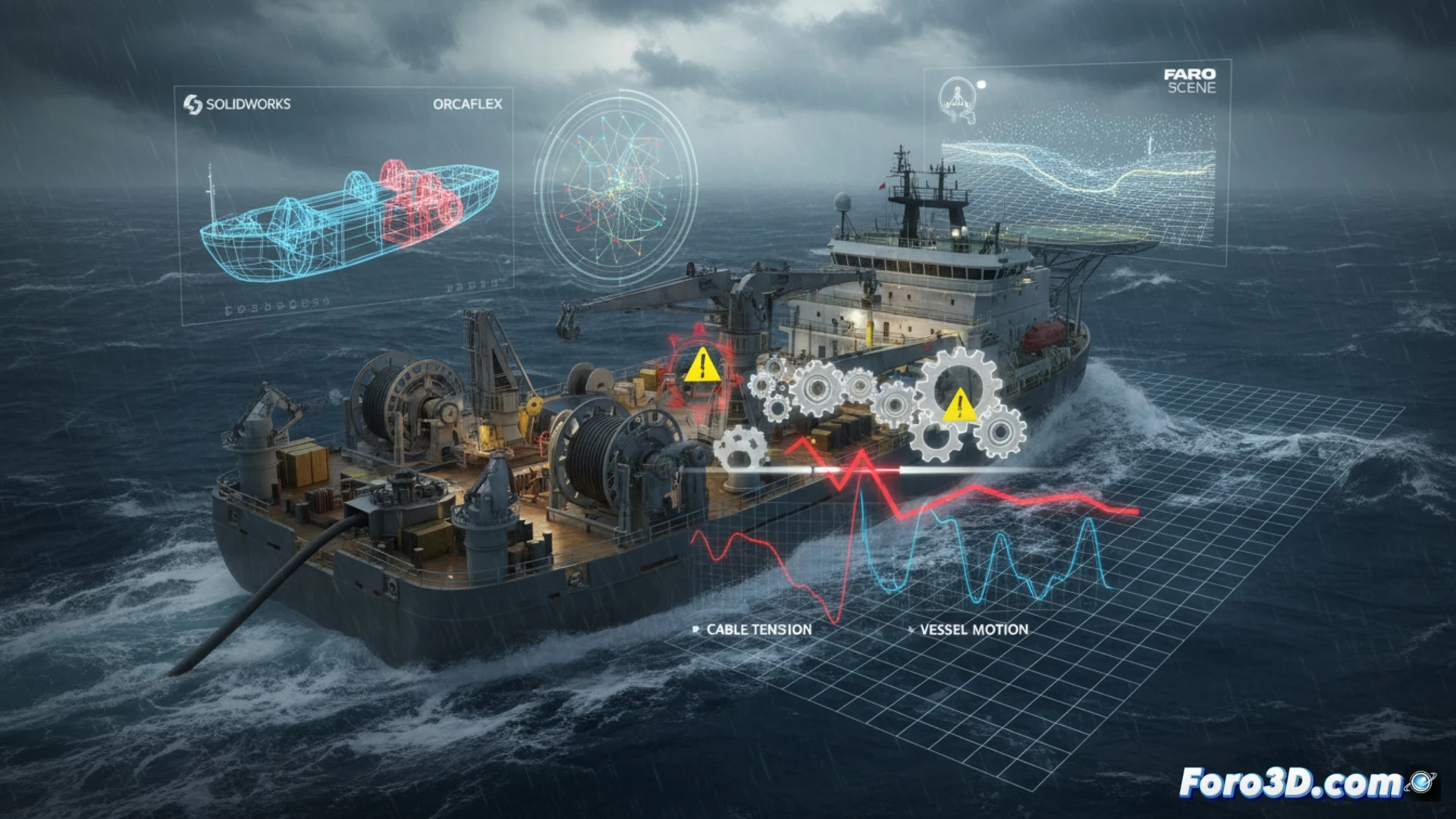
The submarine cable laying industry faces a critical challenge: synchronizing cable tension with vessel motion induced by wave action. A recent failure in a dynamic compensation system has highlighted the need to employ advanced simulation tools to predict these events. In this article, we analyze how the combination of OrcaFlex for marine dynamics, SolidWorks for mechanical design, and FARO Scene for 3D scanning enables modeling and preventing synchronization failures in hostile ocean environments. 🌊
Modeling Critical Interactions with OrcaFlex and SolidWorks ⚙️
To understand the failure, the scenario was recreated in OrcaFlex, software specialized in line dynamics and marine systems. The model included the vessel geometry, cable properties, and an irregular wave spectrum. Results showed that under 3-meter wave conditions, the vessel's vertical acceleration exceeded the hydraulic compensator's response capacity, generating tension peaks up to 40% above the operational limit. Concurrently, SolidWorks was used to redesign the pulley and actuator system, incorporating a finite element model that validated the necessary stiffness to absorb such impacts without plastic deformation.
Validation through Laser Scanning and Lessons Learned 🔍
The final step was verifying the virtual model using FARO Scene. The vessel deck and the actual compensation system were scanned to compare structural deformations with simulated ones. The analysis revealed a 2.3% deviation at the anchor points, attributable to fatigue not initially modeled. This discrepancy allowed adjusting the damping parameters in OrcaFlex, achieving an accurate failure prediction. The lesson is clear: integrated simulation, validated with real data, not only anticipates failures but also guides redesign towards more robust systems for offshore cable laying.
As a simulation engineer, which predictive modeling techniques do you consider most effective for anticipating failures in the dynamic compensation of cable-laying vessels under extreme wave conditions, and how would you validate these models with real operational data?
(PS: Simulating industrial processes is like watching an ant in a maze, but more expensive.)