A patient suffered third-degree burns during a tattoo removal session, an incident initially attributed to human error. However, a forensic investigation using 3D technologies has changed the diagnosis. Using a segmented model of the patient's skin obtained by CT scan and advanced optical simulation, it was discovered that the real cause was a mechanical defect in the laser handpiece, not operator negligence.
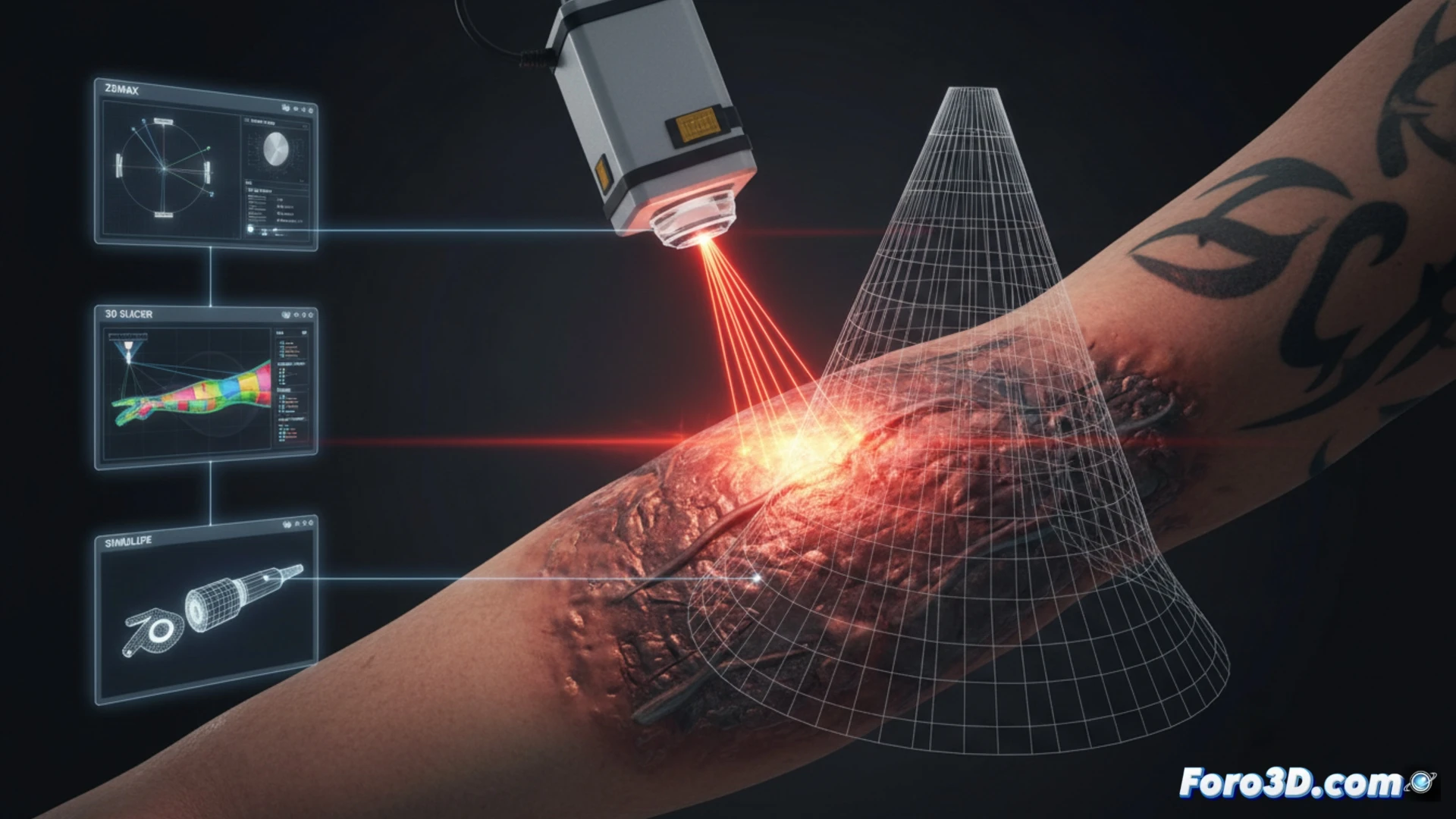
Forensic workflow: from CT scan to optics in Zemax 🔬
The forensic team digitized the patient's anatomy using 3D Slicer to segment the skin layers, tattoo ink, and blood vessels from CT images. This digital twin was imported into SimuLife to simulate thermal interaction. In parallel, the laser's optical system was reconstructed in Zemax. The analysis showed that a misaligned lens in the handpiece deflected the beam, concentrating energy into a focal point only 0.2 mm in diameter. This multiplied the power density tenfold, exceeding the dermal damage threshold and causing tissue necrosis. Blender was used to visualize the beam path and impact zone, creating an animation that served as expert evidence.
Lessons for safety in aesthetic treatments ⚠️
This case demonstrates that medical equipment validation cannot rely solely on standard calibrations. Integrating patient digital twins and 3D optical simulations allows detecting failures invisible to the human eye, such as a misaligned lens. For the 3D biomedicine industry, this workflow becomes a mandatory tool: before applying a laser, software should predict energy distribution on the actual skin model. This prevents accidents and protects both the patient and the professional.
What role does 3D simulation play in identifying optical failures in laser devices for tattoo removal procedures and how can it prevent future third-degree burns?
(PS: If you 3D print a heart, make sure it beats... or at least doesn't cause copyright issues.)