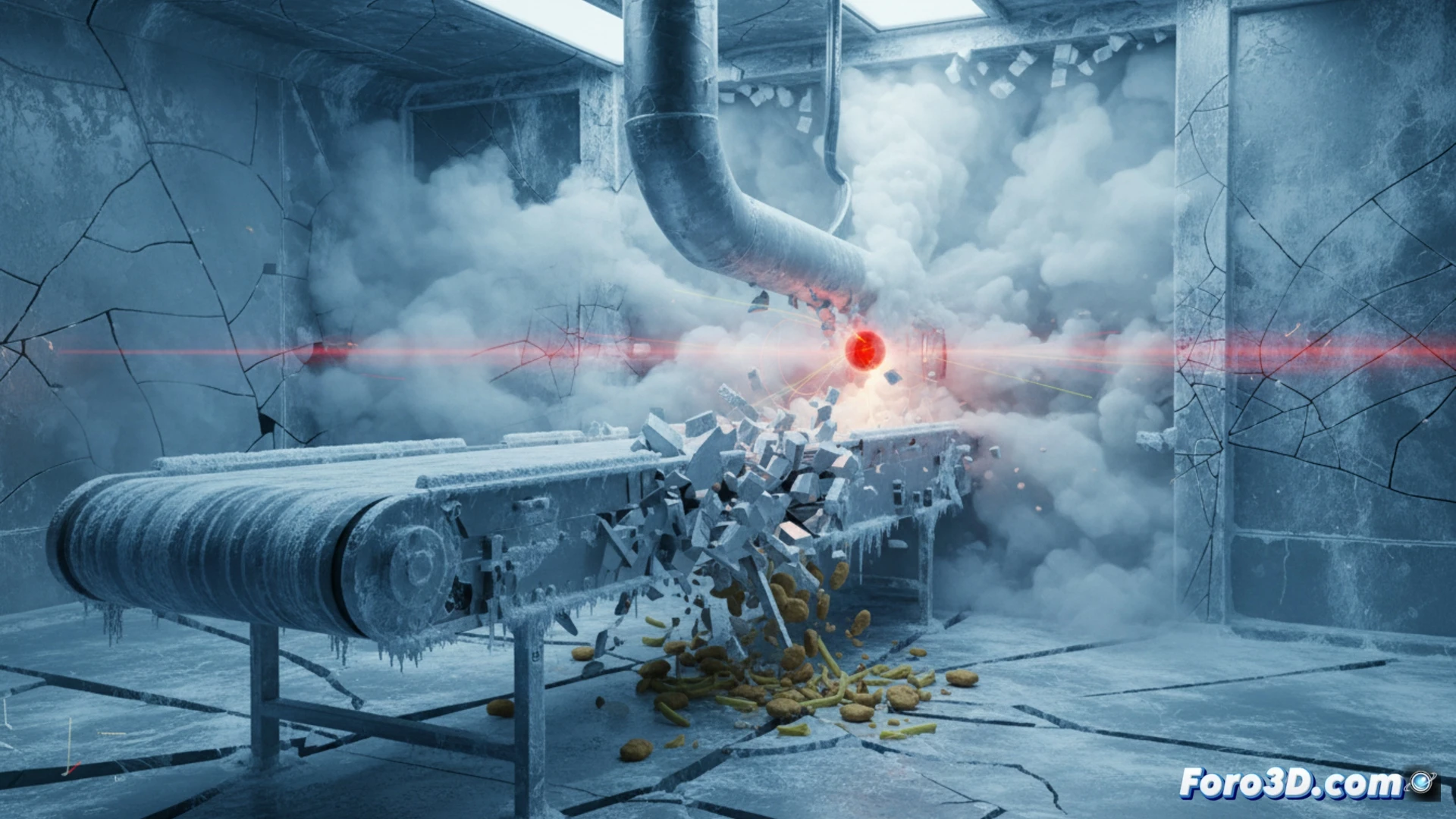
A liquid nitrogen leak in an industrial freezing tunnel caused the catastrophic rupture of the conveyor belt. The metal, upon contact with the cryogenic fluid at -196 degrees Celsius, underwent a process of instantaneous embrittlement. The food processing plant halted its production. The forensic engineering team turned to 3D reconstruction and thermal simulation to discover the exact origin of the failure.
Mapping the thermal gradient with Autodesk CFD and Revit 🔥
The analysis began with capturing thermal data using FLIR Tools 3D, generating a point cloud with surface temperatures. This model was imported into Revit to reconstruct the geometry of the tunnel and the damaged vacuum pipe. Subsequently, a simulation was run in Autodesk CFD using the operating conditions prior to the accident. The software calculated the thermal gradient distribution, identifying a critical point where the temperature dropped sharply from -50 to -190 degrees Celsius in less than 30 centimeters of pipe. This anomaly coincided with a microcrack in the vacuum insulation, allowing the liquid nitrogen to escape.
Lessons from the digital twin for disaster prevention 🛠️
The digital twin of the tunnel allowed recreating the exact scenario of the catastrophe without risk to operators. The embrittlement of the stainless steel, caused by thermal shock, was visualized in the fracture animation. This case demonstrates that CFD simulation not only locates hidden leaks but also predicts risk zones in cryogenic pipes. Implementing continuous thermal monitoring with 3D sensors in food plants could prevent future ruptures and save lives.
In the 3D simulation of the cryogenic leak, which thermal and structural parameters were critical to predict the exact fracture point on the conveyor belt of the freezing tunnel?
(PS: Simulating catastrophes is fun until the computer melts down and you are the catastrophe.)