Operating a refinery involves facing explosions, benzene leaks, H2S gas, and confined spaces on a daily basis. Traditional training with manuals or videos does not prepare the operator for decision-making under pressure. This is where 3D process simulation changes the game, allowing critical scenarios to be recreated without exposing anyone to real danger.
Digital twins as a prevention tool 🛡️
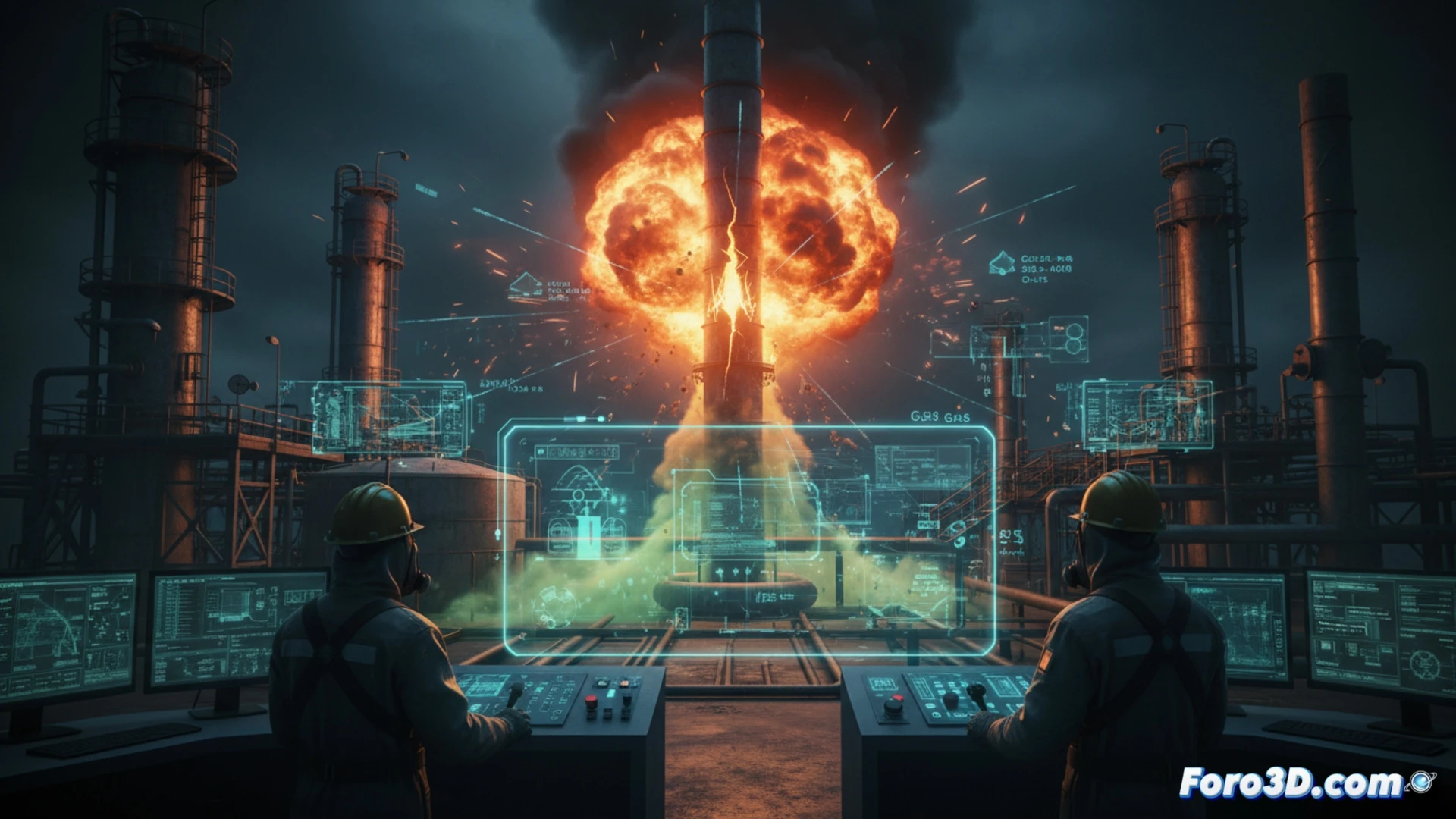
A digital twin of a catalytic cracking unit allows modeling the dispersion of an H2S leak or the propagation of a flame after ignition. The operator can practice emergency shutdown protocols, evaluate evacuation routes, and manage operational stress in an immersive environment. The simulation also quantifies exposure to vibrations and noise, helping to redesign work areas. All of this reduces accidents and costs associated with unplanned shutdowns.
When a mistake in the simulator saves real lives 🚨
The great advantage of the simulator is allowing mistakes without consequences. An operator can open a valve at the wrong time and cause a virtual explosion, learning the lesson without harm. Integrating these risks into continuous training transforms the safety culture, making each worker recognize the process limits before stepping foot on the actual plant.
Is it possible to accurately simulate an explosion in 3D so that an operator learns to react in real time without the failure in the simulation generating a false sense of security?
(PS: Simulating industrial processes is like watching an ant in a maze, but more expensive.)