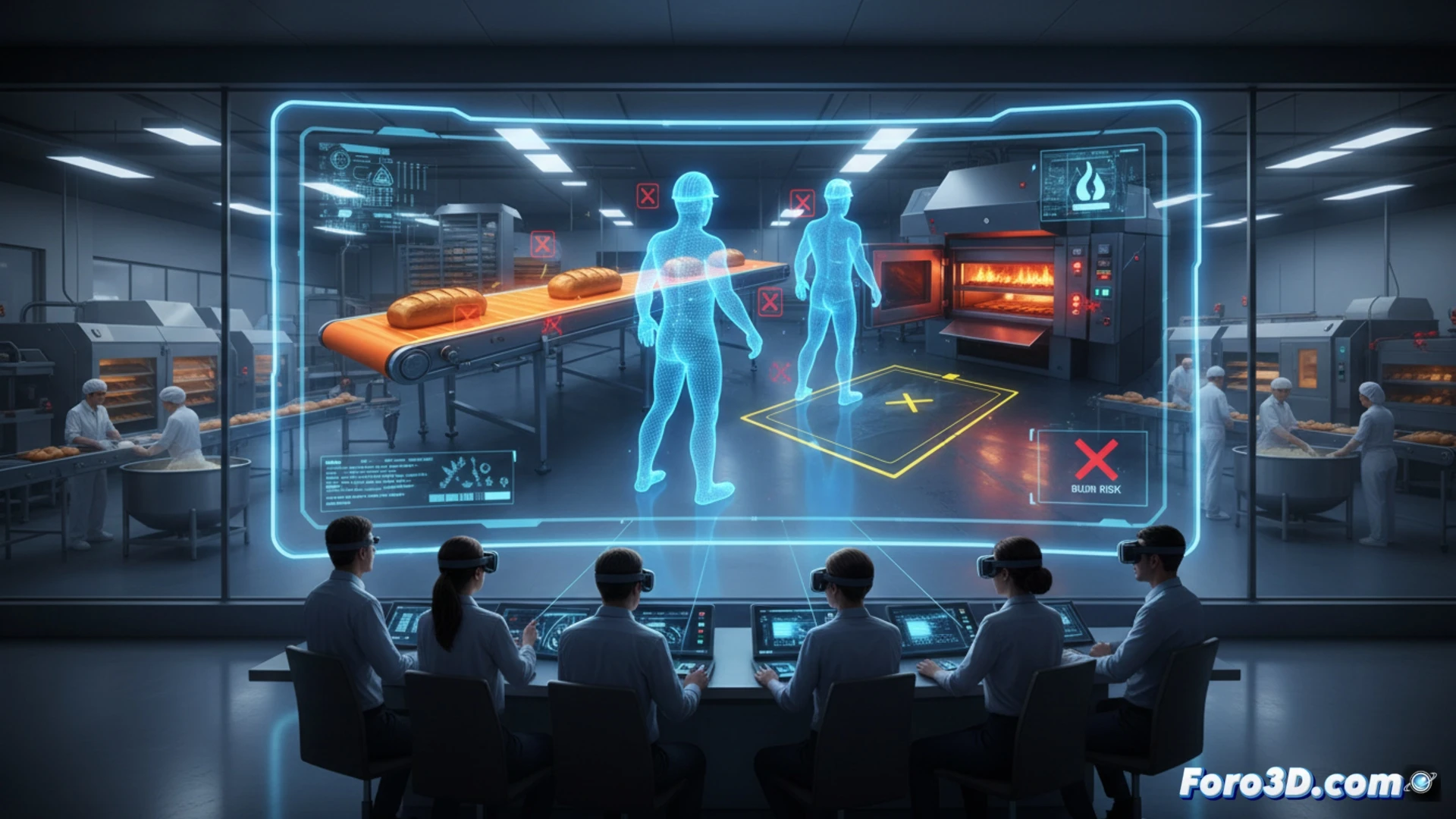
The baker's trade presents multiple physical and respiratory risks that are often underestimated in industrial environments. From burns from contact with hot trays to entrapment in dough mixers or falls on floury floors, each task carries a specific danger. 3D process simulation allows recreating these scenarios with high fidelity, offering a training and redesign tool that reduces accident rates without exposing the actual worker.
Risk modeling and workflow validation 🔧
A digital twin of an industrial bakery can integrate variables such as the surface temperature of ovens, the kinematics of rotary dough mixers, and the reduced friction of floors with flour residue. Through rigid body and particle dynamics simulations, it is possible to visualize entrapment in gears, predict trajectories of hot dough splashes, and calculate the forces exerted on the lumbar spine when handling 25 kg bags. This data allows adjusting safety distances, designing virtual physical barriers, and optimizing work cadence to avoid overexertion, all validated before implementing changes on the actual line.
Towards an immersive prevention culture 🥽
3D simulation not only identifies blind spots in the current design but also transforms training into an active experience. A worker can practice removing trays from the oven with virtual gloves or learn to position their body in front of a dough mixer without the risk of entrapment. This methodology reduces adaptation time and decreases the incidence of respiratory allergies by modeling the dispersion of flour dust in the environment. By integrating simulation into safety protocols, the baker's trade gains in ergonomics, health, and efficiency.
How the dispersion of flour in the environment of an industrial bakery can be modeled in 3D to assess the risk of dust explosion and design more effective ventilation systems.
(PS: Simulating industrial processes is like watching an ant in a maze, but more expensive.)