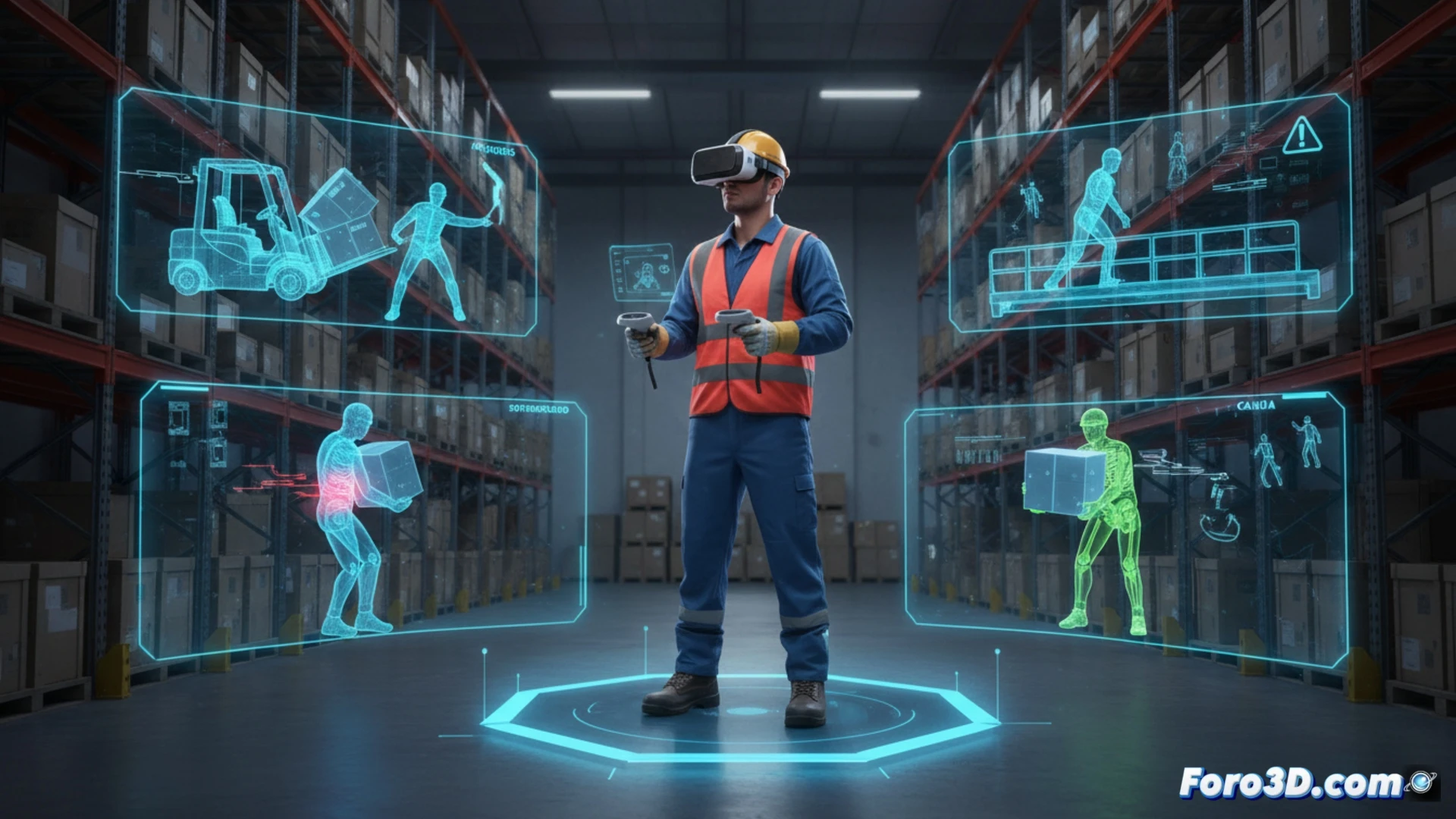
Occupational risk prevention in logistics no longer depends solely on paper manuals. For the warehouse worker, the dangers are constant: falls from shelving, being run over by forklifts, and overexertion when handling loads. 3D simulation allows these scenarios to be recreated with total realism, offering an immersive training tool that anticipates accidents and trains reflexes without exposing the worker to real danger.
Digital twin for dynamic risk analysis 🏭
Modeling a warehouse in 3D allows visualizing critical points that often go unnoticed in a 2D plan. For example, the trajectory of a forklift can be simulated to identify blind spots, or the exact height of a shelving unit where a worker could suffer a fall can be calculated. Simulation technology allows adjusting variables such as lighting, vehicle speed, and load weight, generating concrete data on the risk of entrapment or cutting. This turns the digital twin into a virtual laboratory where safety protocols can be tested before implementing them in the real world.
Immersive training: from risk to safe habit 🎯
The key to reducing accidents lies not only in identifying hazards but also in internalizing preventive behaviors. Through virtual environments, the warehouse worker can practice correct postures to avoid overexertion, learn to navigate safe aisles, and react to falling objects. This controlled repetition in 3D transforms theory into a muscle habit, drastically reducing accident rates due to forced postures and impacts. Simulation does not replace supervision, but complements it with a layer of active and measurable prevention.
As a warehouse worker, what invisible dangers that traditional manuals overlook does a 3D simulation reveal before they turn into real accidents?
(PS: at Foro3D we optimize routes like we optimize polygons: until the computer says stop)