The profession of a seamstress presents critical occupational risks: punctures, cuts, forced postures in the neck and back, eye strain, repetitive movements in the wrists, falls due to objects on the floor, and exposure to textile dust. In the 3D Fashion and Textiles sector, virtual simulation allows us to anticipate these dangers. Through digital twins of the workplace, we can model the operator's ergonomics, identify points of tension, and redesign the environment before an actual injury occurs.
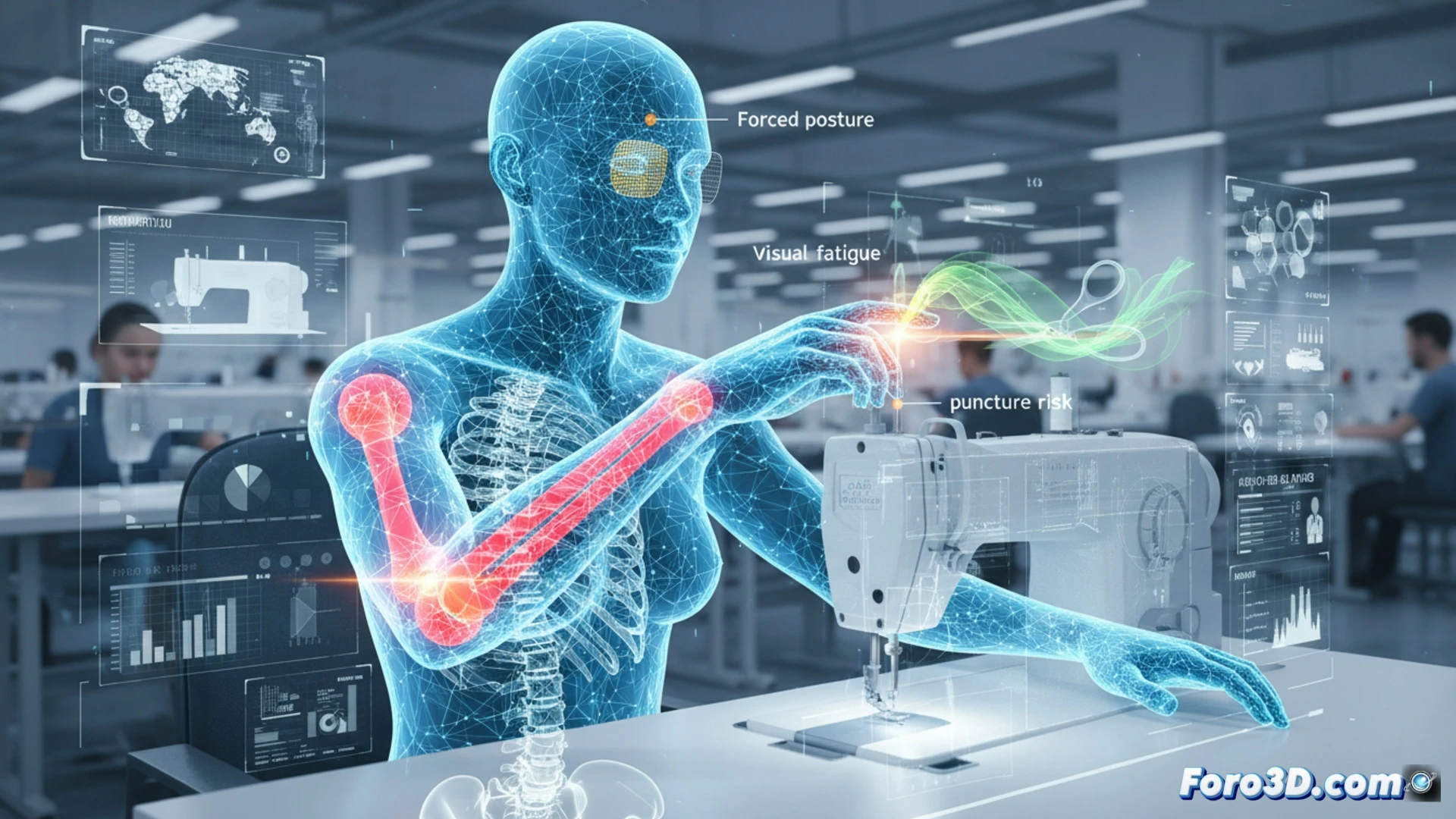
Ergonomic analysis through digital twins 🧵
3D simulation of postures and repetitive movements is key to assessing risks in the neck, back, and wrists. By importing the seamstress's anthropometric and kinematic data into modeling software, joint angles and cumulative loads are visualized. This allows adjusting the table height, seat angle, and sewing machine position. Additionally, the digital twin of the workspace optimizes the arrangement of fabrics and tools, reducing the risk of falls due to objects on the floor. Exposure to textile dust is also modeled using virtual particles, facilitating the placement of localized extraction systems.
Towards safer and more efficient garment manufacturing 🪡
3D technology not only improves productivity but also humanizes the seamstress's work. By integrating simulations of eye strain and forced postures into workstation design, chronic pathologies such as tendinitis or lower back pain are avoided. The textile sector must adopt these digital twins as a mandatory prevention tool. Investing in virtual ergonomics is investing in talent: a healthy seamstress is a more creative and precise seamstress. 3D fashion is not the future; it is the present solution for an essential craft.
How can 3D simulation be applied in the textile industry to model and redesign seamstress workstations, reducing the repetitive movements and forced postures that cause chronic neck and back injuries?
(PS: Designing fashion in 3D has the advantage that you never have to sew a button.)