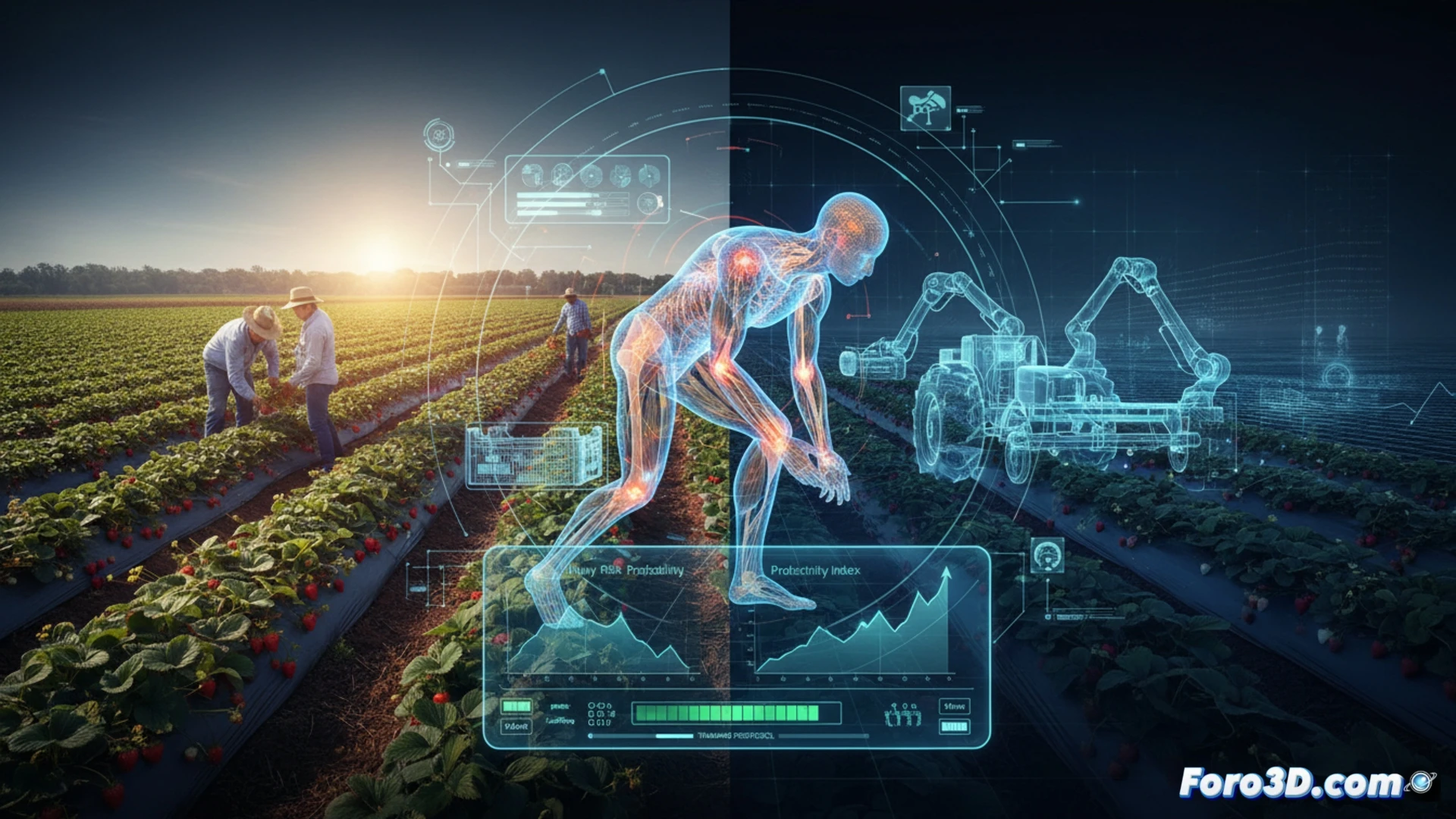
Agricultural harvesting is one of the activities with the highest rate of workplace accidents. Forced postures, repetitive movements, handling heavy loads, and exposure to phytosanitary products are just some of the daily dangers. Process simulation allows for digitally modeling these conditions to analyze the worker's biomechanics and design more effective safety protocols, reducing injuries and improving productivity in the field.
Modeling specific risks in virtual environments 🌾
To replicate the reality of the harvester, the simulator must integrate uneven terrain, extreme weather conditions, and the ergonomics of hand tools. Through motion capture and biomechanical analysis software, loads on the lumbar spine during repetitive bending or the risk of cuts when handling stems can be evaluated. The simulation also allows recreating pesticide drift under different wind conditions, anticipating dermal and respiratory exposure. This quantitative approach transforms prevention from a qualitative analysis to a data-driven predictive model.
Virtual training and workstation optimization 🚜
Beyond analysis, 3D simulation offers a safe laboratory for training. Workers can practice correct postures, load lifting techniques, and the use of protective equipment in an immersive environment without real risks. At the same time, process engineers can redesign harvesting stations, adjusting the height of furrows or the frequency of breaks, validating improvements before implementing them in the field. This not only saves lives but also optimizes the operational efficiency of the agricultural cycle.
How can 3D simulation predict and reduce musculoskeletal injuries caused by forced postures and repetitive movements in agricultural harvesting?
(PS: Simulating industrial processes is like watching an ant in a maze, but more expensive.)