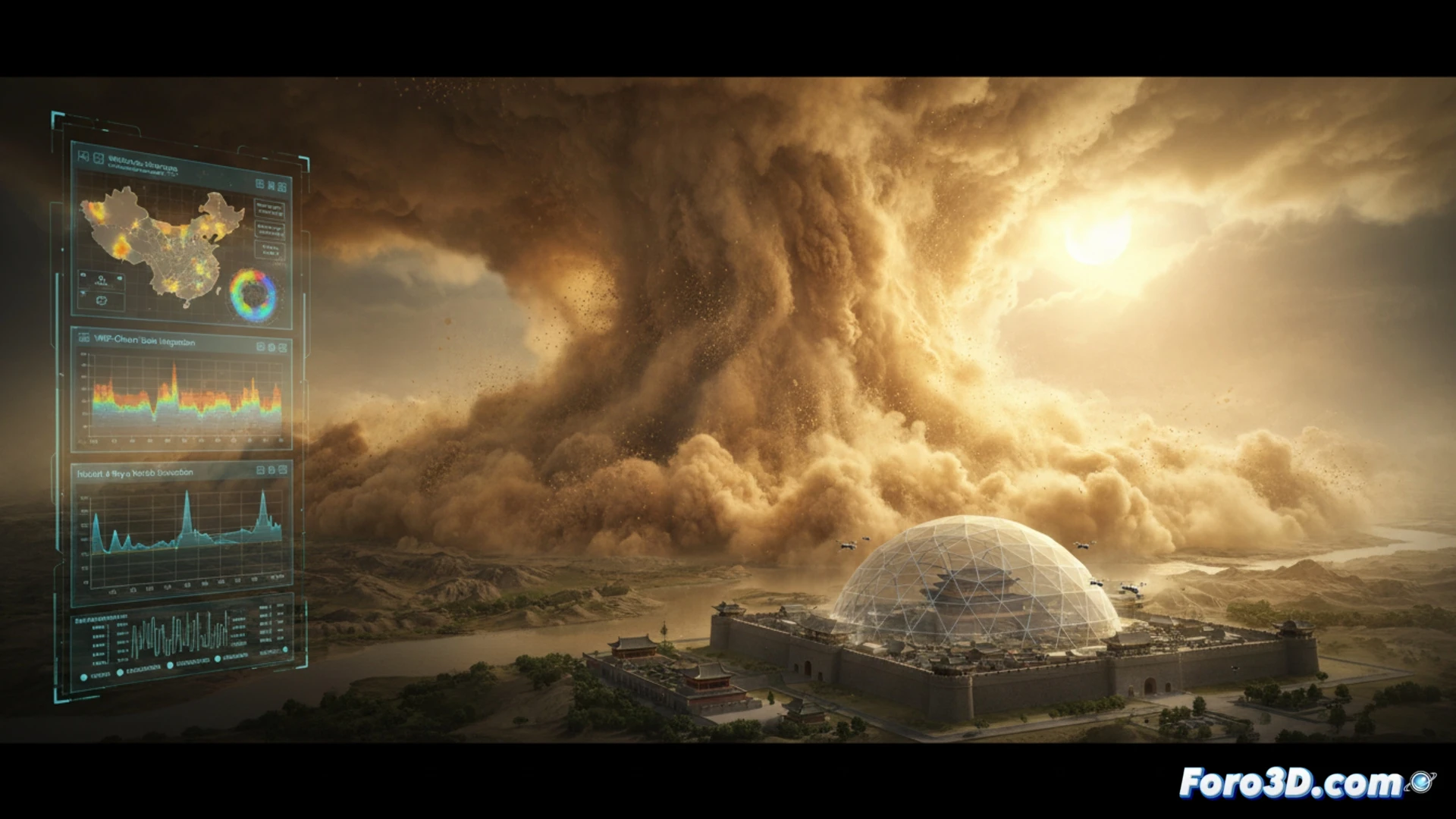
Every spring, northern China faces the Yellow Wind of Huanghe, a massive dust storm that turns the sky ochre and reduces visibility to zero. This phenomenon, capable of depositing sediment thousands of kilometers away, is not only a natural disaster but also a technical challenge for digital simulation. In this article, we break down the professional pipeline for recreating this event, combining meteorological data from WRF-Chem with the power of particles in Houdini and Maya, aimed at disaster prevention.
Technical Pipeline: From WRF-Chem to Houdini and Maya 🌪️
The process begins with WRF-Chem, an air quality model that provides real-time data on wind speed, PM10 particle concentration, and atmospheric pressure during the storm. This data is exported as NetCDF files and imported into Houdini using custom VEX nodes. In Houdini, a massive particle system is generated using the POP solver, where each particle represents a grain of sediment. Turbulence and directional wind forces are applied to replicate the advance of the ochre cloud. Finally, Maya is used for volumetric rendering with Arnold, adjusting smoke density and light scattering to achieve the zero-visibility effect. The key is synchronizing the real disaster's timescale with the simulation, allowing the prediction of the dust's trajectory.
Impact on Disaster Prevention 🛡️
Beyond visual realism, this simulation has a critical purpose: disaster preparedness. By modeling visibility reduction and sediment deposition, emergency teams can identify risk zones and plan evacuation routes. Integrating meteorological data into 3D environments enables the generation of real-time response scenarios, optimizing resources to protect the population. The Yellow Wind is no longer just a natural phenomenon; it is a case study for technical simulation applied to human safety.
Is it possible to model in 3D the interaction between Huanghe loess particles and atmospheric jet streams to predict the trajectory and density of a Yellow Wind storm in real time?
(PS: Simulating disasters is fun until your computer crashes and you become the disaster.)