The Superbolt, or Superbolt, represents a meteorological phenomenon of extreme energy, up to a thousand times more powerful than a conventional lightning bolt. Detectable over great distances, its frequency is notably higher over the Atlantic and Pacific Oceans. For technical artists and scientists, modeling this event requires a multidisciplinary approach that combines fluid simulation, particle dynamics, and geospatial data analysis.
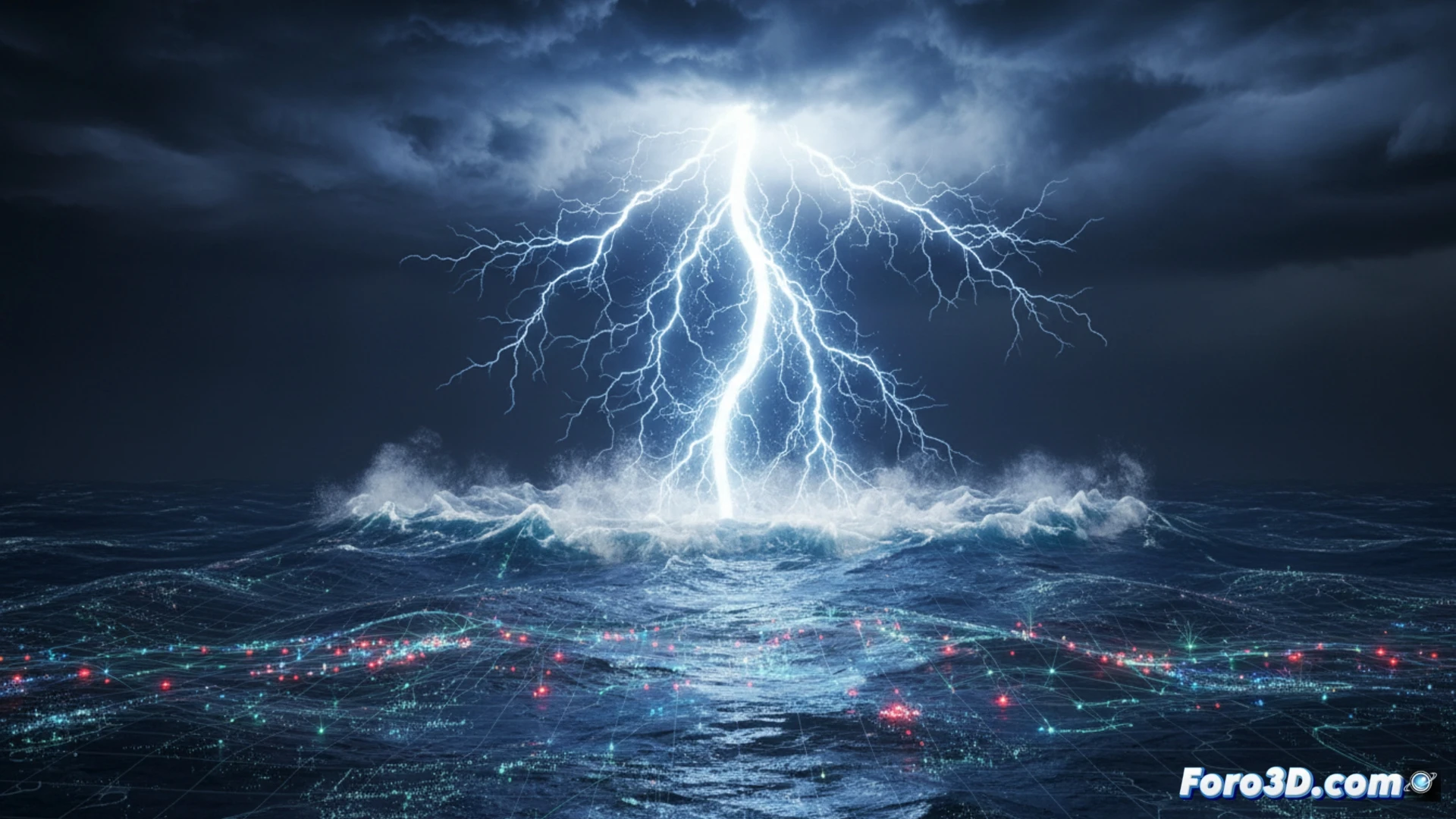
Technical Modeling: Houdini VEX, Maya Fluids, and MATLAB ⚡
In Houdini, the generation of the main discharge is approached using VEX and the Lightning system. A base curve is created that follows a fractal path, to which secondary branches are applied using procedural noise algorithms. For the oceanic atmosphere, Maya Fluids simulates air ionization, generating clouds of variable density that affect the visibility of the lightning. Finally, MATLAB processes frequency location data from GOES-16, allowing the mapping of the geographic distribution of Superbolts and calibrating the light intensity of the simulation to match the real detected energy.
Comparative Visualization and Science Communication 🌊
The key to the project lies in comparative visualization. By overlaying MATLAB data onto the Houdini render, heat maps can be created showing the concentration of Superbolts in the North Atlantic. Using Maya Fluids for the environment allows contextualizing the scale of the phenomenon. This methodology not only produces striking images for science communication but also helps researchers validate atmospheric models, demonstrating that the boundary between VFX and science is increasingly blurred.
What real-time fluid and particle simulation techniques can be combined with scientific superbolt lightning data to generate a visually credible electrified ocean without sacrificing physical rigor on Foro3D.com?
(PS: fluid physics for simulating the ocean is like the sea: unpredictable and you always run out of RAM)