On June 15, 1960, residents of Kopperl, Texas, experienced an unprecedented weather phenomenon: a nocturnal heat burst that raised the ambient temperature to 60 degrees Celsius in seconds. Attributed to extreme adiabatic compression generated by a dissipating storm, this event has been studied to understand the limits of atmospheric thermodynamics. Today, thanks to tools like ANSYS Fluent, MATLAB, and Houdini, we can digitally reconstruct this event and analyze its physical mechanisms.
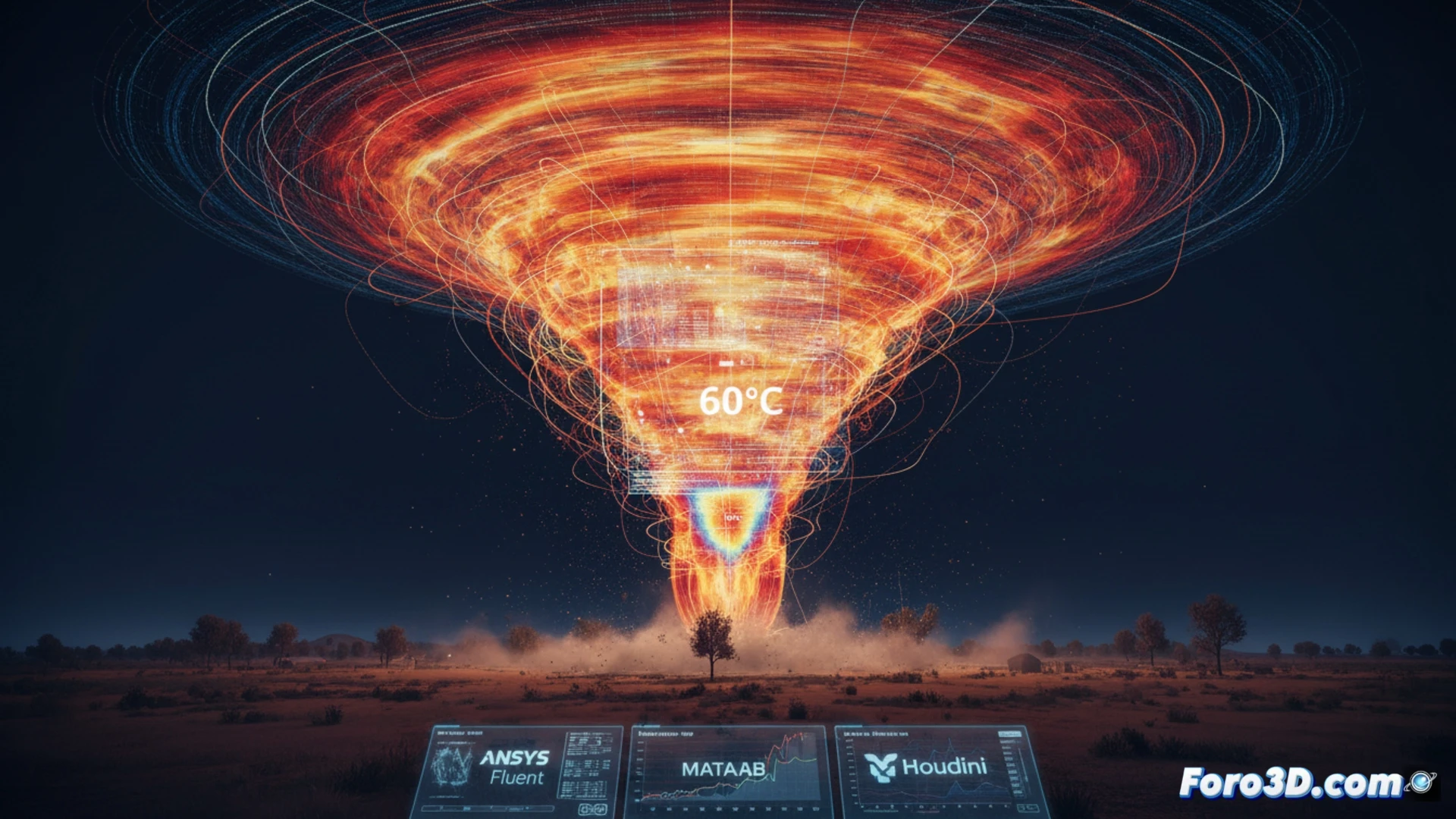
Thermal modeling with ANSYS Fluent and propagation in Houdini 🔥
To recreate the phenomenon, a simulation domain is set up in ANSYS Fluent representing the descending air column of the dissipating storm. Initial pressure and temperature boundary conditions typical of a mature storm cloud are applied, and the adiabatic compression model is activated. The results show a localized thermal increase of up to 60 degrees Celsius at the surface, validating the original hypothesis. Subsequently, the temperature and heat flux data are exported to Houdini, where a volumetric visualization of the thermal front propagating over the Kopperl terrain is generated, allowing observation of the event's spatial dynamics.
Lessons for climate catastrophe prevention 🌍
The 3D reconstruction of the Kopperl heat burst demonstrates that extreme phenomena can originate from seemingly harmless storms in their final phase. Integrating adiabatic compression simulations into early warning systems would allow for real-time identification of risk patterns. By combining the precision of ANSYS Fluent with the visual capability of Houdini, engineers and meteorologists can design more effective response protocols, safeguarding communities against similar events that, although rare, are potentially lethal.
Considering the lack of precise meteorological data from 1960, what adiabatic compression and computational fluid dynamics parameters could be adjusted in a 3D simulation to reproduce the sudden surface temperature increase described by witnesses in Kopperl without generating unrealistic visual artifacts?
(PS: Simulating catastrophes is fun until your computer melts down and you are the catastrophe.)