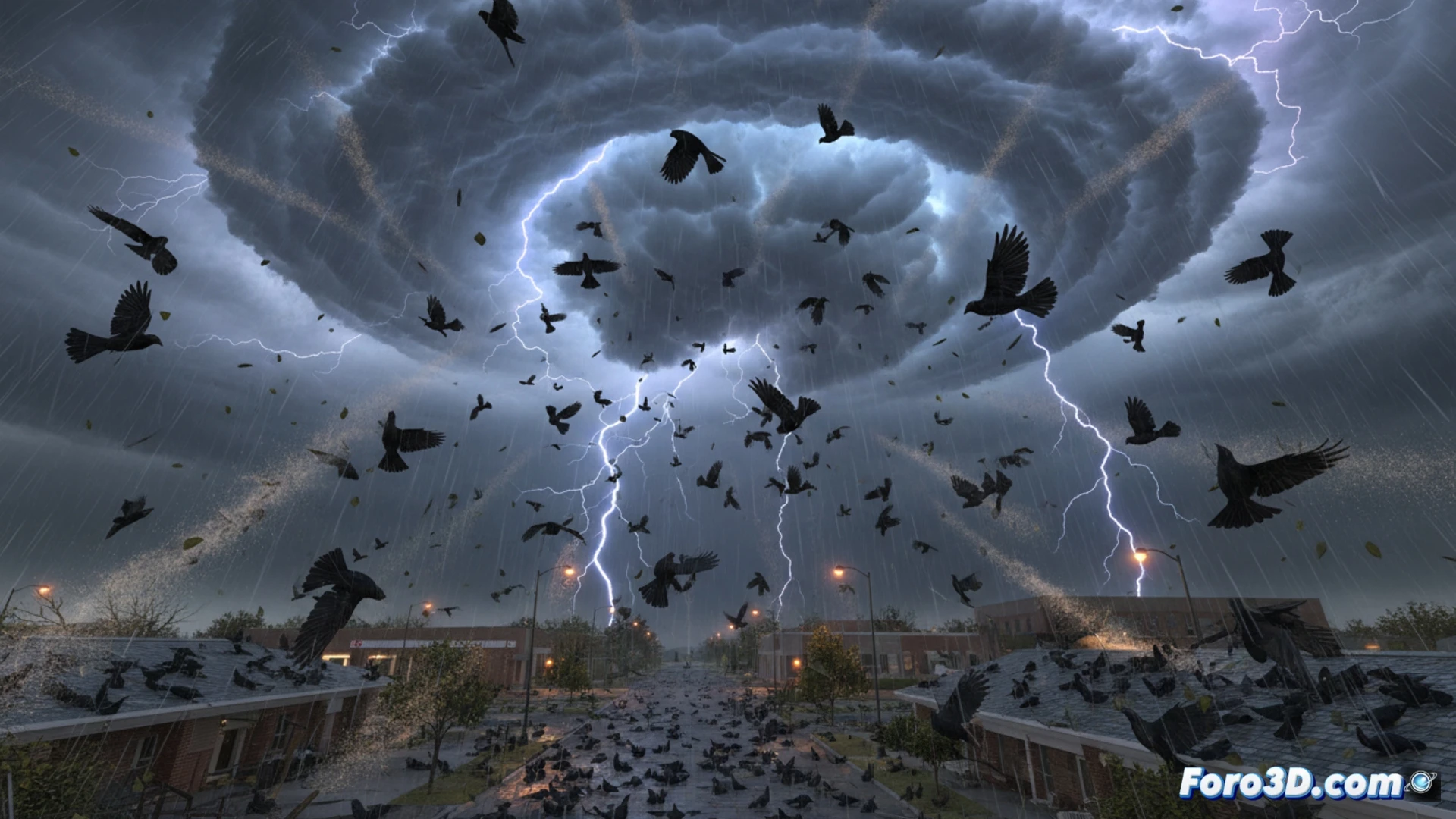
On December 31, 2010, the town of Beebe, Arkansas, was the scene of a chilling event: thousands of red-winged blackbirds fell dead from the sky in a matter of minutes. Investigations pointed to a thunderstorm as the cause, disorienting the birds until they crashed into the ground. This phenomenon, far from being a legend, becomes a perfect case study for 3D disaster simulation, where particle physics and agent behavior can replicate the chaotic aerial stampede.
Technical Workflow: From Houdini to Maya and Blender 🛠️
To recreate the event, the workflow begins in Houdini, using its crowd/agent simulation module. Individual agents (blackbirds) are modeled with velocity and orientation attributes. The key factor is disorientation: a vector noise field is applied to simulate the electromagnetic pulse of a lightning strike, canceling group cohesion. Trajectories become chaotic, and through collisions with a ground plane, impacts are recorded. Position and rotation data are exported as Alembic files. In Maya, wing-flap animations are refined, and feather dynamics are added. Finally, Blender handles the final rendering and compositing, integrating storm light effects and rain particles to contextualize the scene.
Technical Lessons and Parallels with Reality 🧠
The simulation reveals a fascinating fact: the fall rate of the virtual agents matches field reports from Beebe, where most blackbirds impacted within a 200-meter radius. This exercise not only demonstrates Houdini's ability to model biological behaviors under environmental stress but also offers a visual tool for disaster prevention. By adjusting parameters such as electric field intensity or flock density, technicians can predict collision patterns and assess risks to urban infrastructure or air routes.
How can the 3D simulation of the mass blackbird fall in Beebe help model extreme weather patterns and predict similar environmental catastrophes?
(PS: Simulating disasters is fun until your computer crashes and you become the disaster.)