The exponential increase in unmanned flights has opened a new front in disaster management. We analyze, through 3D simulation, the kinetics of a drone collision against vulnerable infrastructures such as commercial aircraft, power towers, and building facades. We model fragment dispersion and structural damage to predict realistic collision scenarios, assessing risk based on the device's mass and speed.
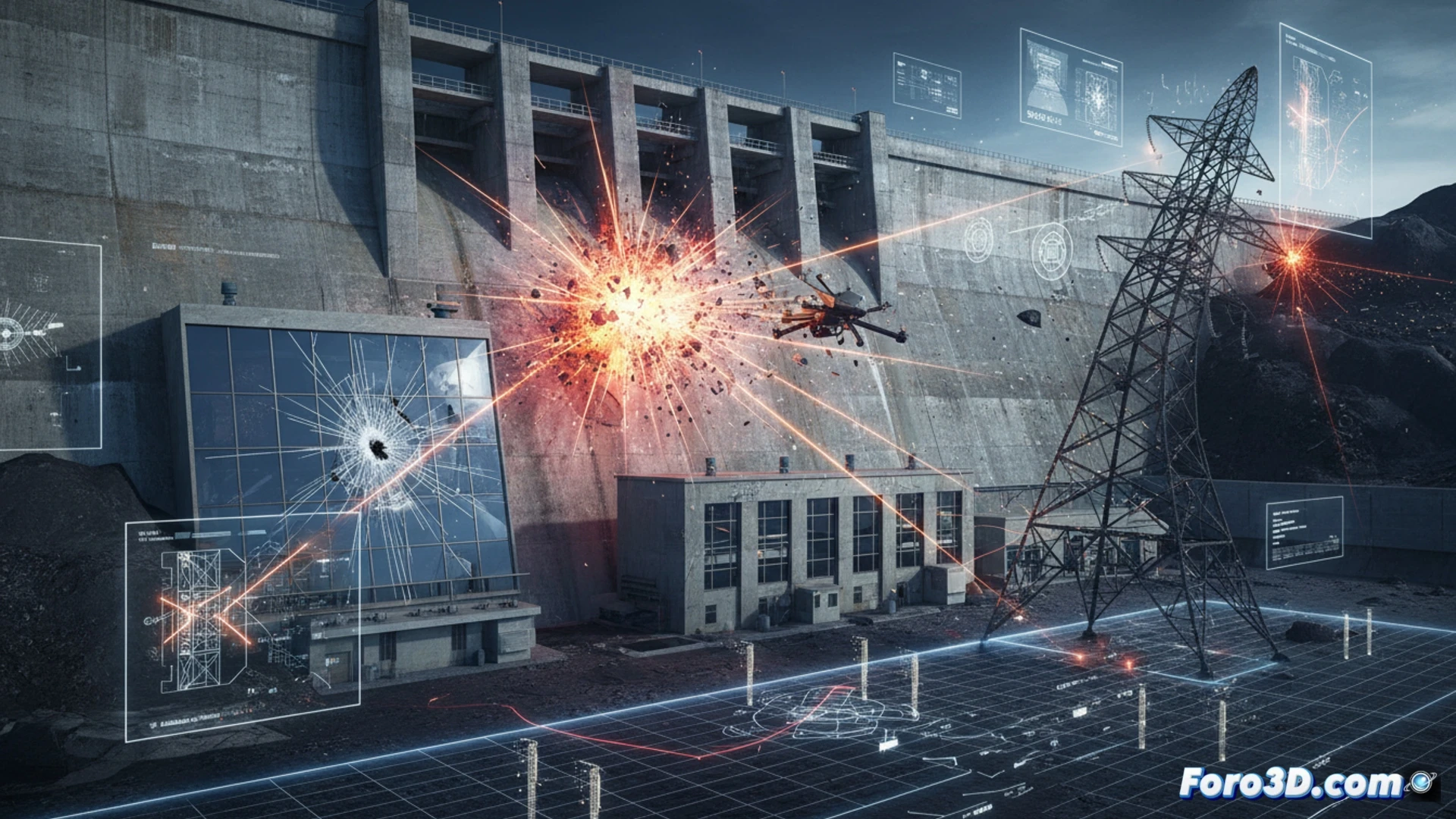
Kinetic modeling and finite element mesh for collisions 🚀
To simulate the impact, we discretize the drone and infrastructure into a high-resolution finite element mesh. We assign mechanical properties such as material density, Young's modulus, and yield strength. The algorithm solves the conservation equation of linear momentum and kinetic energy during the collision. The results reveal that a 2 kg drone at 80 km/h generates a point load equivalent to 800 N on an aeronautical aluminum panel, enough to penetrate the fuselage and trigger rapid decompression. In power lines, the breakage of the insulator by projected fragments causes voltaic arcs and cascading short circuits.
Towards a predictive regulation based on simulation data ⚡
3D simulation demonstrates that the risk is not linear with the drone's mass. A 500-gram device at 120 km/h generates an impact energy of 278 joules, enough to fracture structural safety glass. The technical proposal involves integrating these models into digital geofencing systems and immediate response protocols. Only through kinetic anticipation can we design more resilient infrastructures and establish truly safe flight limits in critical areas.
How can the damage pattern in an electrical substation be accurately modeled when a swarm of drones collides simultaneously at different critical points of the structure?
(PS: Simulating catastrophes is fun until the computer melts down and you are the catastrophe.)