In December 1952, a lethal combination of stagnant cold air and massive coal emissions plunged London into a toxic fog that lasted five days. The thermal inversion trapped pollutants at ground level, seeping into homes and theaters, causing between 4,000 and 12,000 deaths. Today, tools like ANSYS Fluent and Houdini allow us to recreate this phenomenon to understand its dynamics and prevent it from happening again.
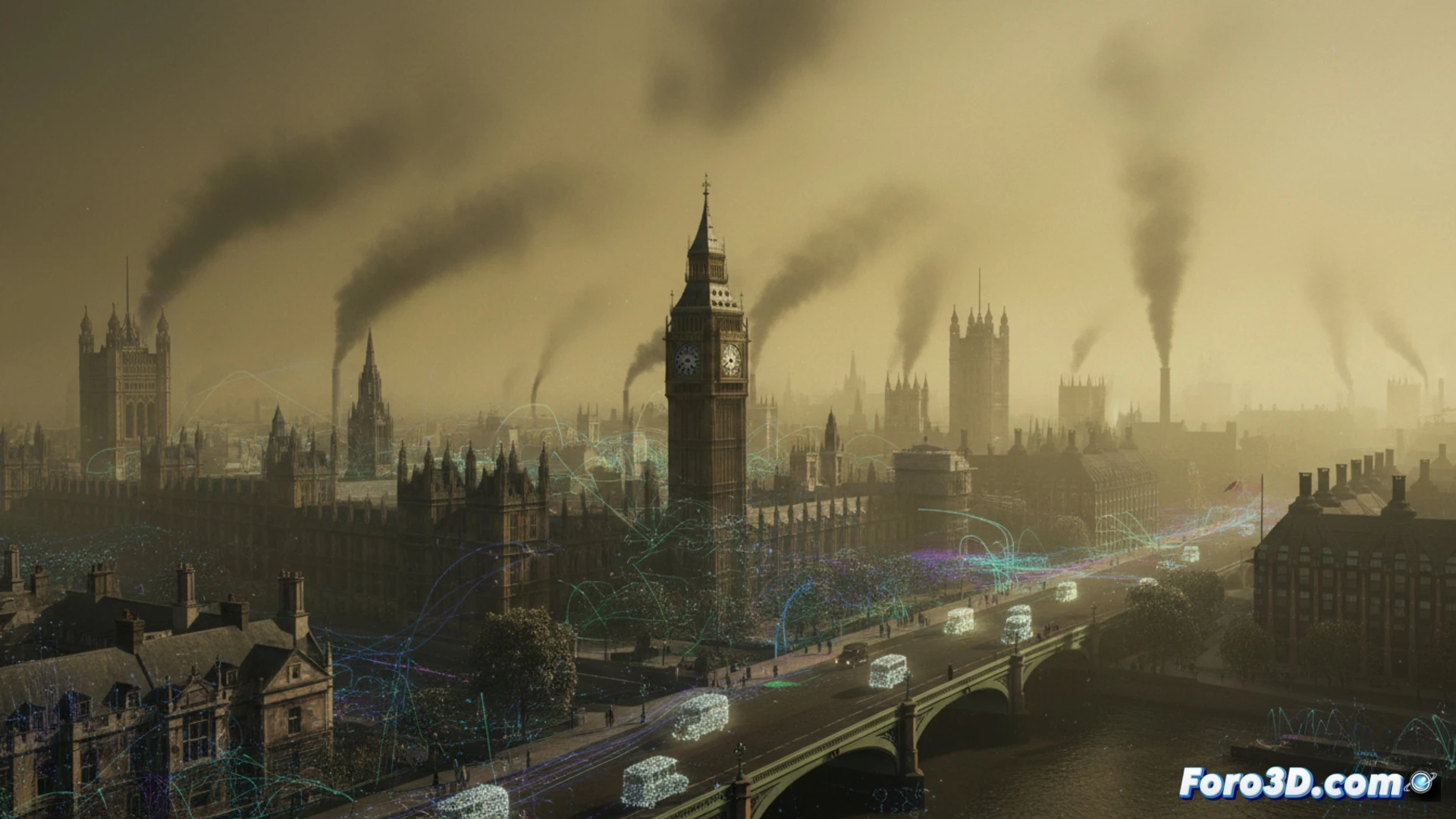
Dispersion modeling with ANSYS Fluent and AirMod 🌫️
The digital recreation of the Great Smog requires two complementary approaches. First, ANSYS Fluent solves the Navier-Stokes equations to simulate urban airflow and thermal inversion, capturing how the warm air layer trapped sulfur dioxide and soot. Historical temperature data and emissions from industrial and domestic chimneys are introduced. Then, AirMod (a Gaussian dispersion model) calculates particle concentration over time, allowing validation of results against mortality records. The main technical challenge is modeling turbulence in urban canyons with high precision, something unthinkable in 1952.
Dense visualization and urban prevention with Houdini 🏙️
To communicate the opacity and danger of the fog, Houdini generates volumetric clouds with particle simulations that react to temperature and humidity. Technical artists can vary the fog density in real time, showing how visibility dropped to less than a meter. Compared to current air quality prediction systems (like the UK-AIR model), these 3D simulations reveal critical accumulation hotspots that modern sensors might miss, offering a visual guide for designing zoning policies and early warnings in megacities.
Would you export the results to GIS format?