The tire's sliding on the asphalt is not just a visual spectacle in competition; it is a complex phenomenon of mass transfer and friction. In the realm of modern automotive engineering, understanding the contact patch and the resulting marking is vital for calibrating traction and stability control systems. This is where 3D simulation becomes an indispensable tool, allowing engineers to visualize tread deformation under extreme loads without the need for a physical prototype.
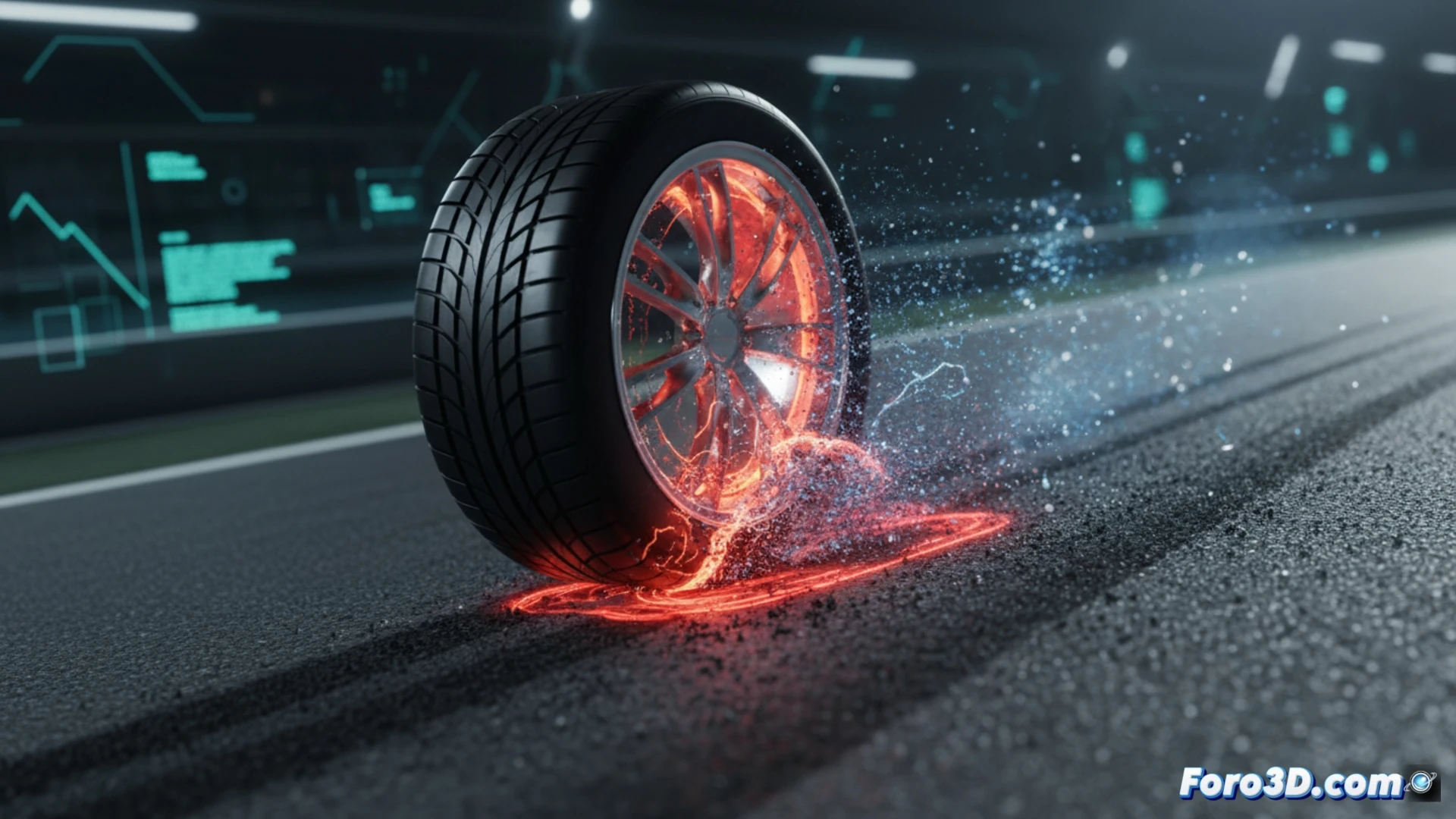
Modeling the contact patch and deformation under load 🏎️
To predict the exact marking a tire will leave on the track, 3D finite element models (FEM) analyze the pressure distribution in the contact patch. When the vehicle enters a corner, lateral load deforms the tire sidewall, generating uneven stress that translates into localized sliding. Simulation allows adjusting parameters such as casing stiffness and rubber compound to minimize grip loss. This analysis is crucial for developing optimized tires and for calibrating ADAS system algorithms.
The boundary between control and controlled chaos ⚖️
Tire marking is the visual record of the struggle for adhesion. In 3D simulation, that black trail on the asphalt becomes a data map revealing the available friction limit. Far from being a failure, controlled sliding is a parameter that engineers seek to manage to extract maximum dynamic performance. Understanding this balance is key to designing safer and more effective vehicles, both in competition and on the daily road.
Is it possible to accurately model heat transfer and tire wear in a 3D sliding simulation without resorting to an extremely dense finite element mesh that makes the calculation unfeasible for real-time?
(PS: modeling a car is easy, the hard part is making sure it doesn't turn into a cube with wheels)