A recent incident in low orbit has raised alarms at space agencies: a short circuit caused by the interaction of a microscopic metallic filament with the solar panels of a communications satellite. This seemingly minor failure triggered a cascade of events that resulted in the total loss of the asset and the generation of a debris cloud. We analyze this event from the perspective of 3D modeling and catastrophe simulation to understand its mechanics and prevent future disasters.
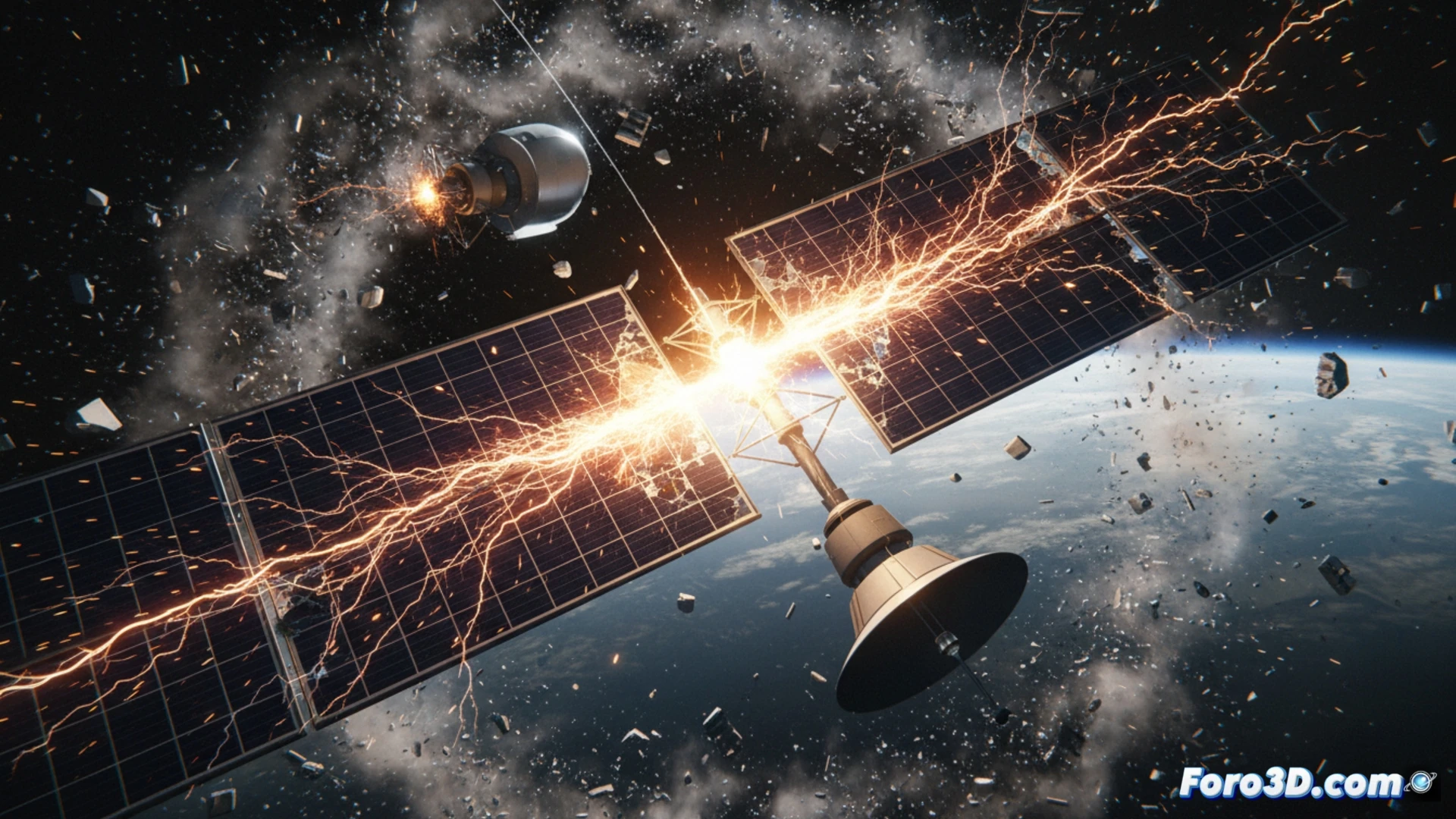
Technical Recreation of the Event in Orbital Simulation Environments 🛰️
To understand the dynamics of the short circuit, engineers turn to multiphysics simulation software such as ANSYS or COMSOL, integrated with orbital dynamics modules (STK or GMAT). In the 3D recreation, the metallic filament is modeled as a stray conductive particle, whose contact with the satellite's high-voltage circuits generates an electric arc. The thermal simulation shows how the arc's heat melts the panel coating, releasing more metallic particles. The next step is to visualize the dispersion of these fragments in an orbital environment, calculating their ballistic trajectories and assessing the probability of impact with other satellites, a classic Kessler syndrome scenario.
Lessons for Preventing Space Catastrophes 🛡️
Beyond the technical failure, this incident underscores the need to integrate predictive modeling into satellite design. 3D simulation allows engineering teams to virtually test shielding against micrometeoroids and metallic debris, as well as design rapid disconnect systems to prevent cascading short circuits. In the Catastrophes niche, these analyses not only help understand the past event but become essential tools for certifying future missions, protecting both orbital infrastructure and the safety of crews on the International Space Station.
Considering the complexity of modeling the interaction between a metallic filament and plasma flows in low orbit, which challenges traditional vacuum short-circuit simulations, what finite element or particle simulation methodologies could be most effective in accurately predicting the catastrophic electric arc in a microgravity and partial vacuum environment?
(PS: Simulating catastrophes is fun until your computer melts down and you are the catastrophe.)