The recent accident in an aerial cable transport system has reopened the debate on material fatigue in critical infrastructures. This article analyzes, through 3D simulations and parametric modeling, the sequence of failures that led to the main cable break. It examines the accumulated stresses at the anchor points and the subsequent cascade of structural collapses, offering a forensic visualization of the disaster.
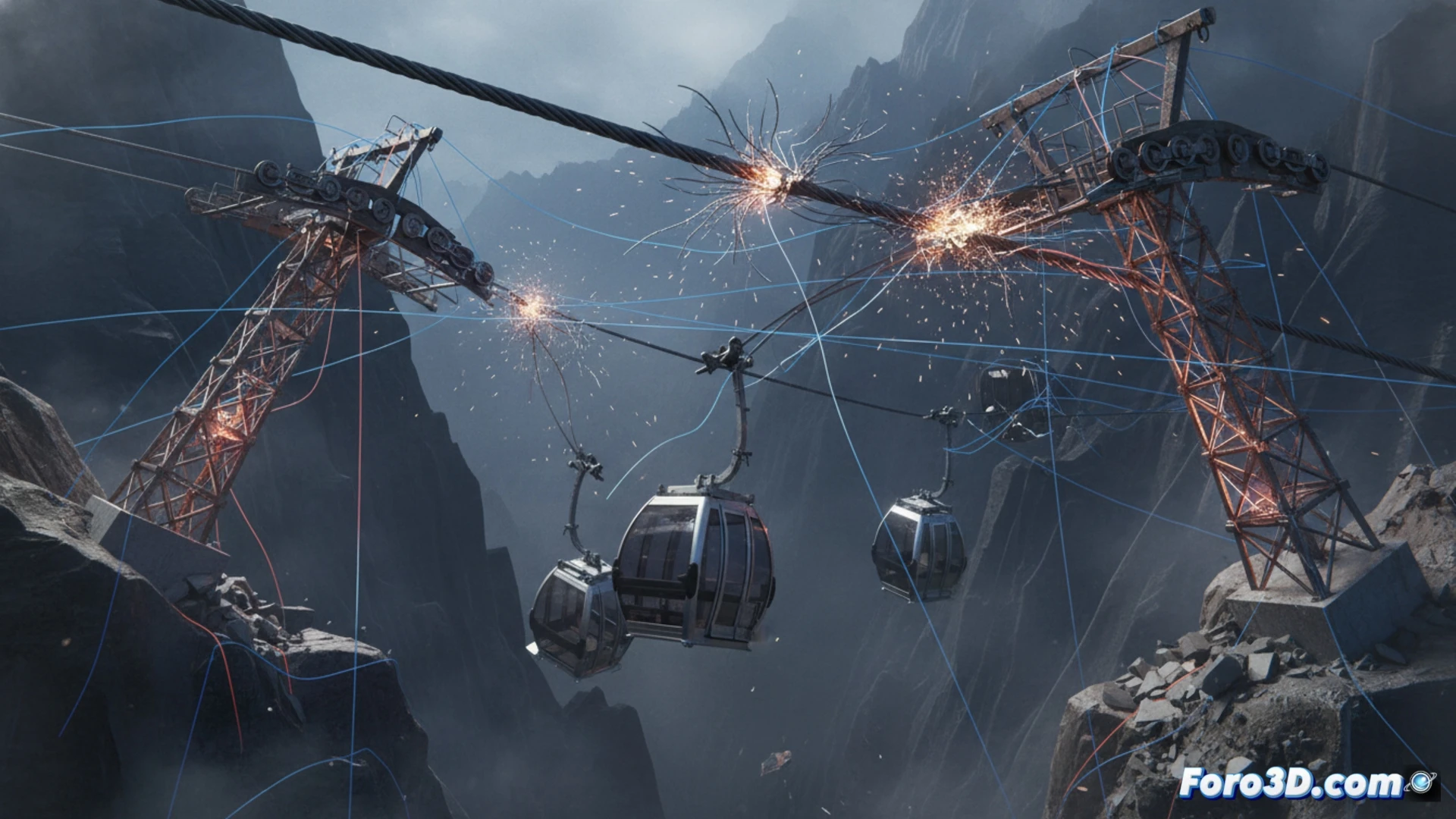
Stress modeling and simulation of catastrophic failure 🏗️
To replicate the accident, the infrastructure was modeled in a finite element environment. The 3D simulation revealed that the fracture was not instantaneous, but the result of microcracks propagating in the cable core during repetitive load cycles. Upon reaching the yield limit, the cable separated, releasing kinetic energy that destabilized the support towers. Vector analysis shows how the shock wave traveled along the line, causing torsions in the pulleys and the sequential collapse of three adjacent spans. This model allows identifying critical points where stress exceeded the safety threshold.
Prevention through digital twins and structural reinforcement 🔧
The 3D visualization of the disaster not only serves to understand the past, but to protect the future. By integrating this data into digital twins, operators can predict real cable wear before a break occurs. Reinforcement proposals include the use of secondary retention cables and real-time deformation sensors. The lesson is clear: safety in cable transport is no longer just a matter of maintenance, but of predictive modeling and extreme scenario simulation.
It is possible to accurately simulate in 3D the behavior of a progressive fatigue fracture in a cable car cable before total collapse occurs
(PS: Simulating catastrophes is fun until the computer melts down and you are the catastrophe.)